Disclosure: This article contains affiliate links or booking widgets. If you book through them, Dreaming of Paris may earn a commission at no extra cost to you. How our affiliate links work.
The most important thing to understand about the Notre-Dame Towers in 2026 is that they are not an add-on you buy after visiting the cathedral. The towers reopened to the public on 20 September 2025 with a redesigned route, separate management by the Centre des monuments nationaux and compulsory online timed admission. There are no on-site ticket sales.
Check tickets and Paris experiences
Compare current tours, timed-entry tickets and experiences before fixing your itinerary.
GetYourGuideTiqetsCivitatisViatorAffiliate links: we may earn a commission at no extra cost to you.
That makes the towers one of the few Paris sights where spontaneous “I’m here, I’ll decide now” planning simply does not work. It is also a genuinely physical visit: 424 steps across the full circuit, narrow passages as tight as about 45 cm, no lift, no toilets and no water point.
2026 essentials
| Item | Current information |
|---|---|
| Ticket | €16 individual admission |
| Reservation | Compulsory online time slot for everyone, including free visitors and Museum Pass holders |
| April–September | 9:00–23:00; last admission one hour before closing |
| October–March | 9:00–17:30; last admission one hour before closing |
| Stairs | 424 over the full route |
| Highest point | South Tower circuit reaches roughly 69 m |
| Typical visit | About 50 minutes |
What actually reopened after the restoration
The reopened route is not simply the old pre-fire experience switched back on. The restoration after the 2019 fire included major work in the towers and belfry, and the visitor circuit was rethought. The north tower leads visitors through the restored structure and bell environment before the route reaches upper viewpoints and continues toward the south tower.
This matters for expectations. You are not buying only a skyline view; you are entering part of the cathedral’s architecture and restoration story. If you only want an easy panorama, our Paris viewpoints guide offers less physically demanding alternatives.
Cathedral vs Towers: two separate visits
Entry to Notre-Dame cathedral is free. Tower admission is separate and paid. A sensible plan is therefore to reserve the tower at a fixed time and keep the cathedral visit flexible around it, rather than trying to force both into one exact sequence. The cathedral can be busy around services, weekends and peak tourism hours.
Use our Notre-Dame and Île de la Cité guide for the church interior, parvis and historic-center walk. The tower ticket does not replace that article; it adds a separate vertical experience.
The 424 steps are not a footnote
The official visitor information explicitly describes the route as physically demanding and advises against it for people with cardiac insufficiency, vertigo, pregnant visitors and very young children. There are 424 steps, narrow stairways and low-clearance passages. There is no elevator. This is qualitatively different from the Arc de Triomphe, where an elevator can assist eligible visitors even though stairs remain part of the normal route.
Wear shoes with grip, carry minimal belongings and use a toilet before entering. Large baggage is not accepted and there is no cloakroom. Pushchairs cannot go through the circuit; staff can indicate the current procedure for leaving one at reception, but families should decide whether the climb is worth the logistics before booking.
Night opening changes the best time to visit
From April through September, the towers are scheduled to stay open until 23:00, which creates a rare opportunity: a high viewpoint after many church and museum interiors have closed. That can be much more valuable than consuming a prime morning slot. In June and July, however, a 21:00 climb may still be in full daylight; in September it can shift toward sunset and blue hour.
Do not buy a “sunset slot” based on an online photo without checking actual sunset time for your date. Also remember weather: tower access can close in adverse conditions. A late slot is spectacular when conditions cooperate, but a weather-sensitive experience should not be your only reason for visiting Île de la Cité.
A practical Île de la Cité route
- Early afternoon: visit the Sainte-Chapelle and Conciergerie with its own timed slot.
- Late afternoon: cross the island slowly, see the exterior of the Palais de Justice, the flower market area and Notre-Dame parvis.
- Cathedral: enter when the queue is reasonable rather than forcing an exact minute.
- Towers: use your reserved time, ideally later in the day in summer.
- Afterward: decompress on Île Saint-Louis instead of rushing to another ticketed sight.
Photography: what the climb is good for
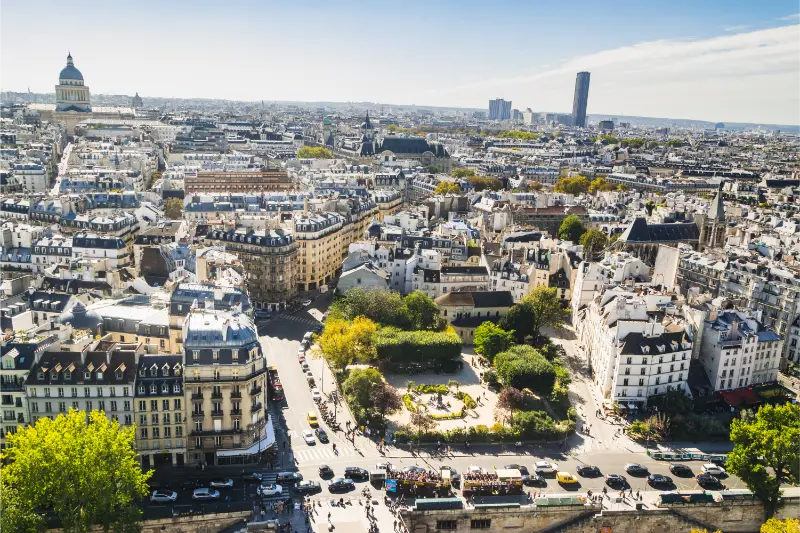
The value of the towers is not a classic postcard angle of Notre-Dame—you are standing on the building. The strength is architectural proximity: stone, bells, roofline details, the Seine and a high 360-degree relationship with the city. For an unobstructed Eiffel Tower skyline, other viewpoints are better. For understanding how Notre-Dame sits inside medieval Paris, this one is exceptional.

Who should skip it
Skip the towers if stair climbing already limits your day, if heights and narrow spiral stairs cause anxiety, or if you are traveling with a stroller-dependent child and only one adult can manage the logistics. You can still have a strong Notre-Dame experience at ground level. Pair the cathedral with the Latin Quarter or Île Saint-Louis and reserve your physical energy for the rest of Paris.
How early should you book?
The rule is simpler than the Eiffel Tower: you need an online slot and there is no on-site fallback. Once your travel dates are firm and the calendar for your date is open, book if the towers are a must. Free-admission quotas exist within time slots and can fill even when paid places remain, so free eligibility is not a reason to postpone.
For a citywide order of operations, use Paris attractions to book in advance. Official Notre-Dame Towers practical information.
Bottom line
The reopened Notre-Dame Towers are now one of Paris’s most distinctive ticketed experiences: part panorama, part architecture, part restoration story. They are also one of the least flexible. Reserve online, treat the 424 steps seriously, avoid overpacking the surrounding day and choose a late slot in the brighter months if you want the climb to become the evening’s main event.
Frequently asked questions
Can I buy a tower ticket at Notre-Dame?
No. The official rules state there are no on-site ticket sales; entry requires an e-ticket and reserved time slot.
Is the tower visit included with the free cathedral?
No. Cathedral entry and the tower circuit are separate.
Is there an elevator?
No. The official circuit has 424 steps and no elevator.
A weather backup for your tower slot
Because high structures can close in poor weather, do not make the tower climb the only meaningful activity on the island. Keep Sainte-Chapelle, Conciergerie, the cathedral interior and Île Saint-Louis as independent options. If the tower circuit is exceptionally closed, official CMN tickets purchased through its platform are refunded under the stated closure procedure.
What the climb actually feels like
The difficulty is not just the number 424. Much of the movement happens on narrow spiral stairs where you cannot establish the same rhythm as on a modern staircase. You climb, stop on intermediate levels, pass architectural details at close range, then continue upward. If you are fit enough for a long day of walking but dislike enclosed staircases, the psychological part may be more important than the cardiovascular one.
Wear shoes with secure soles and keep both hands as free as possible. The official rules prohibit large bags and objects that cannot be managed safely in the narrow circuit. A small day bag is much more practical than arriving after hotel checkout with luggage; there is no reason to turn a vertical monument into a baggage problem.
A 2.5-hour Île de la Cité plan built around the tower slot
If your tower slot is at 16:00, arrive on the island around 14:00. Visit the cathedral interior first if the queue is reasonable, then walk the south side toward Square Jean-XXIII and the Seine. Be back near the tower entrance with margin before the timed entry. After the climb, cross Pont Saint-Louis for a slower walk on Île Saint-Louis rather than booking another timed monument at 17:30. This gives the physical climb room to breathe.
If you also want Sainte-Chapelle, put it in the morning or early afternoon with a generous buffer. Both sites use security controls and timed access, and delays compound quickly. Our Sainte-Chapelle and Conciergerie guide explains how to make that second reservation work without sprinting across the island.
Best light: choose according to the view you want
A late slot in the long-day season can be particularly atmospheric because the stone changes color and the city becomes less flat than at midday. But do not confuse “late opening” with a guaranteed sunset slot: sunset time changes dramatically through the year and tickets are sold by the monument’s operating calendar. Check the actual sunset for your date only after you know which entry times are offered.
Photography without blocking the route
The strength of this viewpoint is close architectural detail: gargoyles, tracery, lead roofs, the river and the spatial relationship between the cathedral and the island. Use a wrist strap, keep gear compact and step aside before framing a photo. Tripods and bulky equipment are inappropriate for a narrow one-way route. A phone or small camera is usually the better tool.
A better comparison with the Eiffel Tower and Arc de Triomphe
Choose Notre-Dame Towers for medieval architecture and proximity, Arc de Triomphe for the clearest geometry of the historic avenues, and the Eiffel Tower for height and the “being on the icon” experience. They are not interchangeable viewpoints. On a first trip you do not need all three; pick the one whose view tells the story you care about most.