Disclosure: This article contains affiliate links or booking widgets. If you book through them, Dreaming of Paris may earn a commission at no extra cost to you. How our affiliate links work.
Jardin du Luxembourg is not just a green pause between “real” attractions. It is one of the best places on the Left Bank to understand how Parisians actually use formal public space: sitting in movable chairs, reading, talking, playing chess, exercising, supervising children and crossing the garden as part of daily routines.
The most important practical detail is that opening and closing times change through the year. The Senate, which manages the garden, adjusts hours roughly every two weeks to daylight. That makes old blog posts with one fixed closing time unreliable. Check the official schedule for your exact date, especially in autumn and winter.
Where the garden fits in a Paris itinerary
Luxembourg Gardens sits between Saint-Germain-des-Prés, the Latin Quarter and Montparnasse. It therefore works as connective tissue: a route can move from the Panthéon to the garden, from Saint-Sulpice into the garden, or from the garden toward Port-Royal and Montparnasse. Using it as a route rather than a detached attraction reduces backtracking.
For a first visit, pair it with our Latin Quarter walk or Saint-Germain-des-Prés route.
The central basin: the postcard and the living room
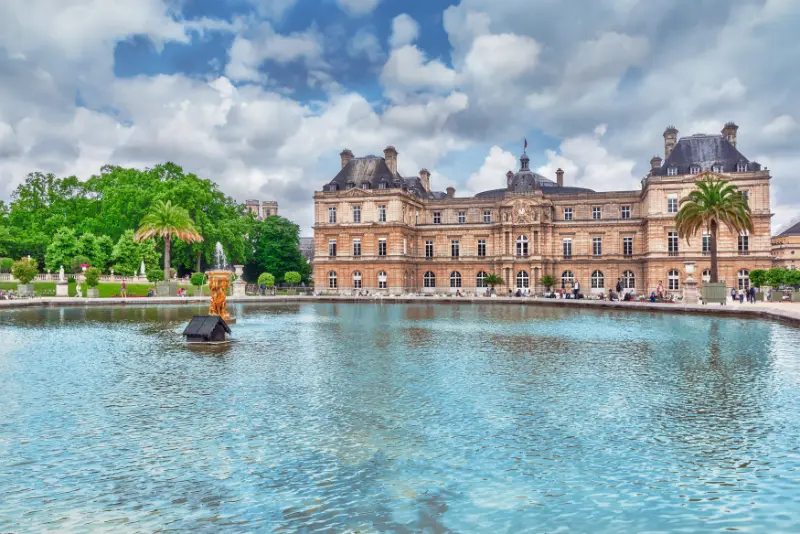
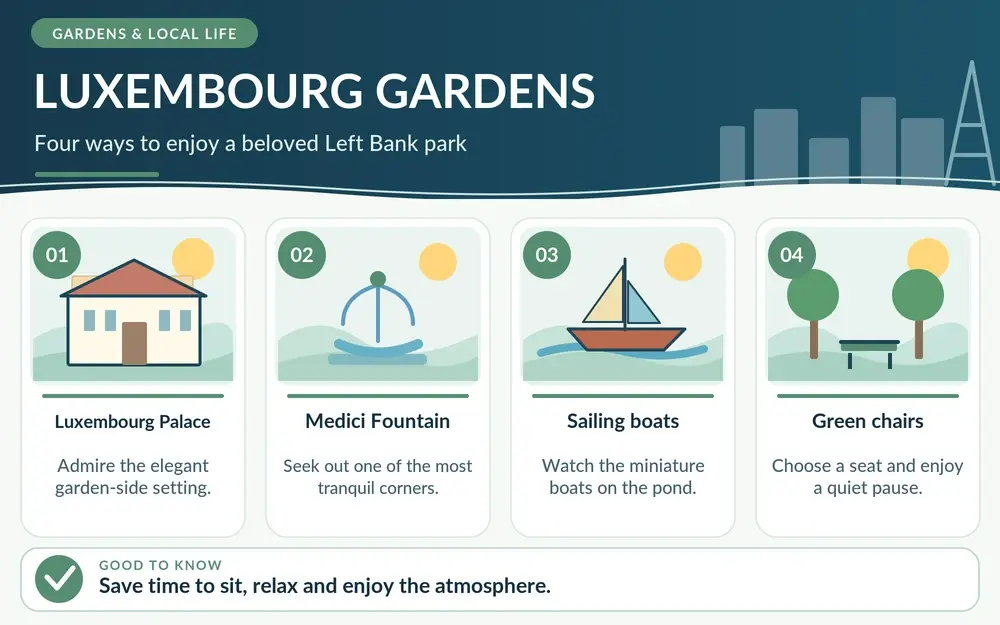
The area in front of the Palais du Luxembourg is the most formal and photographed part of the garden. Movable green chairs are part of the experience: choose one with the view you want rather than assuming every minute must be spent walking. Model sailboats on the basin are especially associated with family visits and can transform the space for children.
This is also where you understand why a public garden can function like an outdoor room. The important activity is often sitting, not sightseeing.
The Medici Fountain: go for a change of scale
The Fontaine Médicis feels different from the open central basin because it is long, shaded and enclosed. It is easy to over-romanticize on social media, but in person its value comes from contrast: after broad lawns and formal geometry, the fountain area feels intimate and cool.
Visit earlier in the day if you want a quieter bench. In warm weather it becomes an obvious refuge and can be busy.
What children can actually do
Luxembourg Gardens can be one of the easiest family stops in central Paris because adults can recover while children have something to do. Depending on current operation, the garden offers a playground, model boats, pony activities and other family-oriented features. Some activities are paid and schedules vary.
For younger children, treat the garden as a reset between indoor visits. Our Paris with kids guide explains why one hour of unstructured play can save the rest of a museum-heavy day.
What is prohibited or restricted
The Senate’s rules are stricter than many visitors expect. Cycling and scooters are prohibited inside the garden, and you cannot simply walk on every lawn. Dogs are restricted to designated areas, and professional photography requires permission. Because the rules vary by area, the signs on site are the most reliable reference.
This matters if you are using our cycling guide: park or dock the bike outside and enter on foot. Luxembourg is a destination, not a bicycle shortcut.
Picnics: where they work best in the garden
A simple picnic can work well, but formal gardens are not one giant picnic lawn. Use areas where sitting and lawn access are permitted, keep food compact and take everything away. Avoid turning a central path or formal planting edge into a dining room.
Our Paris picnic guide explains the difference between romantic picnic imagery and the practical rules that vary from park to park.
Best time of day
Morning is best for calm and clear walking routes. Lunchtime brings students, workers and residents, which can make the garden feel more local. Late afternoon can be beautiful but closing time changes seasonally; in winter you cannot assume the garden will remain open through an evening itinerary.
If you are visiting in December or January, check the official closing time before placing the garden after a 4 p.m. museum booking. In June the same plan can work easily because the garden stays open much later.
A 90-minute Left Bank mini-itinerary
Start at the Panthéon, descend toward the garden, spend 30–45 minutes around the central basin and Medici Fountain, then exit toward Saint-Sulpice and Saint-Germain. That route mixes monument, park, church and neighborhood streets without using transport.
Read our Panthéon guide first because current access conditions there — including the panorama status — can affect how much time you need.
Tours and Left Bank walks
You do not need a tour to enjoy Luxembourg Gardens. A guided Left Bank walk can add context if your interest is literary history, architecture or French institutions rather than horticulture alone. Compare whether a tour uses the garden as a meaningful stop or simply passes through.
Official hours
Use the official Jardin du Luxembourg opening-hours page for your exact date. The schedule changes on the 1st and 16th of many months and follows seasonal daylight.
Frequently asked questions
Is Jardin du Luxembourg free?
Yes, normal access to the public garden is free. Some activities inside or adjacent to the garden may charge separately.
Can you cycle through Luxembourg Gardens?
No. The Senate lists cycling and scooters among prohibited activities inside the garden.
How long should I spend?
Thirty to sixty minutes works as a route stop; 90 minutes or more makes sense if you want to sit, use family activities or picnic.
What should I combine with it?
The Panthéon, Latin Quarter, Saint-Sulpice and Saint-Germain-des-Prés are the most natural combinations.
The chairs are part of the design culture
The movable green chairs are more than convenient furniture. They let users create personal viewing positions around formal public space — facing the basin, sunlight, shade or another person. Taking twenty minutes in a chair is not “doing nothing”; it is participating in one of the garden’s characteristic uses.
Running and exercise
The garden is used by local runners, walkers and people exercising, especially around its perimeter routes. If you are visiting early, share the path predictably and avoid stopping abruptly in narrow sections for photos. The mix of leisure and everyday routine is one reason the garden feels less like a preserved attraction than many central landmarks.
Statues and visual details
The garden contains numerous statues, fountains and monuments that are easy to miss if you walk only between the palace and Medici Fountain. Do not try to inventory them. Pick a side path and let one or two works interrupt the walk. This keeps the formal garden from becoming a single-axis postcard.
Why the garden changes by season
Flower beds, leaf cover, daylight and lawn use all change the atmosphere. Summer emphasizes chairs, shade and social life; autumn makes the tree-lined paths stronger; winter reveals structure and sculpture; spring gradually restores color. A garden visit therefore reflects season more strongly than most indoor attractions.
The Palais du Luxembourg is not normally a walk-in attraction
The palace is the seat of the French Senate. Visitors often assume the impressive façade means they can enter like a museum. Public access is limited to specific events or arrangements, including exceptional openings such as European Heritage Days. Plan the garden as the normal visitor experience unless an official event states otherwise.
Where to eat nearby
Rather than buying overpriced food at the closest tourist corner, use the garden as a boundary between Saint-Germain, the Latin Quarter and Montparnasse. A bakery picnic, simple café lunch or neighborhood restaurant can all work. Choose based on the direction of your next stop so food does not create unnecessary backtracking.
Weather fallback without abandoning the area
If rain becomes persistent, do not force a garden visit just because it was on the plan. The nearby Latin Quarter and Saint-Germain contain churches, cafés, bookshops and museums that can absorb the time. Return to Luxembourg when the rain eases; because entry is free, there is no sunk ticket cost pushing you to stay in bad conditions.
Accessibility and surfaces
Most major garden paths are broad, but historic surfaces, gradients and seasonal crowding can affect comfort. Visitors with mobility needs should consult the Senate’s current accessibility information and choose entrances strategically. The garden is large enough that entering from the wrong side can add unnecessary distance.
Why Luxembourg is worth repeating
On a first trip the garden may be a thirty-minute connection between monuments. On a longer stay it can become a routine: morning coffee nearby, a chair in the sun, children at play or an evening walk before closing. That repeatability is part of its value and one reason locals use it differently from tourists.
A useful rule for a short Paris trip
If you have only two or three days, do not cross the city solely to “see” Luxembourg Gardens for ten minutes. Visit it when you are already on the Left Bank. On a longer trip, however, it is worth returning because the garden changes by time of day, weather and season more than many paid attractions do. That difference matters for planning.