Disclosure: This article contains affiliate links or booking widgets. If you book through them, Dreaming of Paris may earn a commission at no extra cost to you. How our affiliate links work.
Paris is particularly strong for solo travel because museums, cafés, parks and walking routes do not require company. The main advantage is flexibility; the main risk is letting that flexibility turn into poor planning late at night.
Quick planning summary
Why Paris works alone
Many of the city’s core experiences are naturally individual: looking at art, reading in a garden, walking a neighborhood, sitting at a café or browsing a market. You do not need to fill the trip with group tours simply to avoid being alone. Use structured activities selectively when you actually want company.
Choosing a base
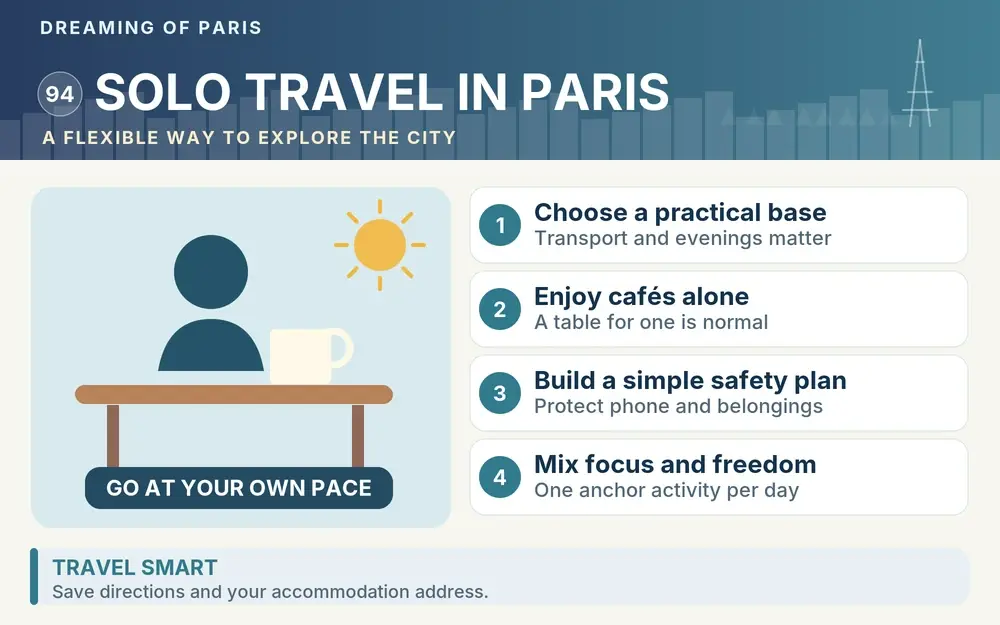
A solo traveler benefits from a neighborhood that feels comfortable after dinner and offers direct transport. Being able to walk ten minutes from a restaurant to the hotel is often more valuable than saving a small amount on a room near a complicated late-night interchange.
Dining alone
Eating alone is normal in Paris, especially at lunch, cafés and counter-style venues. A book or phone is optional; you do not need to look busy. Reserve if the restaurant is popular and mention one person without apology. Bar seating can be excellent when available.
Cafés
Cafés are natural solo spaces. Sit with coffee, write, read or simply watch the street. Choose indoor seating if terrace smoke bothers you. The rhythm of a café can also create a reassuring pause between more anonymous museum and street time.
Museums
Solo museum visits are a major advantage because you control pace completely. Use that freedom to leave when your attention fades instead of trying to extract maximum value from the ticket. Smaller museums are especially rewarding alone because you can make spontaneous decisions.
Safety
Normal big-city precautions apply: keep your phone controlled near doors and crowded transport, watch bags in cafés, ignore pressure from street scammers and avoid walking isolated routes when exhausted or intoxicated. Paris is not uniquely dangerous, but solo travelers have no companion to notice when judgment is slipping.
Nightlife
If you want nightlife, choose a neighborhood with several venues and plan the return in advance. A guided bar experience can be useful socially, but only book products with clear meeting points and recent reviews. Do not rely on meeting strangers online for your only transport plan home.
Day trips
Versailles, Giverny, Fontainebleau and Chantilly can all work solo. The question is whether you enjoy managing transport independently or prefer a guided day for social contact and logistics. Solo travel lets you leave a destination when you are ready rather than matching a group.
Photography and asking strangers
If you want photographs of yourself, choose a busy safe place and ask another traveler rather than handing your unlocked phone to someone who approaches you. A small tripod can be restricted in attractions and awkward on pavements; check venue rules.
Build one social anchor
For longer solo trips, one food tour, class, walking tour or performance can add conversation without sacrificing independence. Put it early enough in the trip that any recommendations or new contacts can influence later days.
How this article fits into the Dreaming of Paris cluster
For a deeper plan, continue with Paris safety and scams, Paris café culture, Paris food tours, second-trip ideas. These guides are linked because they share geography or a real planning decision, not simply because they mention Paris.
Compare current bookable experiences
Official information
For the details most likely to change, use the Paris je t’aime solo Paris guide. Recheck it shortly before the visit rather than relying on a screenshot saved weeks earlier.
Practical checklist before you leave the hotel
- Recheck opening hours, closures or transport work.
- Save the exact entrance or meeting point, not only the attraction name.
- Carry water and keep enough phone battery for navigation.
- Know one nearby alternative in case the main plan changes.
- Allow more time if you have luggage, children or reduced mobility.
- Avoid scheduling another major timed attraction immediately afterward.
Is Paris good for solo travel?
Yes. Museums, cafés, gardens and neighborhood walks work exceptionally well alone, and public transport makes independent exploration easy.
Is it awkward to eat alone in Paris?
No. Solo diners are common, particularly at lunch, cafés and restaurants with counter seating.
Is Paris safe at night alone?
Use normal large-city precautions, choose lively routes and plan your transport home before drinking or staying out late.
What is a good social activity for solo travelers?
A small food tour, walking tour, class or guided evening can add company without controlling the entire trip.
Final planning advice
The best way to use this guide to solo travel Paris is to place it inside a coherent day rather than treat it as an isolated checklist item. Paris becomes easier when every reservation has a reason, every journey has a nearby second purpose and at least one part of the day remains flexible. That approach protects you from queues, weather changes and simple fatigue while leaving space for the unplanned café, street or view that often becomes the strongest memory.
Solo travel is strongest when you mix independence with one social anchor
Paris is easy to explore alone because museums, cafés, parks and walking routes do not require a companion. The trip becomes more balanced when you add one optional social activity every day or two: a small food tour, guided walk, cooking class, group day trip or simply dinner at a counter. That gives you interaction without surrendering the flexibility that makes solo travel attractive.
Dining alone is normal. Lunch is often the easiest time to try a sought-after restaurant, while wine bars and counter seating can make evenings feel more relaxed. Book a table for one when reservations are required rather than assuming restaurants dislike solo diners. Staff are usually more concerned with clear reservations and punctuality than party size.
Night safety is mostly about transitions
Choose a hotel with a straightforward late route, know the nearest active station and avoid arriving at an unfamiliar interchange with a dead phone. On terraces and public transport, keep your phone and bag controlled rather than placed beside you. If a street feels uncomfortable, move toward a staffed business, hotel or busier route instead of trying to prove the area is “safe.”
For solo-friendly evening ideas, use the nightlife guide or Paris at Night. A solo itinerary does not need different monuments; it needs better attention to meals, late transport and the moments when you would prefer company.
A practical decision check for Solo Travel in Paris
Solo Paris works when you alternate independent exploration with optional social moments. Before you give it a fixed slot, compare that reason with the strongest alternative already on your itinerary. If the alternative matters more, move this stop to an optional block instead of forcing both into the same half-day. That simple choice keeps the article useful for different travelers rather than implying that every reader needs the same Paris.
A realistic way to fit it into the day
Use museums and walks in the daytime, book one small-group activity or counter-seat meal every day or two, and keep the evening return route simple. Keep the previous and following stops close enough that a delay of twenty or thirty minutes does not create a cascade of missed reservations. Paris days become much easier when the route can absorb a longer lunch, a queue or a weather change without requiring a taxi across the city.
The trade-off worth making explicit
The trade-off is freedom versus decision fatigue. Too many open choices can be tiring, so one reservation per day provides structure without removing flexibility. Making that trade-off deliberately is more useful than adding another item to a checklist. Ask what you would remove if this experience takes longer than expected; if the answer is “nothing,” the day is probably already too full.
Small details that prevent avoidable problems
Share basic itinerary details with someone you trust if desired, keep phone power available and avoid displaying valuables unnecessarily on transport or terraces. Save the exact address or entrance you intend to use, keep enough phone battery for the return route and recheck any time-sensitive information on the official site. These are small steps, but they protect the part of the experience that actually matters from being swallowed by logistics.
Where it belongs in the wider Paris cluster
Food tours, neighborhood walks and day trips are good social anchors; cafés, museums and parks are ideal independent blocks. Treat that pairing as a geographic or thematic cluster, not an obligation to complete everything. One strong connection is enough to make the day coherent; two or three distant add-ons usually reduce the value of the place you came to see.
Use your independence as an advantage
Solo travelers can change pace without negotiating. If a museum is overwhelming, leave; if a neighborhood is interesting, stay for another hour. Build the itinerary to exploit that freedom rather than copying a group tour schedule. One carefully chosen reservation provides structure, while the surrounding time remains open enough to follow curiosity without inconveniencing anyone else.