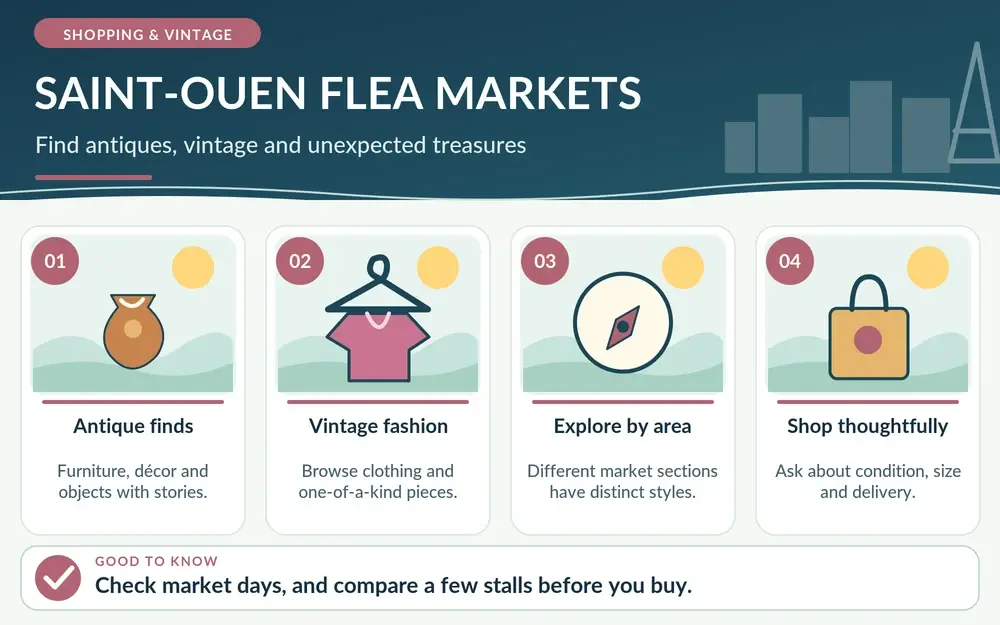
The Puces de Saint-Ouen are not one flea market and that is the first thing to understand. The site is a network of markets, passages and streets north of Paris, with antiques, design, vintage clothing, decorative objects and specialist dealers. The official market currently presents Saturday and Sunday as the clearest full public days, with Monday also open on a more limited schedule; Friday information varies by individual market and is often oriented to professionals, so weekend visits are simplest for first-timers.
Do not arrive with the idea of seeing everything
Different named markets specialize in different periods and price levels. Your first objective should be orientation, not coverage. Walk one main axis, enter two or three market areas that match your interests, and accept that many lanes will remain unexplored.
Saturday or Sunday is the easiest choice
Weekend daytime provides the most straightforward visitor experience because the largest number of dealers are operating. Monday can work if it suits your schedule, but it generally feels quieter and some businesses may differ. Check the official Puces site and any must-visit dealer before making a special trip.
How to arrive and orient yourself
Metro access puts you near the wider Saint-Ouen area rather than at a single front gate. Follow official market signage and be aware that street vending around the approach is not the same thing as the established antique markets. Keep valuables secure in crowded transition areas.
Antiques, design or vintage: choose a goal
Serious antique furniture and collectible design require more time and often higher budgets. Vintage clothing and decorative browsing can be easier for casual visitors. If you have a specific object in mind, photograph dimensions at home and know the maximum size you can actually transport.
Negotiation and buying
Polite discussion about price can be part of antique-market culture, but aggressive haggling is not a useful strategy. Ask questions, confirm condition, and understand shipping before committing to a large object. For expensive pieces, provenance, restoration and export considerations matter more than winning a small discount.
Make Saint-Ouen part of the day
The markets can absorb several hours, so avoid scheduling a timed central-Paris attraction immediately afterward. A relaxed lunch nearby or a return toward Montmartre works better than a rigid cross-city dash.
Useful connections on Dreaming of Paris
Compare other shopping areas in our shopping in Paris guide. If you continue south, use our Montmartre neighborhood walk.
What is the best day for a first visit?
Saturday or Sunday is usually the simplest because the market network is at its most visitor-friendly and active.
Is it one market?
No. It is a large collection of distinct markets, dealers, passages and surrounding streets.
Can I find cheap bargains?
Possibly, but Saint-Ouen is also a major professional antiques and design destination. Go to browse and learn, not with the assumption that everything should be inexpensive.
A final planning note
The trick to Saint-Ouen is selective curiosity. Pick a broad interest, explore a few market sections well, and leave before visual fatigue turns hundreds of fascinating objects into background noise.
For Puces de Saint-Ouen, one more practical point is worth keeping in mind. Visit at a time that matches the character you want. Residential streets can feel empty in the middle of a workday, while market zones or bar streets become much more animated later. There is no single ‘best’ hour; there is a best hour for the version of the neighborhood you want to see. Use this as a decision rule rather than a rigid instruction: the best version of the day is the one that keeps the route coherent and leaves enough energy for the place itself.
For Puces de Saint-Ouen, one more practical point is worth keeping in mind. Homes, schools, religious sites and memorials can sit alongside the route, so quieter photography and less intrusive stops tend to fit these areas better. Many of the places that make lesser-known Paris rewarding are ordinary lived-in spaces rather than purpose-built attractions. Use this as a decision rule rather than a rigid instruction: the best version of the day is the one that keeps the route coherent and leaves enough energy for the place itself.
For Puces de Saint-Ouen, one more practical point is worth keeping in mind. A neighborhood guide works best when you walk through it rather than commute between isolated pins. Start at one edge, follow a clear direction, and let cafés, small parks and ordinary shopping streets become part of the experience. The point is to understand how the area connects, not to claim every landmark. Use this as a decision rule rather than a rigid instruction: the best version of the day is the one that keeps the route coherent and leaves enough energy for the place itself.
Choose a market before you arrive
The Puces de Saint-Ouen are not one hall. They are a network of markets, streets and specialist dealers, which is why arriving with only the instruction “go to the flea market” can waste an hour. Decide first whether you care most about high-end antiques, twentieth-century design, vintage clothing, decorative objects or simply the atmosphere. Then identify two or three named markets on the official map and use rue des Rosiers as the organizing spine.
The official Puces site currently lists public opening on Saturday and Sunday from 10 a.m. to 6 p.m. and Monday from 11 a.m. to 5 p.m.; Friday activity is more limited and parts of the trade can operate differently. For a first visit, Saturday or Sunday gives the clearest version of the destination. Monday can be calmer but not every dealer keeps identical hours, so it is better for visitors who already know what they want.
How not to get trapped at the wrong edge
Porte de Clignancourt is a common arrival point, but the first stalls you see are not the whole antiques district. Keep moving toward the established markets around rue des Rosiers before deciding what the Puces are like. Metro line 14 at Saint-Ouen can also be useful depending on your starting point. Use the official map rather than following a single social-media pin.
If you may buy something valuable, ask about condition, restoration, provenance when relevant, and delivery before paying. Large furniture purchases need a shipping plan; carrying an impulse purchase across Paris is rarely sensible. Bargaining exists, but it is not a performance. Ask politely whether there is flexibility, especially when buying more than one item, and accept a clear no without turning the interaction into a contest.
Allow at least half a day if antiques are a real interest. If they are not, two focused hours are enough to see the atmosphere before returning to central Paris. For a different kind of second-hand and shopping day, compare this with our Paris shopping guide. The Puces are worth the journey when the market itself is the objective—not when they are squeezed between Montmartre and a timed museum reservation.
A practical decision check for Puces de Saint-Ouen
Saint-Ouen is worth the trip when antiques, design, vintage or the market culture itself is a priority. It is not a generic souvenir market and it is not one building. Before you give it a fixed slot, compare that reason with the strongest alternative already on your itinerary. If the alternative matters more, move this stop to an optional block instead of forcing both into the same half-day. That simple choice keeps the article useful for different travelers rather than implying that every reader needs the same Paris.
A realistic way to fit it into the day
Arrive around opening, walk to the core market area, use the official map to select two or three markets and stop for lunch nearby. Leave before you are too tired to evaluate anything you might buy. Keep the previous and following stops close enough that a delay of twenty or thirty minutes does not create a cascade of missed reservations. Paris days become much easier when the route can absorb a longer lunch, a queue or a weather change without requiring a taxi across the city.
The trade-off worth making explicit
The famous size is an advantage only if you narrow the search. Trying to see every aisle produces fatigue and makes all objects blur together. Making that trade-off deliberately is more useful than adding another item to a checklist. Ask what you would remove if this experience takes longer than expected; if the answer is “nothing,” the day is probably already too full.
Small details that prevent avoidable problems
For expensive objects, ask about restoration, dimensions and shipping before payment. For small vintage purchases, inspect condition in natural light when possible and keep receipts. Save the exact address or entrance you intend to use, keep enough phone battery for the return route and recheck any time-sensitive information on the official site. These are small steps, but they protect the part of the experience that actually matters from being swallowed by logistics.
Where it belongs in the wider Paris cluster
Combine the Puces with a dedicated north-Paris day or Montmartre only if you have a full day. Avoid placing a timed central museum immediately after a shopping visit whose duration is unpredictable. Treat that pairing as a geographic or thematic cluster, not an obligation to complete everything. One strong connection is enough to make the day coherent; two or three distant add-ons usually reduce the value of the place you came to see.