With children, the best Paris hotel is the one that removes friction from the day. A beautiful room in the wrong place can mean carrying a sleeping toddler through two Metro changes, searching for dinner after everyone is tired, or spending every afternoon far from a park. Families should judge neighborhoods by daily logistics: lifts, food shops, playgrounds, direct transport and the ability to return to the room without sacrificing half a day.
Compare hotels for your stay in Paris
Check current availability, location and prices before choosing the exact neighborhood.
Check Paris hotels on Booking.comAffiliate link: we may earn a commission at no extra cost to you.
This guide complements our Paris with kids guide and baby and toddler guide. It focuses only on where to sleep. The right answer changes with age: a stroller family may value flat streets and buses, while teenagers may prefer a livelier neighborhood with food, shopping and easy evening options.
This guide contains affiliate links. If you book through them, Dreaming of Paris may earn a commission at no extra cost to you.
The 5th arrondissement: central, walkable and strong for mixed-age families
The Latin Quarter is one of my favorite bases for a first family trip because it gives children and adults useful options within walking distance. The Jardin des Plantes, Seine, Panthéon, Luxembourg Garden and Notre-Dame area form a compact network of days. The 5th arrondissement guide helps separate the busy Saint-Michel zone from calmer streets toward the Jardin des Plantes and Place Monge.
For families, being able to walk to breakfast, a bakery, a small supermarket and a park can matter more than being beside a single attraction. The 5th also works well for rainy-day flexibility because you can switch between indoor cultural stops and outdoor walking without crossing Paris. Prices are not low, and some older hotels have small lifts, so verify family-room configuration carefully.
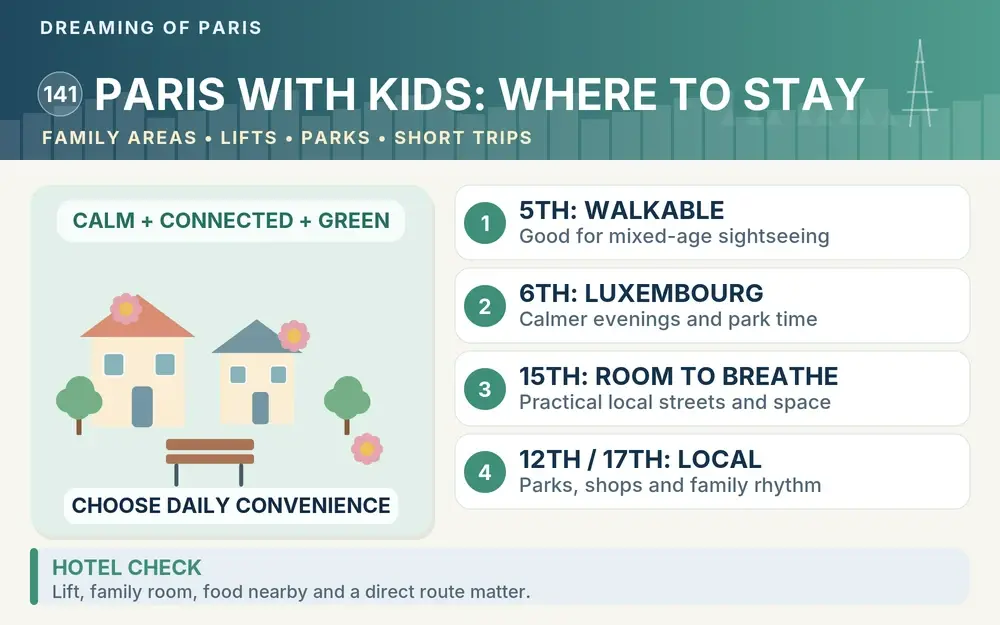
The 6th arrondissement: easiest for calm evenings and Luxembourg Garden
The 6th is expensive, but it is unusually forgiving with younger children. Luxembourg Garden provides a reliable open-space break, and the Seine, Saint-Germain and central Left Bank are close. Our Luxembourg Garden guide shows why families often use the park as more than a sightseeing stop: it can reset a day after a museum, long lunch or rainy morning.
The compromise is room value. You may pay considerably more for a family room than in the 12th or 15th, and aparthotel inventory is more limited. If your budget allows it, the 6th can reduce transport enough to justify the premium on a short trip. For a longer stay, I would compare that premium against a larger room or kitchenette farther out.
The 15th arrondissement: one of the best space-and-calm compromises
The 15th is a strong family district because it feels residential, has everyday shops and parks, and often offers better room value than the historic core. Around Convention, Commerce and the eastern side toward Montparnasse, you can stay in a real neighborhood while remaining well connected. Read the 15th arrondissement guide before booking, because the district is large and a hotel at the wrong edge can add unnecessary travel.
Families who need an aparthotel, connecting rooms or simply more floor space should pay particular attention here. The area is quieter at night than the Marais or 11th, which can be a major advantage with small children. The trade-off is that you will use transport more often to reach the Louvre, Marais and eastern Paris.
The 12th arrondissement: green space, easy east-Paris days and practical rooms
The 12th works especially well for families who like parks and want quick access to the eastern side of the city. Coulée Verte, Bercy and the Bois de Vincennes create several low-stress options when children need space. The 12th arrondissement guide and Bois de Vincennes guide show how much family time you can build without queues.
Staying near Gare de Lyon can also be useful for regional trains and RER A, including trips toward Disneyland Paris. The station surroundings are busy, so I prefer side streets rather than a room facing the main traffic. Farther east, accommodation can be better value, but always check the exact Metro line and walking distance with a stroller.
The 17th arrondissement: Batignolles for families who want local Paris
Batignolles is attractive for repeat visitors or families staying longer than a weekend. Parc Martin Luther King gives children a modern open space, and the neighborhood has bakeries, food shops and a more residential rhythm. Our 17th arrondissement guide explains how the district changes between Batignolles, Ternes and the edges around Parc Monceau.
This is not the best base if your plan is to walk to Notre-Dame every morning. It is a good base if you value apartment-style accommodation, a quieter evening and a neighborhood that still feels interesting after the children are asleep. Direct transport matters more here, so choose the street with the same care as the arrondissement.
What about staying near the Eiffel Tower with children?
The 7th and 15th near the Eiffel Tower can be excellent for children who are genuinely excited by the monument. Seeing it on the first evening can create the emotional “we are in Paris” moment families often want. But the tower area is not automatically the easiest family base. Some streets become quiet after dinner and many other major attractions sit farther east. Use our Eiffel Tower planning guide to decide whether proximity is worth the room premium.
A practical alternative is the 15th around Dupleix or La Motte-Picquet–Grenelle, where you can still reach the tower quickly but have more everyday shops and residential services. That often gives a better balance than paying purely for a tower-view room.
Family-room details that matter more than star rating
- Actual sleeping layout: a sofa bed, rollaway and true connecting room are not the same thing.
- Lift size: confirm whether a stroller fits without folding if that matters to you.
- Bath vs shower: small children may make one arrangement much easier than the other.
- Fridge or kitchenette: useful for milk, snacks and early breakfasts.
- Laundry: valuable on stays longer than four or five nights.
- Breakfast timing: an early, simple breakfast can save a surprising amount of stress before timed tickets.
- Soundproofing: street noise and internal corridor noise both matter when children sleep early.
Do not rely on the label “family room” alone. Read the bedding description and maximum occupancy carefully, especially when traveling with three children or a baby cot. Paris rooms are often physically compact, and a legal occupancy of four does not guarantee comfortable space for four suitcases and a stroller.
Transport strategy with kids: fewer changes beats shorter distance
With children, I prefer one direct ride of twenty minutes to two short rides with stairs. Paris Metro stations vary enormously in lift and escalator access. Buses can be easier with a stroller, while line 14 is valuable for step-free modern stations on many journeys. Check our public transport guide and plan the hotel around the journeys you will actually repeat.
If you will visit Disneyland, the airport or a specific family attraction, include that journey in the hotel decision before booking. Families often optimize for the Eiffel Tower and then discover that the hardest travel day is the early transfer to a station or airport with tired children.
Compare accommodation before you commit
Hotel prices in Paris move sharply with exhibitions, school holidays, fashion events and major weekends. Use Booking.com to compare current room inventory, but compare the exact street, nearest station, cancellation terms, room size and air-conditioning rather than ranking properties only by headline price. A cheaper room that adds two awkward changes to every journey is not always the cheaper trip.
Official information to check before your trip
The official Paris je t’aime accommodation directory currently highlights the 15th as a particularly useful family area and provides neighborhood-by-neighborhood hotel listings. Verify room configurations directly with the property before paying.
For a first family trip, the 5th and 6th offer the easiest central experience if the budget works. The 15th and 12th are stronger for space, residential convenience and value; Batignolles suits longer stays and families who already know the city. There is no single “family arrondissement,” only a better fit for your children’s age and your daily rhythm.
The best family hotel is usually not the one with the most decorative children’s amenities. It is the one where everyone can sleep, breakfast is simple, transport is direct and you can reach a park or easy dinner before a tired evening becomes a crisis.
One final planning check before you book
Open the map and trace the three journeys you are most likely to repeat: the first morning, the longest sightseeing day and the return after dinner. Then check the route from the station or bus stop to the hotel door, not only the station name. Paris blocks, hills, large intersections and station exits can make a short map distance feel very different with luggage or after a long day.
Compare the flexible rate with the cheapest non-refundable rate. If the saving is small, flexibility is often worth more than the discount because train times, flights, family plans and event dates can move. A good accommodation decision should still look good after the itinerary changes once or twice; that resilience is part of value, not an optional luxury.
Also check the most recent reviews for issues that are difficult to judge from official photographs: street noise after midnight, lift reliability, room temperature, construction nearby and how staff handle luggage before check-in. Look for repeated patterns rather than one angry review. When three or four recent guests mention the same practical problem, treat it as useful evidence and decide whether that compromise matters to your trip.
Finally, remember that Paris hotel pricing is highly date-sensitive. A neighborhood that looks expensive for one weekend may be competitive a week later, and the opposite can happen during trade fairs, fashion events, concerts or school holidays. Compare the same dates across several districts before deciding that one area is categorically outside your budget.