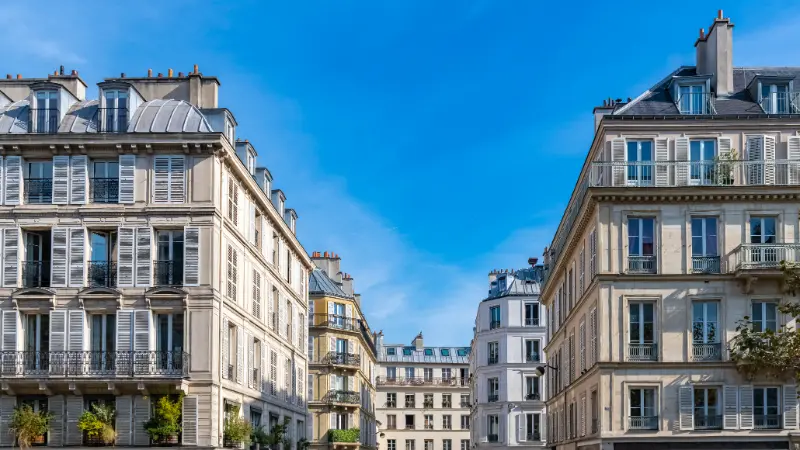
Your first Paris hotel should make the city easier, not merely put a famous landmark outside the window. For a first visit, the best area is usually the one that lets you walk to several priorities and reach the rest with one simple Metro or RER ride. That is why the historic center, the Marais, the Latin Quarter and Saint-Germain are so consistently useful: they reduce the number of decisions you have to make before breakfast and give you something worth walking through even when you are not sightseeing.
Compare hotels for your stay in Paris
Check current availability, location and prices before choosing the exact neighborhood.
Check Paris hotels on Booking.comAffiliate link: we may earn a commission at no extra cost to you.
This article is deliberately narrower than our general where-to-stay guide. It is for travelers who have never been to Paris and are trying to choose a base for three to five days. The goal is not to crown one arrondissement. It is to show how hotel location changes a first itinerary, where paying more saves real time and where a cheaper district is a sensible compromise rather than false economy.
This guide contains affiliate links. If you book through them, Dreaming of Paris may earn a commission at no extra cost to you.
Start with the shape of your first itinerary, not a hotel map
Look at the places you are most likely to visit on a first trip: Notre-Dame and Île de la Cité, the Louvre, the Seine, the Eiffel Tower, one major museum, Montmartre and perhaps Versailles. Our first-time four-day itinerary clusters these geographically for a reason. If your hotel sits near the center of those clusters, you can start days on foot and use public transport for the longer jump rather than commuting in and out repeatedly.
A central base does not mean you need to stay on the Rue de Rivoli. Paris is compact enough that a hotel around the 4th, 5th or 6th can be more useful than a room beside one specific monument. The test I use is simple: can you walk to an interesting dinner area after sightseeing, and can you reach at least two major day clusters without changing Metro lines? If the answer is yes, the location is doing real work for you.
The Marais: the easiest all-round base for atmosphere and walking
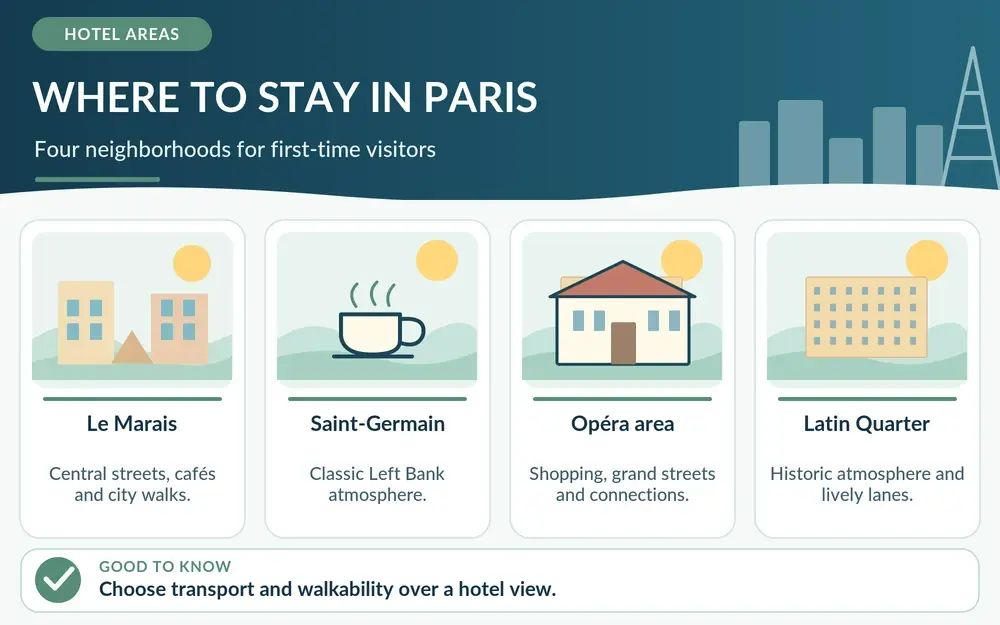
The Marais, mainly in the 3rd and 4th arrondissements, is one of the strongest first-visit bases because the neighborhood itself is an attraction. You can walk to Place des Vosges, the Seine, Hôtel de Ville and Île de la Cité, then connect quickly to the Louvre or Bastille. Read the 4th arrondissement guide and Marais walking route before choosing the exact street, because a quiet lane near Saint-Paul feels very different at night from a busy axis closer to Les Halles.
The trade-off is price and room size. Boutique hotels in older buildings can have compact rooms, small lifts and limited sound insulation. The Marais also attracts evening crowds. If you value atmosphere and want to walk home after dinner, that may be a benefit; if you are a light sleeper, a room facing an internal courtyard can matter more than an extra star on the hotel rating.
Latin Quarter and Saint-Germain: the best first base for Left Bank travelers
The 5th and 6th arrondissements work especially well if your idea of Paris is river walks, bookshops, gardens and long café breaks. From the Latin Quarter you can reach Notre-Dame, the Panthéon, Luxembourg Garden and Saint-Germain on foot. The 5th arrondissement guide shows why a hotel near Maubert-Mutualité or the quieter upper Latin Quarter can be more practical than one directly on the noisiest tourist lanes around Saint-Michel.
Saint-Germain is generally more expensive but exceptionally convenient for couples and short stays. It connects naturally to the Saint-Germain walk, the Seine and the 7th arrondissement. The weakness is value: you often pay for location and atmosphere rather than a large room. If you know you will leave the hotel early and return late, that trade-off can still make sense.
1st and 2nd arrondissements: maximum convenience, less neighborhood intimacy
The 1st arrondissement is hard to beat for a two- or three-night trip centered on the Louvre, Palais-Royal, Tuileries and the historic core. Our 1st arrondissement guide explains how much you can cover on foot. Châtelet-Les Halles also provides unusually broad transport connections, which is useful when weather or fatigue makes walking less attractive.
The downside is that the most central streets can feel commercial after office hours, and prices can be high for what you get inside the room. The nearby 2nd arrondissement often gives a better balance around Montorgueil, the Bourse and the covered passages. It is central without putting you directly in the highest-price monument zone, and it works particularly well for travelers who like food streets and evening walks.
7th arrondissement: choose it for the Eiffel Tower, not because it is “the center”
Staying in the 7th makes sense when the Eiffel Tower is a major emotional priority or you want elegant, quiet evenings. It is also useful for Invalides, the Musée d’Orsay and the Rodin Museum. Our 7th arrondissement guide gives a more realistic picture than hotel ads that simply say “Eiffel Tower area.”
The district is long, however, and parts of it become very quiet at night. A room near the tower may still be a considerable walk from Saint-Germain or the historic center. First-time visitors sometimes pay a large premium for a partial tower view and then spend more time on transport than expected. If a view matters, ask the hotel to define what “Eiffel Tower view” means for the exact room category rather than assuming every room faces the monument.
9th arrondissement: a smart compromise for transport, restaurants and value
The 9th can be an excellent first-trip compromise, especially around Opéra, the Grands Boulevards and the southern edge toward Rue des Martyrs. It is less postcard-central than the 1st or 6th, but it gives you restaurants, department stores, direct links across the city and an easy route north toward Montmartre. See the 9th arrondissement guide for the difference between the busy Opéra zone and quieter streets nearer South Pigalle.
For travelers arriving by train or wanting straightforward airport connections, this can be a better use of money than paying for the Seine. The key is station choice. A hotel five minutes from a useful line can outperform a prettier property that forces a change every time you go east or south.
How much should location influence your budget?
For a first visit, I would rather reduce the room category than move far outside the areas you actually want to explore. Saving €30 or €40 a night can disappear quickly if you add taxis, breakfast near a station because there is nothing around the hotel, or an hour of commuting every day. The calculation changes on a week-long stay, when a residential district can become part of the experience and the savings multiply across more nights.
Do not assume outer arrondissements are automatically inconvenient. The 12th, 14th and 15th can work very well when the hotel is close to a direct line. What matters is the whole journey. Use our Paris public transport guide to check line changes, late-evening options and airport connections before paying for a non-refundable room.
The hotel details first-time visitors underestimate
- Room size: Paris hotel rooms can be much smaller than first-time visitors expect; check square meters, not only photos.
- Lift access: old buildings may have tiny lifts or stairs between the lift and the room.
- Air-conditioning: never assume it is present, especially in older boutique properties.
- Street noise: nightlife, cafés and deliveries can matter more than the arrondissement name.
- Nearest station: check the walking route with luggage and whether the line serves your actual itinerary.
- Cancellation: a flexible rate can be worth the difference when flights, rail plans or family circumstances are not fixed.
The official Paris tourism office currently recommends the Marais and Latin Quarter as particularly useful first-visit areas and emphasizes checking the Metro connection rather than judging location only by distance. That matches the practical reality: Paris rewards a hotel that connects naturally to your itinerary more than a hotel with a fashionable postcode but awkward daily journeys.
Compare accommodation before you commit
Hotel prices in Paris move sharply with exhibitions, school holidays, fashion events and major weekends. Use Booking.com to compare current room inventory, but compare the exact street, nearest station, cancellation terms, room size and air-conditioning rather than ranking properties only by headline price. A cheaper room that adds two awkward changes to every journey is not always the cheaper trip.
Official information to check before your trip
For current neighborhood descriptions and accommodation listings, check the official Paris je t’aime accommodation guide. Its directory was updated in August 2026, but hotel inventories and prices change continuously, so verify the exact property before booking.
For most first-time visitors staying three to five nights, I would shortlist the Marais, Latin Quarter, Saint-Germain, the 1st/2nd or the 9th, then choose between them based on budget and evening atmosphere. The 7th is excellent when the Eiffel Tower is central to the trip, but it should be a deliberate choice rather than an automatic one.
A good first Paris hotel does not need to be memorable by itself. It needs to make the days flow: easy mornings, simple returns, food nearby and enough flexibility that one closed museum or rainy afternoon does not force you to rebuild the trip.
\n\nLocation-specific hotel guides
\n\n\nIf your itinerary is anchored to a major arrival point or attraction, continue with our guides to the Louvre, Gare de Lyon, Montparnasse, Disneyland Paris and CDG Airport.
\n