Disclosure: This article contains affiliate links or booking widgets. If you book through them, Dreaming of Paris may earn a commission at no extra cost to you. How our affiliate links work.
Jardin des Plantes is one of the best places in Paris to solve a family-travel problem: adults want a beautiful historic setting, children need something active and visual, and nobody wants to spend six straight hours inside a museum. The site combines botanical gardens with several Muséum national d’Histoire naturelle venues, so you can build the day in modules.
Check tickets and Paris experiences
Compare current tours, timed-entry tickets and experiences before fixing your itinerary.
GetYourGuideTiqetsCivitatisViatorAffiliate links: we may earn a commission at no extra cost to you.
The mistake is to treat “Jardin des Plantes” as a single attraction. The garden itself and the Grande Galerie de l’Évolution, greenhouses, Menagerie and other galleries have different tickets and schedules. Decide on one primary paid venue and use the garden as the flexible part.
Grande Galerie de l’Évolution in 2026
| Item | Current information |
|---|---|
| Permanent collection | €13 full price / €10 reduced |
| Permanent + temporary offer | Common combined rate around €16 full / €13 reduced, depending on program |
| Core display | Around 7,000 specimens telling the story of biodiversity and evolution |
| Best for | School-age children, animal lovers, rainy days, families needing a high-impact indoor block |
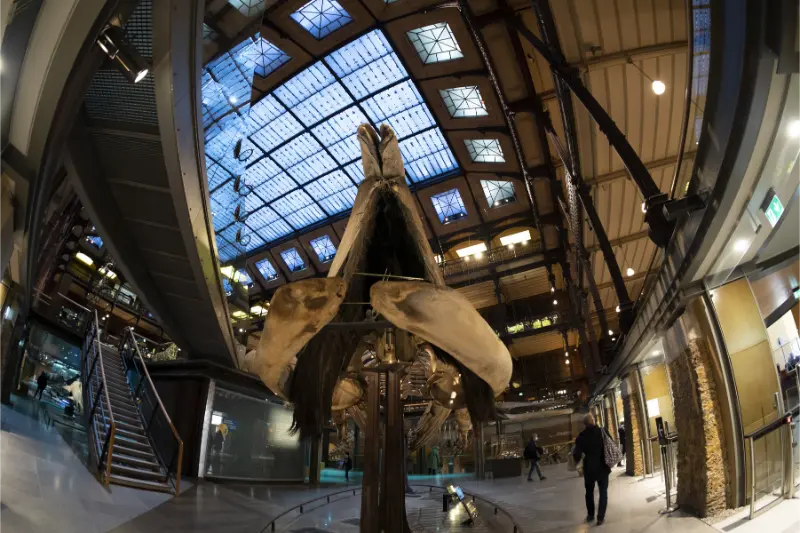
The central procession of animals is the visual hook, but the gallery is not a zoo substitute. Its strength is scale and comparison: marine life, terrestrial ecosystems, extinction, biodiversity and the human relationship with nature. Children who rush past labels can still understand the structure through the specimens; older children and adults can go much deeper.
How long should you spend inside?
For most families, 90 minutes to two hours in the Grande Galerie is enough before concentration falls. Do not schedule another major museum immediately afterward. Walk outside, find lunch, let children move and then decide whether you genuinely want a second paid venue.
That is the same pacing principle we recommend in Cité des Sciences with kids: one strong learning block plus physical freedom works better than trying to extract maximum value from every ticket.
The garden is not just a corridor between museums
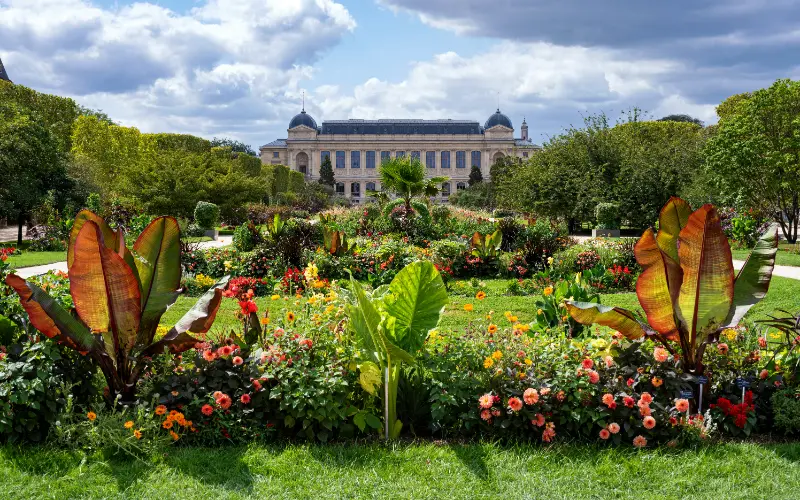
The Jardin des Plantes is a historic botanical garden and deserves its own time. Use it as a decompression zone: seasonal beds, tree-lined axes and specialized garden areas make it possible to change pace without leaving the site. In spring, plant collections are the attraction; in summer, shade and slower walking matter; in cold weather, the outdoor part becomes a shorter connector.
Families who enjoyed Luxembourg Gardens should expect a different atmosphere. Luxembourg is social and recreational; Jardin des Plantes is more explicitly botanical and scientific.
Menagerie, greenhouses or another gallery? Choose one
The site can tempt you into buying multiple tickets. Resist unless your children have exceptional stamina. The Menagerie is a historic zoological garden; the Grandes Serres focus on plant environments; other museum spaces vary by current program. Pick the second stop according to interest, not because it is “there.”
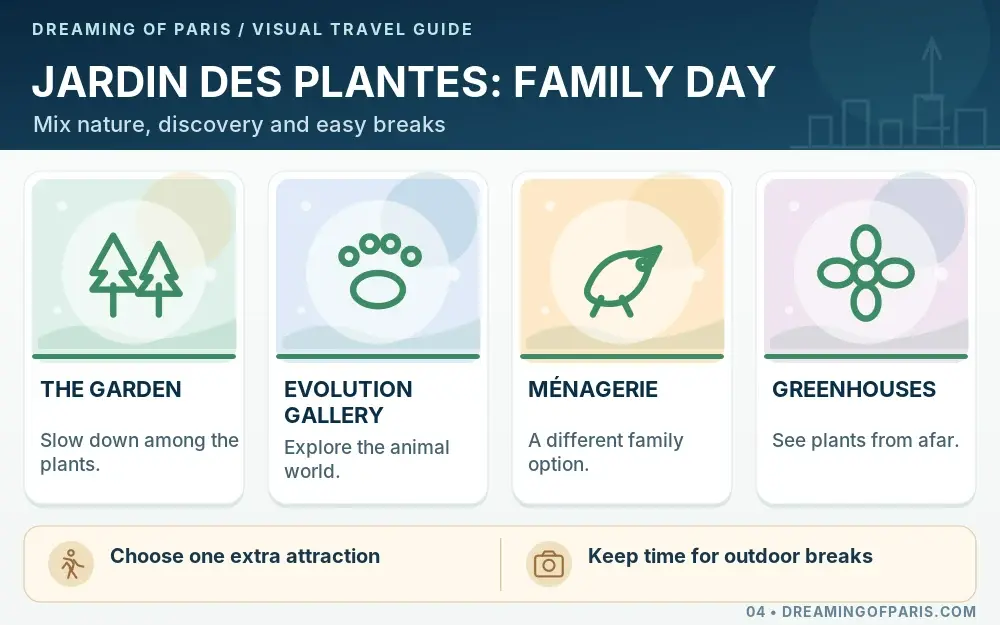
A child obsessed with animals may prefer the Menagerie after the Evolution gallery. A plant-focused adult with a patient teenager may choose the greenhouses. A family with a five-year-old who has already walked 8 km should choose lunch and a playground-style break instead.
A realistic half-day plan
- 10:00: Grande Galerie de l’Évolution while attention is fresh.
- 11:45: leave the gallery before fatigue becomes the memory of the visit.
- 12:00: walk the garden and choose lunch based on energy rather than a rigid reservation across town.
- 13:30: optional second venue only if everyone still wants it.
- 15:00: continue toward the Latin Quarter or Seine rather than another giant museum.
What to pair nearby
The garden sits at the eastern edge of the Latin Quarter and works naturally with our Latin Quarter walk. Older children interested in medieval history can move toward Musée de Cluny. Families who need open air can instead keep the day almost entirely in the garden and along the Seine.
Rain strategy
This is a strong rainy-day anchor, not an all-day rain bunker. Reserve the gallery, carry proper rain gear, and use dry intervals for the garden. Our Paris in the rain guide explains why moving between short indoor and outdoor blocks is usually more pleasant than spending the whole day in one overcrowded museum.
Toddlers vs teenagers
Toddlers may love the animals but struggle with the length of the galleries; keep the visit short and protect nap timing. Read Paris with babies and toddlers. Teenagers who like biology, climate, photography or design can spend much longer, especially if you give them a task—choose one extinct species story, compare two ecosystems, or photograph the architectural volume rather than “read every panel.” Our teen guide has more age-specific ideas.
Official information
Official Grande Galerie de l’Évolution page. Ticket combinations and temporary exhibitions change, so verify the exact offer for your date.
Bottom line
Jardin des Plantes works because it does not force a family to choose between “educational” and “pleasant.” Make the Grande Galerie your anchor, then let weather and energy decide the garden and optional second venue. That flexibility is what turns a science visit into a genuinely good Paris day.
Frequently asked questions
Is the garden itself free?
The outdoor garden areas have their own access rules and the paid museum venues are ticketed separately. Check the exact venue you want before arrival.
Should we do the Menagerie and Grande Galerie on the same day?
Only if your family has the energy and a strong interest in animals. One paid venue plus garden time is often the better day.
Is it good in rain?
Yes as a flexible cluster because the Grande Galerie provides a major indoor anchor, but the site is best when you can also use the garden between showers.
A good learning game that costs nothing
Before entering the Grande Galerie, ask each child to choose one animal they expect to see and one they have never heard of. At the end, compare which display changed their mind about size, habitat or extinction. The task gives purpose without forcing children to read every label and works especially well with siblings of different ages.
The key planning fact: there is no single “Jardin des Plantes ticket”
The Muséum national d’Histoire naturelle explicitly states that the Grande Galerie, Ménagerie, Grandes Serres and other paid venues have their own tickets and opening times; there is no universal day ticket covering everything. This matters for families because “we will do the whole garden” can quietly become an expensive, overlong day. Choose one main paid venue, then treat the gardens as the flexible layer around it.
Three family plans that actually fit different ages
Ages 3–6: keep the goal simple. Spend 60–90 minutes in the Grande Galerie, have a snack, then use the outdoor paths as decompression. Add the Ménagerie only if animals are the child’s main interest and nap timing still works. Two major paid venues plus a long garden walk is often too much.
Ages 7–11: the Grande Galerie works well as the anchor because the scale of the central hall and biodiversity displays provide immediate visual payoff. After lunch, choose either the Ménagerie or another science venue—not both by default. Give children a small mission such as finding one species they know, one they have never seen and one adaptation they can explain.
Teenagers: connect biodiversity to extinction, conservation and museum design rather than treating the visit as “animals for kids.” A photography challenge in the gallery followed by the Latin Quarter or Seine can make the day feel less child-coded. See our Paris with teenagers guide for other age-appropriate pairings.
Grande Galerie: why it works even if you are not a natural-history person
The Grande Galerie de l’Évolution displays thousands of specimens in a theatrical central volume rather than a sequence of small cabinets. The visual organization makes it possible to understand broad themes—diversity, environments, human impact—without reading every panel. That is why 90 focused minutes can be better than trying to “complete” every level.
For 2026, the permanent-gallery full price listed by the museum is €13, with reduced rates and other bundles for temporary experiences. Check the official ticket page because family and “Tribe” offers can be more relevant than buying four isolated adult/child tickets.
Ménagerie: add it because you want a zoo, not because it is next door
The Ménagerie is a separate ticketed venue. Its central location is convenient, but convenience alone is not enough reason to add it. If your children have just spent two hours looking at animal specimens indoors, they may either love the transition to living animals or be completely saturated. Make the decision based on the child, weather and remaining energy at lunchtime.
Lunch strategy beats carrying a perfect itinerary
The Jardin des Plantes has food services, but families often benefit from keeping lunch flexible. In dry weather, a simple bakery lunch before or after the main museum slot can protect both budget and energy. In rain, use an indoor café/restaurant plan and avoid crossing the garden repeatedly. The nearby Rue Mouffetard/Latin Quarter area can also work later in the day, but it is not necessary to drag tired children there just because it is famous.
Rainy-day advantage without pretending the whole site is indoors
The Grande Galerie is a strong rain anchor, but moving between separate buildings still means outdoor exposure. Pack a compact umbrella or rain jackets and choose one second indoor venue at most. If the forecast improves, replace that second ticket with garden time. This is a better use of Paris weather than prepaying an entire day of indoor admissions.
A sample 10:00–14:00 half-day
- 10:00: enter the Grande Galerie near opening, before attention and energy fall.
- 11:30: snack and free garden walk; let children move rather than immediately queue again.
- 12:15: lunch nearby or on site depending weather.
- 13:00: optional Ménagerie or a shorter outdoor loop; skip it without guilt if the family is done.
- 14:00: continue toward the Latin Quarter or return for rest.
Strollers and realistic movement
The garden environment is much easier with a stroller than many Metro stations and medieval monuments. The useful constraint is not the park itself but the route you use to get there and the policies of individual galleries. Check accessibility and stroller rules for the exact venue before travel, especially with a sleeping child. Our Paris with babies and toddlers guide covers the wider transport problem.