Disclosure: This article contains affiliate links or booking widgets. If you book through them, Dreaming of Paris may earn a commission at no extra cost to you. How our affiliate links work.
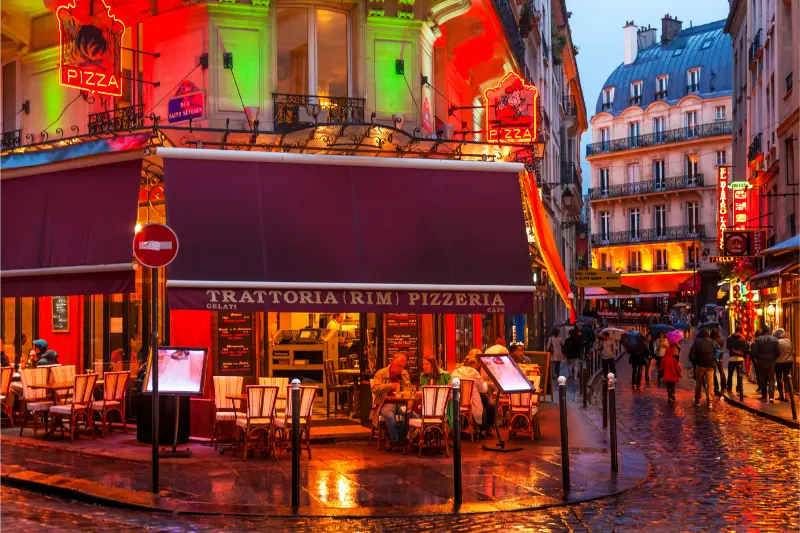
The Latin Quarter is not a neat neighborhood with one central square. It is a layered part of the Left Bank where Roman ruins, medieval universities, revolutionary memory, bookshops, student life, churches, gardens and tourist streets sit within a few steep blocks. If you simply follow the crowd from Saint-Michel to a restaurant on rue de la Huchette, you see the loudest version and miss much of the reason the area matters.
This route starts near the Seine, climbs through the university quarter, reaches the Panthéon and then gives you a choice: descend toward Luxembourg Garden or continue east toward rue Mouffetard and the Jardin des Plantes. It is designed as a half-day walk with optional museum stops.
Why is it called the Latin Quarter?
The name comes from Latin as the language of teaching in the medieval schools and university institutions that developed on the Left Bank. The Sorbonne remains the symbolic center of this academic identity, although the modern university landscape is much broader than a single building.
The useful insight is that the “Latin” in Latin Quarter is about education, not Roman Paris. Yet the district also contains important Roman remains, so two very different layers of history overlap in the same walk.
Start at Saint-Michel, but do not stay on the tourist axis
Place Saint-Michel is a convenient meeting point and transport hub, not the most rewarding place to linger. Walk away from the river through smaller streets and you quickly reach a different scale. Rue de la Huchette has historical associations but is now intensely visitor-oriented. See it if you are curious, then move on rather than using it as your image of the whole quarter.
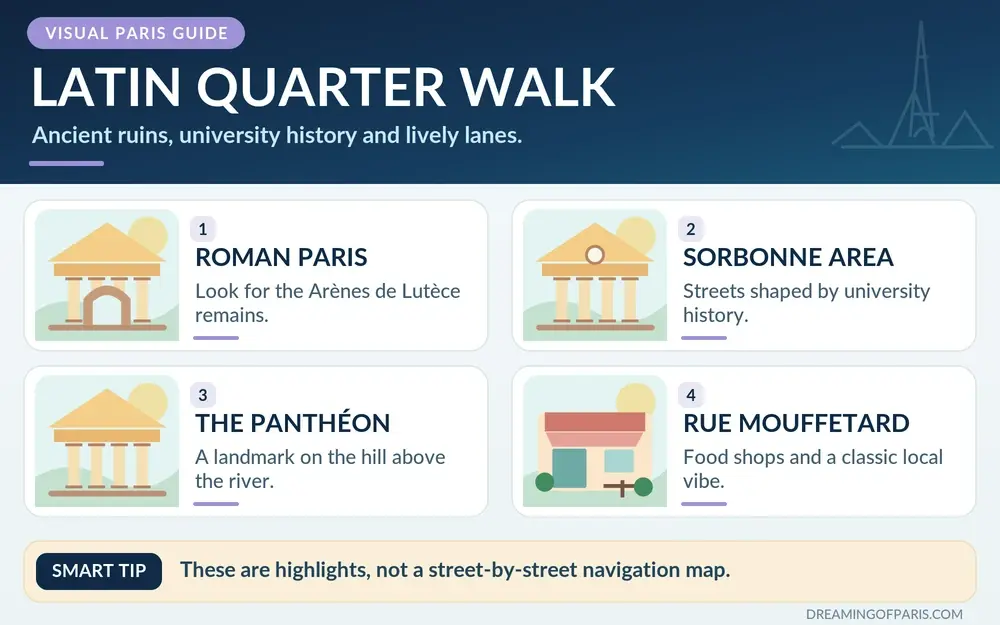
The official Paris tourism Latin Quarter walk similarly treats Saint-Michel as a starting point before moving toward the Sorbonne and Panthéon.
Cluny and the Roman baths: one building, two civilizations
The Musée de Cluny is one of the best places in Paris for understanding the Middle Ages, but its site also incorporates the remains of Roman baths from ancient Lutetia. Even if you do not enter the museum, knowing those ruins are there changes your sense of the neighborhood’s age.
If medieval art matters to you, Cluny deserves at least 90 minutes. Otherwise, make it a separate visit. The biggest itinerary mistake in the Latin Quarter is adding Cluny, Panthéon, Jardin des Plantes museums and Sainte-Chapelle simply because they look close on a map.
The Sorbonne streets: atmosphere without pretending the university is a tourist attraction
Walk around rue des Écoles, rue de la Sorbonne and the surrounding lanes. The Sorbonne is a working academic institution, and access to interiors is not equivalent to entering a museum. Enjoy the façades, bookshops and student rhythm without expecting to wander freely through every courtyard.
Look for the way the streets climb toward the Montagne Sainte-Geneviève. Topography matters here: the Panthéon appears and disappears between buildings before dominating the upper part of the quarter.
Panthéon: more than a skyline dome
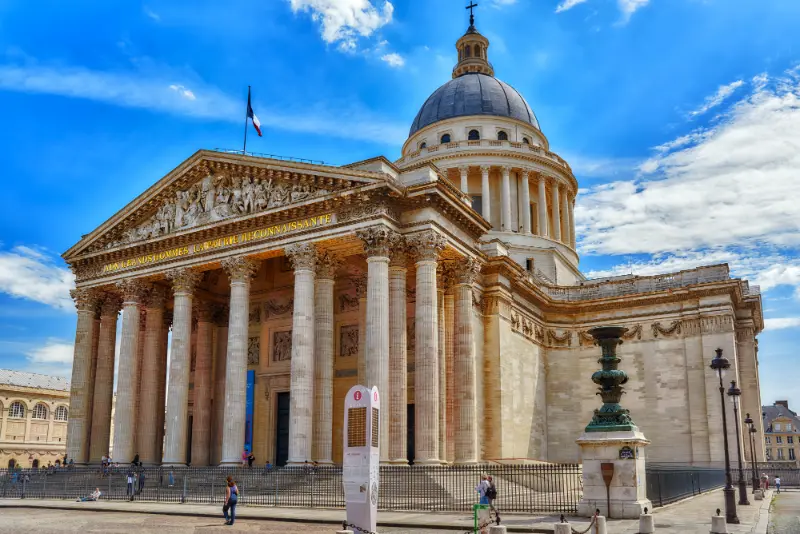
The Panthéon began as a church dedicated to Sainte Geneviève and became a secular mausoleum honoring major figures in French history. Inside, the nave, Foucault’s pendulum and crypt make it one of Paris’s most conceptually interesting monuments: religion, science, architecture and national memory occupy the same building.
For current hours and tickets, use the official Panthéon website. In 2026, the monument lists daily opening with seasonal hours. At the time of this update, its practical-information page states that the panoramic visit is closed, so do not rely on older guides that automatically promise dome access. This is exactly the kind of Paris detail worth checking shortly before travel.
Place de la Contrescarpe and rue Mouffetard: visit early for a different feel
From the Panthéon, walk southeast toward Place de la Contrescarpe and rue Mouffetard. The upper section has cafés and student energy; farther down, food shops and market traditions become more visible. This is one of the classic Paris streets where time of day changes the experience dramatically.
Morning emphasizes food shopping and daily life. Evening emphasizes bars and restaurants. Neither is more “authentic”; they are simply different uses of the same street.
Arènes de Lutèce: Roman Paris hiding beside everyday streets
The Arènes de Lutèce are the remains of a Roman amphitheater, today functioning as a public space rather than a sealed archaeological attraction. That ordinary use is part of their appeal. People sit, play and pass through a site whose origins reach back to ancient Lutetia.
Do not expect the visual completeness of a major Roman arena. Visit for context. Combined with the Cluny baths, the arena helps you imagine a Paris that predates the medieval city by centuries.
Jardin des Plantes: the best eastern finish
If you continue east, the Jardin des Plantes gives the walk a spacious ending. It is the historic botanical garden associated with the Muséum national d’Histoire naturelle and includes planted avenues, greenhouses and several museums or galleries around the site.
This is particularly good with children because the day can shift from streets and monuments to open space. Do not assume every museum within the complex is included in one general garden visit; check the institution’s current ticketing for the specific gallery you want.
Alternative finish: Luxembourg Garden
If your priority is classic Left Bank atmosphere rather than Roman Paris, turn west from the Panthéon toward Jardin du Luxembourg. The garden is one of the most effective breaks in central Paris: chairs, formal terraces, tree-lined sections and enough space to stop moving.
This route also connects naturally with Saint-Germain-des-Prés if you want a full Left Bank day.
Bookshops: avoid turning one famous address into a queue
The Latin Quarter’s literary identity is broader than a single English-language bookshop. Shakespeare and Company is famous and worth visiting if it matters to you, but queues can be long and photography rules should be respected. Walk farther into the neighborhood and browse French academic, art, used-book and specialist shops too.
The bouquinistes along the Seine provide another literary layer, but individual stalls and opening patterns vary. Treat them as part of a walk, not a guaranteed shopping appointment.
A realistic 4-hour Latin Quarter route
- 0:00–0:20: Saint-Michel and river edge.
- 0:20–0:50: Cluny area and medieval/Roman context.
- 0:50–1:30: Sorbonne streets and climb toward the Panthéon.
- 1:30–2:15: Panthéon visit or exterior/coffee break.
- 2:15–2:50: Contrescarpe and rue Mouffetard.
- 2:50–3:15: Arènes de Lutèce.
- 3:15–4:00: Jardin des Plantes or return toward Luxembourg Garden.
Enter Cluny or spend a full hour in the Panthéon and this becomes five to six hours. The walk is short in kilometers but dense in decisions.
Where to eat without falling into the easiest tourist trap
Move away from the most aggressively menu-lined streets around Saint-Michel before choosing lunch. Rue Mouffetard gives you bakeries, cheese shops, produce and casual options, while side streets around the Panthéon and Maubert offer many alternatives. Check recent menus rather than assuming a place is good because it looks old.
For a cheap lunch, a bakery sandwich and pastry eaten in a garden can be more satisfying than a rushed three-course tourist menu.
Latin Quarter at night
The area stays lively because of restaurants, cinemas, students and cultural venues. Saint-Michel can feel crowded late, while upper streets around the Panthéon become quieter. This contrast makes the quarter good for an evening walk, but remember that gardens close seasonally and should not be used as late-night shortcuts.
For a broader evening plan, use our Paris at night guide.
Where to stay in the Latin Quarter
The advantages are centrality, Left Bank atmosphere and easy walking to Notre-Dame, Saint-Germain and several major sights. The disadvantages are small hotel rooms, prices near prime streets and potential noise around nightlife pockets. Our Paris accommodation area guide compares the district with alternatives.
Compare hotels for your stay in Paris
Check current availability, location and prices before choosing the exact neighborhood.
Check Paris hotels on Booking.comAffiliate link: we may earn a commission at no extra cost to you.
Common Latin Quarter mistakes
- Thinking the neighborhood begins and ends at Saint-Michel.
- Booking several museums because they appear close together.
- Assuming the Sorbonne is freely open like a public museum.
- Using old information about the Panthéon panorama without checking current access.
- Ignoring Roman sites because the area is marketed mainly for medieval and literary history.
How to shorten the Latin Quarter without making it generic
If you have only two hours, skip the temptation to cover both eastern and western branches. Start at Saint-Michel, pass Cluny, walk around the Sorbonne, climb to the Panthéon and finish at Luxembourg Garden. You will still experience river level, medieval university streets, the hill and a major public space. Save rue Mouffetard and the Jardin des Plantes for another day.
This shorter route is especially useful after Notre-Dame because it avoids transport and keeps the historic narrative coherent.
FAQ
How long should I spend in the Latin Quarter?
Half a day is ideal for a walk plus one major interior visit. A full day works if you add Cluny, the Panthéon and the Jardin des Plantes museums.
Is the Latin Quarter walkable?
Very, but there are slopes around the Panthéon and Montagne Sainte-Geneviève. Comfortable shoes matter more than the short distances suggest.
Is the Latin Quarter good for a first trip?
Yes. It connects naturally with Notre-Dame and Saint-Germain and gives you history, food and street atmosphere without long transfers.
What is the quietest part?
There is no permanently quiet pocket, but early mornings around the Panthéon, side streets east of the Sorbonne and sections near the Jardin des Plantes can feel much calmer than Saint-Michel.
The Latin Quarter is best understood as a timeline you can walk. Roman Lutetia, medieval scholarship, revolutionary France and contemporary student life are all visible within a small radius. Give each layer enough attention and the district becomes far more than restaurants and bookshop photos.
Books and writers beyond the Latin Quarter
Continue the literary thread with our literary Paris guide.
Panthéon and Luxembourg Gardens
Deepen this Left Bank route with our Panthéon 2026 guide and Luxembourg Gardens guide.
Medieval Paris indoors
For the Roman baths, medieval sculpture and the Lady and the Unicorn tapestries, add the Musée de Cluny guide to this Latin Quarter route.
Compare Latin Quarter walking tours
The live options below are useful if you want a guided visit, reserved experience or packaged activity for this specific part of the trip. Compare the exact inclusions, meeting point, language and cancellation terms before booking.