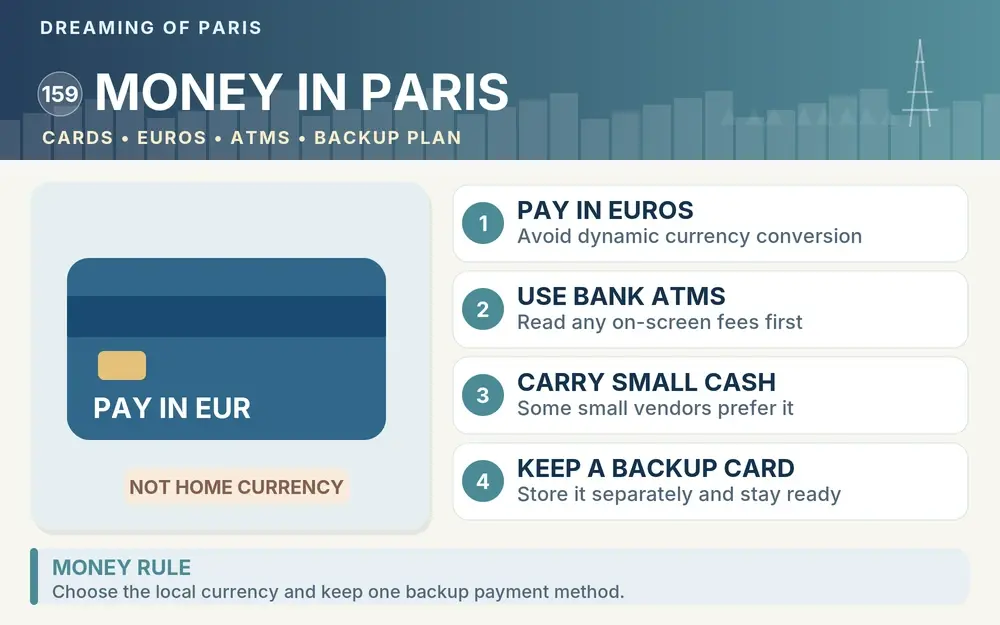
The short version: pay in euros and carry a backup
Paris is easy to navigate without carrying a thick wallet of cash, but it is still useful to arrive with a payment plan rather than assuming one card will work everywhere. The euro is the only currency you need for ordinary spending. Cards and mobile wallets are common in hotels, museums, restaurants, supermarkets and most shops, while cash remains widely accepted and can be useful for small purchases, markets, tips and moments when a terminal or network is unavailable.
The practical setup is simple: bring at least two payment methods, keep them in different places, know your own bank’s foreign-transaction and cash-withdrawal fees, and choose euros whenever a terminal or ATM offers to convert the transaction into your home currency. The goal is not to find one “perfect” Paris payment method. It is to make sure one blocked card, dead phone or unexpected minimum does not interrupt the day.
Cards are the default for many travelers
Contactless debit and credit cards work across much of Paris, including major museums, department stores, supermarkets, ticket machines and restaurants. Mobile wallets are also common. A traveler can therefore spend most of a trip without making repeated ATM withdrawals. That is useful not only for convenience but also for security: you do not need to carry the whole trip budget in cash.
Acceptance is broad rather than universal. A small bakery, market stall or independent shop may set a card minimum or have a temporary terminal problem. Some self-service machines work best with chip-and-PIN cards. American Express can be less consistently accepted than Visa or Mastercard, especially at smaller businesses. If a merchant declines one method, treat it as a practical issue rather than a dispute and switch to a backup.
Why you should still carry some cash
Cash has not disappeared in France. Banque de France data published in 2026 show that cash remained accepted by a very large majority of physical businesses in the euro area even as card and mobile-payment use continued to grow. In Paris, a modest amount of cash is useful for small market purchases, a café when the terminal is down, a public facility that still uses coins, or simply splitting costs without creating another digital transaction.
You do not need to carry hundreds of euros for a normal sightseeing day. Think in terms of resilience rather than dependence: enough for a meal, a taxi backup or a few small purchases. Store larger notes securely and avoid displaying your entire cash supply when paying. If you are traveling as a couple or family, splitting emergency cash between two adults is more sensible than one person carrying everything.
ATMs: use bank machines, not the first screen that flashes at you
Paris has many ATMs, and French banks operate machines throughout the city. When possible, prefer an ATM attached to or clearly branded by a bank rather than an anonymous machine placed in a tourist-heavy shopfront. Your home bank may charge a withdrawal fee or foreign-exchange fee, and the ATM operator may also display its own charge. Read the confirmation screen before accepting the withdrawal.
A useful strategy is to make fewer, sensible withdrawals rather than repeated tiny withdrawals if your bank charges a flat fee each time. At the same time, do not withdraw so much that you are carrying money you do not need. If the machine retains your card or something feels wrong, use a bank branch or official support channel rather than accepting “help” from a stranger standing nearby.
Always understand the currency choice on a terminal
Visitors with a card issued outside the euro area may be offered a choice such as “pay in EUR” or “pay in USD/GBP/CAD.” The home-currency option is a form of dynamic currency conversion. EU consumer guidance explains that paying in your own currency often includes an additional conversion markup, while paying in the local currency lets your card issuer perform the conversion under the terms of your card.
That does not mean every bank card has cheap foreign exchange. Your own card may still charge a fee. The important point is that you should know who is doing the conversion. In Paris the local currency is the euro, so choosing EUR generally avoids accepting the merchant or ATM’s conversion offer. If you are shown a percentage markup for conversion, read it before pressing the brightly colored confirmation button.
Check your bank before the trip
Before leaving home, look up four things: foreign purchase fees, ATM withdrawal fees, daily withdrawal limits and whether your bank needs travel notification. Many banks no longer require a formal travel notice, but fraud systems can still block unusual transactions. Make sure you can receive security messages or approve transactions in the banking app while abroad.
If your primary card is linked to a phone number you will not be able to access in France, change that before departure. Save the international number for reporting a lost card somewhere other than the wallet that contains the card. A screenshot stored securely or a note in an encrypted password manager can be more useful than searching for support details while stressed.
PINs, signatures and unattended machines
A four-digit PIN is the safest assumption for European payment terminals and ticket machines. If your card relies heavily on signatures or does not have a PIN you know, ask the issuer how it behaves at unattended terminals abroad. Modern contactless payments reduce this issue, but a terminal can still request chip-and-PIN after several contactless transactions or above certain thresholds.
Do not panic if contactless fails. Insert the card and follow the terminal instructions. A failed tap does not necessarily mean the account is blocked. At Metro or train machines, avoid repeatedly tapping several cards at once from the same wallet; remove the card you intend to use so the reader does not detect the wrong one.
Paying in restaurants and cafés
In many Paris restaurants the server brings a portable card terminal to the table. You normally do not hand the card over to disappear into a back room. Check the amount, pay, and take the receipt if you want it. If you are splitting a bill, ask before the payment process begins. Some restaurants are happy to split by amount, while others prefer one payment for a busy table.
Service is included in menu prices under French rules, so a large percentage tip is not a standard obligation. If service was particularly good, rounding up or leaving a modest extra amount is a personal choice. For the deeper etiquette around water, reservations, meal times and tipping, use the site’s dedicated restaurant-etiquette guide rather than treating payment as the whole dining experience.
Markets, bakeries and very small purchases
A bakery coffee and croissant, a market punnet of fruit or a small souvenir may cost only a few euros. Card acceptance has improved dramatically, but minimum card amounts still appear in some independent businesses. Look for a sign near the register or ask before the purchase if you have no cash at all.
At produce markets, do not assume every stall handles payment the same way. Some accept contactless immediately; others prefer cash. Keep small denominations accessible rather than pulling out a large note. If you are buying food to eat as you walk, make the payment first and step aside so residents can continue shopping.
Currency exchange offices: usually a second-choice solution
If you arrive with foreign cash, exchange offices exist around central Paris and major transport hubs. Compare the full rate and commission, not a sign promising “0% commission.” A poor exchange rate can cost more than an explicit fee. Airports and heavily touristed areas are convenient but may not offer the most competitive terms.
For most travelers, using a well-priced bank card and withdrawing euros from a bank ATM is simpler than carrying large amounts of foreign cash to exchange. Exchange offices make more sense if you already hold cash, cannot use your cards, or need a specific currency before another country. Never exchange money informally on the street.
Lost card, stolen wallet or suspicious transaction
If a card disappears, freeze it immediately in the issuer’s app if that function is available, then contact the bank. If your wallet was stolen, also follow the practical safety steps in our Paris scams and tourist-mistakes guide and report the theft when appropriate. Do not wait until the evening to see whether the card “turns up” if it could be used in the meantime.
Review transactions during the trip rather than weeks later. A push notification for every card payment is useful because it lets you spot a duplicated or unfamiliar charge quickly. Avoid logging into banking on unknown public computers, and prefer your own mobile connection or trusted network when dealing with financial accounts.
A simple payment setup for different travelers
Travelers from the euro area have the easiest setup because there is no currency conversion for euro purchases. EU rules also protect equal charges for many cross-border euro payments, although individual account conditions still matter. Visitors from outside the euro area should pay special attention to foreign-exchange fees and dynamic currency conversion.
Families should consider two cards from different networks or issuers so one technical problem does not affect everyone. Solo travelers should keep the backup card away from the primary wallet. Business travelers who need receipts should photograph paper slips before they fade or get lost. The principle is the same: separate your payment risk instead of concentrating it in one card and one phone.
What I would carry on a normal Paris day
For a typical day, I would take one primary card, a second payment method stored separately, a small amount of euros and a phone with the banking app already authenticated. I would leave unnecessary cards and most cash in secure accommodation storage. That is enough redundancy without turning sightseeing into money management.
Before a high-cost purchase, check whether your card has a daily limit. Before a day trip, make sure you have a payment option that works even if mobile data is weak. Before leaving a restaurant, verify you have retrieved the physical card if you inserted it. These habits are simple, but they prevent the most common payment frustrations.
Official sources worth checking
For current payment and cash information, consult Banque de France guidance and the European Union’s Your Europe pages on cross-border payments and currency conversion. Rules and card fees can change, and the terms that matter most are often those of your own bank rather than the city you are visiting.
Useful official references include www.banque-france.fr and europa.eu/youreurope/citizens/consumers/shopping/pricing-payments/index_en.htm. For tax-free shopping by eligible non-EU residents, verify the separate rules on the French Ministry of Economy website instead of assuming every purchase qualifies.
Related Dreaming of Paris guides
Continue planning with Paris on a Budget, Eating in Paris: Restaurant Etiquette, Shopping in Paris, Paris Scams and Tourist Mistakes. Each link covers a separate practical decision so you can move from this topic into the rest of the trip without repeating the same advice.