Disclosure: This article contains affiliate links or booking widgets. If you book through them, Dreaming of Paris may earn a commission at no extra cost to you. How our affiliate links work.
Giverny works best when you understand that the attraction is seasonal, visual and relatively compact. Claude Monet’s house and gardens are not a huge estate like Versailles. The official Fondation Monet recommends roughly 1½–2 hours for an unguided visit, which means the quality of the day depends more on your arrival timing, the transfer from Paris and what you do with the rest of the village than on trying to “cover” a long list of rooms.
Check tickets and Paris experiences
Compare current tours, timed-entry tickets and experiences before fixing your itinerary.
GetYourGuideTiqetsCivitatisViatorAffiliate links: we may earn a commission at no extra cost to you.
2026 opening dates and the one fact that changes everything
For 2026, the Fondation Monet lists the house and gardens as open every day from April 1 to November 1, 10:00–18:00, with last admission at 17:30. Adult self-guided admission is €13, children 7–17 and students €7, and children under 7 are free under the published conditions. The site has no luggage storage and large luggage is prohibited, so do not plan Giverny as a stop between hotels with suitcases in tow.
Getting from Paris: think in two stages
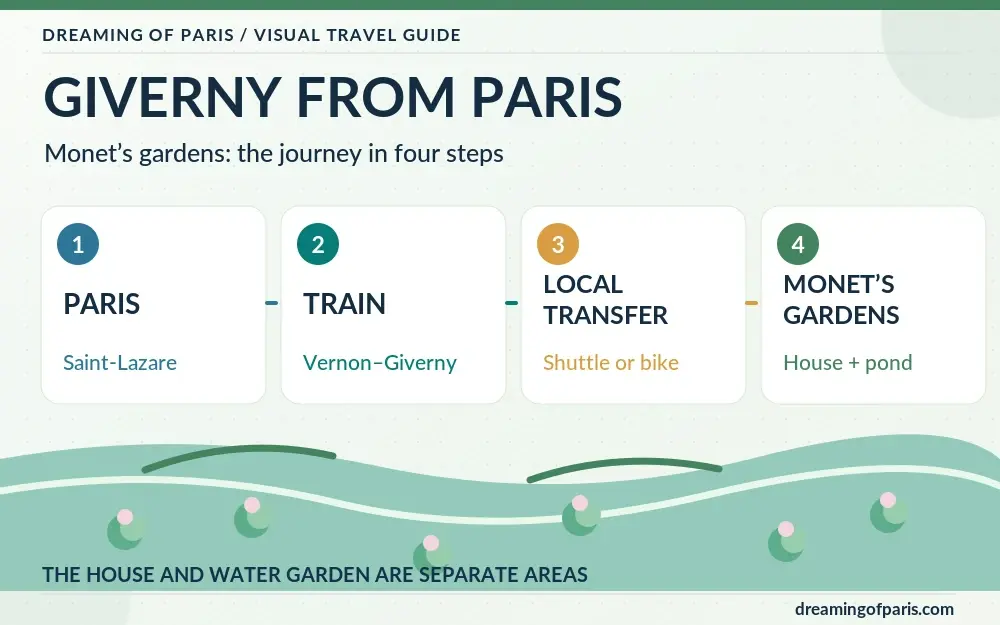
The classic independent route is train from Paris Saint-Lazare toward Vernon-Giverny, then a local connection to Giverny. The important planning point is that the train only solves the first stage. Bus, shuttle, taxi, bicycle or a longer walk solves the second. Check both directions before leaving Paris so you do not finish the garden visit and discover a long gap before your return connection.
If you dislike coordinating the last local leg, an organized excursion can simplify the transport, but independent travel gives you more control over how long you stay in the village. Compare the structure rather than assuming one is inherently better.
What you are actually visiting
Monet lived at Giverny from 1883 until 1926. The visit combines the house, the Clos Normand flower garden and the water garden that became inseparable from his later paintings. This matters because the experience is not “see the original Water Lilies paintings.” You are seeing the environment Monet shaped and repeatedly observed. If you want the monumental Water Lilies themselves, the Musée de l’Orangerie in Paris is the complementary museum stop.
Garden first or house first?
There is no universal order, because crowd flow changes during the day. If the house queue is short when you enter, using that moment can be smart; if the garden light is exceptional or the house queue is already long, start outdoors. The useful principle is to avoid standing in a queue simply because a guidebook told you to do one section first. The site is compact enough to adapt.
The water garden is not beside the house
One detail first-time visitors often miss is the physical separation between the main flower garden and the water garden. You pass beneath the road through an underpass rather than simply stepping from one lawn to the other. The water garden is where the Japanese bridge, pond and water lilies create the most recognizable Monet associations. Give it time to look rather than treating it as a single photograph.
Which season is best?
There is no single “best bloom” date because the garden is intentionally seasonal. Spring emphasizes bulbs, wisteria and fresh growth; summer changes the palette; later months bring different flowers such as dahlias and autumn color. If your only expectation is one flower at peak bloom, weather can disappoint you. If your goal is to see how Monet composed with changing color and planting, the entire open season has value.
Giverny after the main garden
The village itself is small and linear, which is part of its appeal. Walk rather than immediately returning to the shuttle. Depending on your interests and opening schedule, the Musée des Impressionnismes Giverny can add context, while the church and Monet’s grave provide a quieter historical stop. Lunch in the village can turn the trip into a relaxed day instead of a transport exercise.
Giverny with children
The gardens can work very well with children because the visit is visual and outdoors, but the house is tighter and requires more patience. The Fondation Monet provides educational resources for children, and the official site notes that picnicking is not allowed inside the property. Plan food outside the attraction and remember there is no luggage storage. For broader family pacing, see our Paris with kids guide.
Should you combine Giverny with Versailles?
Independent travelers should usually resist that temptation. They lie in different directions from Paris and each visit has its own transport chain. Organized tours can combine them because transport is controlled, but the trade-off is a more compressed experience. If you have only one excursion day, compare Giverny with Versailles, Fontainebleau and Reims in our day trips guide rather than trying to collect two major destinations.
A realistic Giverny day
- Early train from Saint-Lazare to the Vernon area.
- Local transfer to Giverny.
- House and gardens before or around the busiest midday period.
- Lunch in the village.
- Optional Musée des Impressionnismes or slow village walk.
- Return via your pre-checked local connection and train.
Frequently asked questions
Is Giverny open all year?
No. In 2026, Claude Monet’s house and gardens are scheduled to open from April 1 through November 1.
How long do you need inside Monet’s house and gardens?
The Fondation Monet recommends about 1½ to 2 hours for an unguided visit.
Can I take luggage to Giverny?
The official site states there is no luggage storage and large luggage is prohibited.
Is Giverny worth it if I am not a Monet expert?
Yes if you enjoy gardens, color, photography or quieter day trips. The visit explains the physical setting behind a major part of Monet’s later work.
Can I visit Giverny in winter?
Monet’s house and gardens are closed outside the published seasonal opening, so a winter trip needs a different day-trip choice.
How this fits into our Day Trips from Paris cluster
This guide is designed to connect with the rest of the site rather than sit alone. Continue with day-trip comparison, Musée d’Orsay and summer Paris. Internal links are placed where the next decision naturally appears, so you can move from transport to neighborhood, attraction, season or day trip without rebuilding the plan from scratch.
The decision that matters most
Do not overengineer Giverny. Get the two-stage transport right, reserve enough time for the gardens and leave space to walk the village. The trip is strongest when it feels like a change of pace from Paris, not another race through famous images.
Where this day trip fits in a Paris itinerary
Giverny from Paris in 2026: Monet’s House, Gardens, Transport and the Best Way to Plan the Day works best when it replaces a full Paris sightseeing day rather than being squeezed between major city reservations. Put it after a lighter evening and avoid scheduling a high-effort Paris morning immediately after the return. The excursion should add contrast to the trip: gardens after museum days, a medieval town after Haussmann Paris, Champagne and cathedral architecture after several monument-heavy days, or Disney when family entertainment is a genuine priority.
Booking order that avoids timetable traps
Book the element with the least flexibility first: a timed palace entry, cellar tour, garden admission, park ticket or specific high-speed train. Only then choose the connecting transport around it. Leave margin between independent transport legs and reservations. A day trip can fail even when every individual booking is valid if the sequence assumes perfect connections. Keep one activity optional so a delayed train does not force you to rush through the attraction you traveled to see.
The lunch decision matters more than it seems
Decide whether lunch is part of the experience or simply fuel. If it matters, reserve somewhere that fits the route. If it does not, choose a flexible local option and protect the best sightseeing hours. Long formal lunches can be wonderful, but they change how many monuments or neighborhoods realistically fit afterward. Families should eat before everyone is hungry; adults on tasting-focused days should make food and hydration a non-negotiable part of the plan.
Weather backup without wasting the ticket
Check the forecast one or two days before travel and identify what remains worthwhile in bad weather. Palace interiors and city museums retain value in rain; gardens, viewpoints and forest walks change much more. In heat, move exposed outdoor portions earlier or later and use lunch or interiors at midday. If a ticket cannot be changed, adjust the order rather than abandoning the day.
Energy and footwear
A “day trip by train” can still mean 15,000–25,000 steps once stations, estates, old towns and gardens are included. Wear shoes for the walking surface, not for the train. Carry less than you would for an airport day and identify where you can sit. Travelers with children or reduced stamina should choose two priorities rather than trying to complete every included attraction simply because a pass makes them available.
Return-to-Paris strategy
Know the next two realistic return departures, not only one perfect train. This gives you the freedom to leave early if the weather turns or stay longer if the day is going well. Keep dinner back in Paris flexible unless the return timing is exceptionally reliable. Arriving hungry at 21:30 after a delayed excursion is easier to solve with a neighborhood meal than with a missed fixed reservation across town.
When to skip the excursion entirely
If your Paris visit is only three or four days and this excursion is not one of your strongest interests, staying in the city can be the better choice. Paris neighborhoods themselves provide enormous variety. Day trips are most valuable when they deepen a theme you care about or give a deliberate change of scenery, not when they are added because a list says you “must” leave Paris once.
How to protect the main reason for the excursion
Identify the one experience that would make the trip worthwhile even if something else went wrong: the palace rooms, Monet’s garden, one cellar tour, the medieval upper town, a Disney land or a specific exhibition. Put that experience in the safest part of the schedule and make secondary activities flexible around it. This prevents a day trip from becoming a chain of equal-priority tasks where one late train causes everything to fail. A strong excursion has one anchor, two supporting experiences and enough slack to enjoy the place rather than merely arrive there.
What to carry for a day outside Paris
Take less than you think: water, a small snack, weather protection, a charged phone, portable battery if needed, reservation confirmations and only the valuables you genuinely need. Heavy day bags become more annoying on station stairs and long estate walks. If the destination has no luggage storage, this matters even more. Families should add whatever prevents an avoidable crisis—small snacks, a simple activity for train time and a layer for temperature changes—without turning one adult into the group pack mule.
How to judge whether the day was worth it
Do not measure Giverny from Paris by how many sub-attractions you completed. Ask whether the excursion gave you a different historical period, landscape, artistic context or family experience from Paris itself. If the answer is yes, leaving one museum room, garden corner or secondary stop unseen is not a failure. In fact, stopping before fatigue usually makes the return to Paris better and preserves the final evening. The point of a day trip is contrast and depth, not total coverage.
A specialist Monet museum in Paris
Before or after Giverny, see our Musée Marmottan Monet guide, including the museum’s current combined-ticket option with the Fondation Monet.
Another art-focused day trip
If you want a village connected to Van Gogh rather than Monet, compare Giverny with our Auvers-sur-Oise day-trip guide.
Compare Giverny tours and transport packages
The live options below are useful if you want a guided visit, reserved experience or packaged activity for this specific part of the trip. Compare the exact inclusions, meeting point, language and cancellation terms before booking.