Disclosure: This article contains affiliate links or booking widgets. If you book through them, Dreaming of Paris may earn a commission at no extra cost to you. How our affiliate links work.
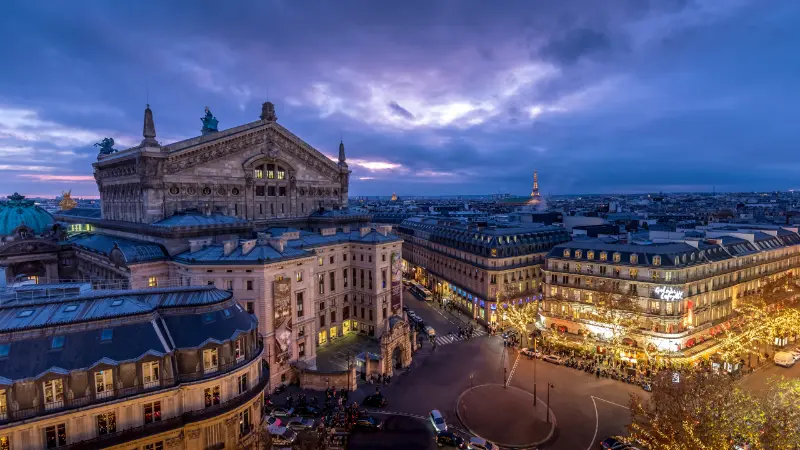
Palais Garnier is easy to mistake for a place you should only visit if you have an opera ticket. In reality, the building operates both as a working theatre and as a daytime monument with self-guided and guided visits. That dual identity is also the reason you should never assume every room — especially the auditorium — will be available during a daytime visit.
Check tickets and Paris experiences
Compare current tours, timed-entry tickets and experiences before fixing your itinerary.
GetYourGuideTiqetsCivitatisViatorAffiliate links: we may earn a commission at no extra cost to you.
The Opéra national de Paris currently lists visitor entry from 10 a.m. to 4 p.m. on standard open days, with the building closing at 5 p.m., subject to occasional closures and theatre activity. Online booking is strongly recommended, and the Opera explicitly warns that the auditorium can be inaccessible when rehearsals, performances or technical needs require it.
What a daytime ticket actually lets you see
A standard self-guided visit focuses on the public spaces of the Palais Garnier: the grand staircase, salons, foyers and architectural decoration, plus temporary exhibitions when available. The building itself is the attraction. You do not need to understand opera repertoire to appreciate the sequence of spaces and the theatrical way Charles Garnier designed arrival, circulation and spectacle.
The auditorium is one of the most desired spaces, partly because of Marc Chagall’s ceiling. But access is not guaranteed during every visit. If seeing the auditorium is non-negotiable, check the official visit calendar and accept that theatre operations take priority.
How long to allow
Most first-time visitors should allow 75–90 minutes for a self-guided visit without rushing. Architecture enthusiasts and photographers can easily spend longer. A guided tour may take around the same amount of time but changes the value proposition: you trade some freedom for historical context and access shaped by the tour format.
Do not schedule a timed Louvre entry immediately afterward. Garnier sits in a useful neighborhood for slower continuation: covered passages, department stores, the Madeleine area, or a walk toward the grands boulevards.
The grand staircase: look at the circulation, not only the marble
The staircase is photographed as an object, but its real effect comes from movement. Landings, balconies and sightlines were designed so the audience could see and be seen. Spend a few minutes observing how people appear at different levels rather than trying to take one empty symmetrical photo in a building that is rarely empty.
If you enjoy this kind of interior urban history, connect the Opera to our covered passages walk. The passages and Garnier belong to the same broad 19th-century world of consumption, display and modern city life, even though their scales are completely different.
The Grand Foyer and the temptation to rush
The Grand Foyer is the space where many visitors slow down only long enough for a wide-angle photo. Instead, look at the ceiling painting, mirrors, gilding and how the room borrows the language of palace galleries. The Opera is not subtle, and that is part of its significance: it was designed to perform wealth, state ambition and social hierarchy.
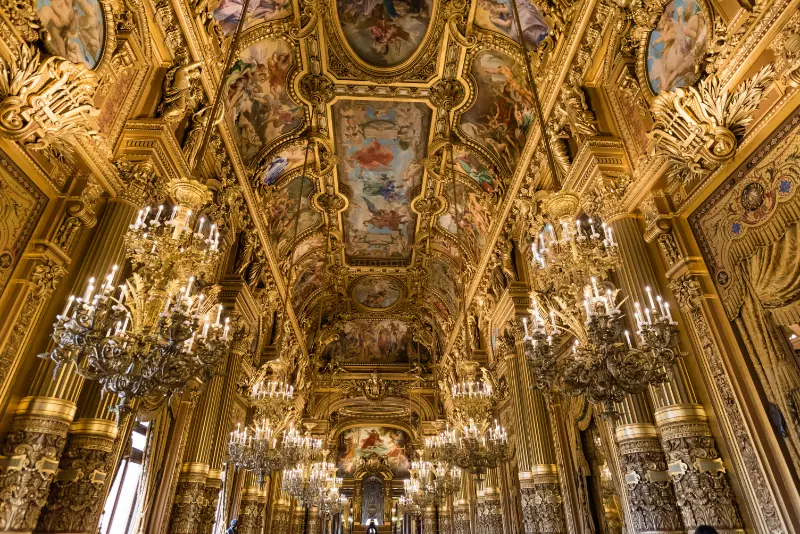
If the building feels visually overwhelming, pick three details and follow them — light fixtures, ceiling painting, or repeated motifs — rather than attempting to “see” every surface.
The auditorium and Chagall ceiling: understand the limitation
When the auditorium is open to daytime visitors, access may still be limited to a viewing area rather than free movement through every seat. The famous painted ceiling by Marc Chagall, installed in the 20th century, sits within a much older decorative environment and creates one of the building’s most interesting contrasts.
Because the Palais Garnier is a working theatre, closures are not a service failure. They are part of what keeps the building alive. If seeing a performance appeals to you, compare the performance calendar separately from daytime visit tickets; attending a performance is a different experience, not a substitute for a full architectural tour.
Best time of day and crowd strategy
Early entry is usually the simplest choice if you want a calmer staircase and more room in the foyers. Late slots can work if your day is already concentrated around the 9th arrondissement, but do not arrive close to final admission expecting a leisurely visit. Security and operational closures can alter flow.
The Opera area is especially efficient on a rainy day because you can combine Garnier with the passages, department stores and cafés. See our Paris in the rain guide for a neighborhood-based bad-weather plan.
A half-day route around Palais Garnier
Begin at Palais Garnier, then choose one direction rather than zigzagging. North and east lead naturally toward the grands boulevards and covered passages. West and south connect to Madeleine, Place Vendôme and the Tuileries. If shopping matters, the major department stores sit immediately behind the Opera and connect to our shopping in Paris guide.
This is also a useful area for a first evening because streets remain active after museum hours. Do not overload the day with another huge attraction; the value is the sequence of architecture, streets and interiors.
Guided tour or self-guided visit?
Choose self-guided if your priority is architecture, photography and controlling your pace. Choose guided if you want theatre history, anecdotes and interpretation. A third option is to use the Opera as one stop in a broader architecture or central Paris tour. Compare what is actually included, because a city walking tour that stops outside Garnier is not the same as an interior visit.
Official booking and current closures
Use the official Palais Garnier visit page for current tickets and closure dates. The Opera’s calendar is the source that matters most because rehearsal and performance needs can affect access on short notice.
Frequently asked questions
Can you visit Palais Garnier without seeing a performance?
Yes. Daytime self-guided and guided visits are sold separately from performance tickets.
Is the auditorium always open?
No. The Opera explicitly states that the auditorium can be inaccessible because of theatre activity.
How long do you need?
Around 75–90 minutes is comfortable for most self-guided visitors, with longer needed if you read exhibitions closely or spend time photographing details.
What should I combine with it?
Covered passages, department stores, Madeleine and the grands boulevards make the most coherent nearby combinations.
Do not confuse the Palais Garnier with Opéra Bastille
The Paris Opera operates two major venues. Palais Garnier is the historic 19th-century building in the 9th arrondissement; Opéra Bastille is the modern opera house near Place de la Bastille. Performance tickets can be for either venue, so check the address before planning dinner, transport or a daytime visit.
Photography strategy
A phone or normal camera is enough for the public spaces; the bigger challenge is people and contrast, not equipment. Step to the side, use balconies to create layered compositions and avoid blocking stairs while waiting for a perfect empty frame. Tripod rules and photography restrictions can change, so follow the instructions on site.
Accessibility and the reality of a historic theatre
Palais Garnier is a protected historic building with lifts and visitor arrangements, but not every route through a 19th-century theatre can be assumed barrier-free. Visitors with mobility requirements should consult the Opera’s current accessibility information before booking and identify which spaces are accessible on the chosen tour format.
Architecture lovers: what to look for beyond gold
The building rewards attention to structure as much as decoration. Notice the sequence from exterior façade to vestibules, grand staircase and foyers; the hierarchy of spaces is deliberate. Garnier created a building where circulation itself becomes performance. Looking for that sequence makes the visit more coherent than counting chandeliers.
Department stores before or after Garnier?
If shopping is important, visit Garnier first while your attention is fresh, then move to Galeries Lafayette or Printemps. If you mainly want rooftop views or window displays, the order can reverse. Around Christmas, department-store displays can dramatically increase foot traffic, so leave more time to move through the area.
Seeing a performance is a different kind of planning
A performance evening requires earlier arrival for security and ticket checks, appropriate timing for dinner and confirmation of the actual venue. Do not buy a Garnier performance ticket merely because you want to see the building; some productions are at Opéra Bastille. Check the venue name on the ticket before making any neighborhood reservations.
Palais Garnier on a first trip versus a repeat trip
On a first visit to Paris, Garnier competes with many headline sights, so it works best when architecture or theatre genuinely interest you or when the weather favors an indoor central stop. On a repeat trip, it becomes easier to give the building the time it deserves and combine it with passages, small museums and the 9th arrondissement rather than treating it as an isolated monument.
What not to schedule immediately before entry
Avoid placing a distant restaurant reservation, airport transfer or another non-refundable ticket immediately before your Garnier slot. Central Paris travel times can be deceptively variable, and security plus queues add uncertainty. Give yourself a buffer and use the surrounding streets if you arrive early; this neighborhood is easy to fill without wasting time.
Choosing a performance, not just a building visit
Our opera and classical concerts guide compares Garnier, Bastille, Philharmonie, ticket categories and beginner-friendly concert options.