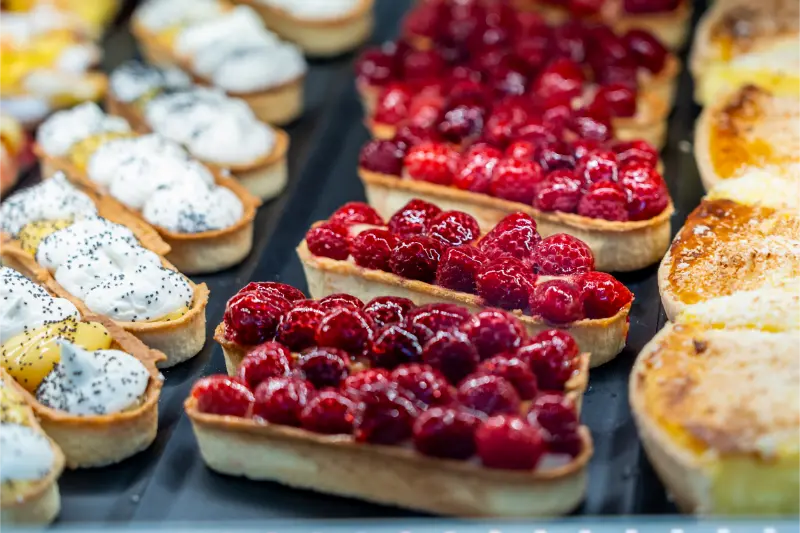
Paris does not need a list of fifty bakeries as much as it needs a method for recognizing what is worth buying, when to go and how to order without turning breakfast into a performance.
Quick planning summary
Boulangerie, pâtisserie and bakery-counter vocabulary
A boulangerie is first and foremost a bread bakery; a pâtisserie specializes in cakes and pastry, although many excellent addresses do both. The distinction matters because the best croissant in one shop does not imply the best entremets, and a famous pastry house may not be where you should buy a daily baguette. Look for what the shop actually produces on site, the rhythm of local customers and a range that makes sense for the time of day. Paris rewards specialization more than chasing a universal ‘best bakery’.
The baguette tradition is the useful baseline
If you want to compare bread, ask for a baguette tradition rather than choosing only by appearance. The protected recipe framework is stricter than for a standard baguette, and it is a practical benchmark for crust, fermentation and crumb. Buy one where locals are also buying bread for lunch or dinner, then eat at least part of it while still fresh. A baguette is not designed to be judged six hours later in a hotel room.
Croissants: what to look for
A good croissant should feel light for its size, smell clearly of butter and show defined lamination rather than a bread-like interior. Color can range from golden to deeper caramel depending on the bakery, so judge texture and flavor instead of Instagram perfection. Morning is usually the safest moment for maximum freshness. If the shop is busy, watch what is moving quickly; high turnover is often more useful than a viral ranking published months earlier.
Pâtisserie without ordering too much
For a first tasting, choose one classic you understand and one house specialty. That gives you a reference point without buying six desserts simply because the display is beautiful. Paris pâtisseries are often rich, and a single individual pastry can be a complete afternoon break. If you are walking, ask whether a fragile item can realistically survive the route before buying it. Macarons travel better than cream-heavy pastries; mille-feuille generally does not.
When Parisians actually use bakeries
Bakeries are part of daily logistics: breakfast, a lunchtime sandwich, bread for dinner and a small dessert. The queue at 12:30 can therefore be very different from the one at 9:00. If you want time to look at the display and ask a question, avoid the sharpest commuter and lunch rush. If you want to see the neighborhood rhythm, join it. Either choice is valid as long as you understand why the counter suddenly feels rushed.
Ordering without anxiety
A greeting before ordering and a brief thank-you matter more than perfect French. Know roughly what you want when the queue reaches you, point politely if pronunciation is difficult, and do not be embarrassed to ask for an item by describing it. For bread, say the quantity and type first. For pastries, staff may box them carefully; let them. The goal is not to imitate a Parisian accent but to keep the exchange simple and considerate.
How to build a food walk
Use a bakery as one stop in a neighborhood rather than traveling across Paris for every snack. Rue des Martyrs works because bread, cheese, produce and cafés sit within a walkable urban fabric. Marché d’Aligre works differently: the market itself creates the rhythm. A useful food walk combines three or four tastes with streets, architecture and a sitting break, not ten shops in rapid succession.
The ‘best bakery in Paris’ trap
Annual competitions and awards are useful signals, but they are snapshots. Staff changes, production changes and personal taste still matter. A technically excellent baguette five arrondissements away may add little to your day if a very good neighborhood bakery is downstairs. Use awards to discover, not to turn the trip into a scavenger hunt.
What to buy for a picnic
Bread, a savory tart or sandwich, fruit and one sweet item are easier than a large pastry box. For a Seine or park picnic, avoid items that need refrigeration for long periods and anything that becomes messy in heat. Pair this guide with our picnic planning article before assuming every lawn allows the same behavior.
What is actually worth bringing home
Dry biscuits, chocolate and some packaged specialties travel better than fresh viennoiserie. A croissant bought for tomorrow morning is usually a disappointment compared with eating one fresh. If you want a food souvenir, choose something designed to keep rather than trying to preserve the most fragile part of Paris bakery culture in hand luggage.
How this article fits into the Dreaming of Paris cluster
For a deeper plan, continue with Eating in Paris, Rue des Martyrs food walk, Marché d’Aligre, Paris picnic guide. These guides are linked because they share geography or a real planning decision, not simply because they mention Paris.
Official information
For the details most likely to change, use the Paris je t’aime baguette guide. Recheck it shortly before the visit rather than relying on a screenshot saved weeks earlier.
Practical checklist before you leave the hotel
- Recheck opening hours, closures or transport work.
- Save the exact entrance or meeting point, not only the attraction name.
- Carry water and keep enough phone battery for navigation.
- Know one nearby alternative in case the main plan changes.
- Allow more time if you have luggage, children or reduced mobility.
- Avoid scheduling another major timed attraction immediately afterward.
What is the difference between a baguette and a baguette tradition?
A baguette tradition follows a more restrictive recipe and production framework and is the better baseline for comparing artisanal bread.
Do I need to speak French in a Paris bakery?
No. A greeting, a clear order and basic courtesy are enough; pointing politely is perfectly normal.
What time should I buy croissants?
Morning gives you the best odds of very fresh viennoiserie, although good bakeries bake in several waves.
Should I travel across Paris for a famous bakery?
Only if food is a major priority. Otherwise choose a strong bakery that fits the neighborhood you are already exploring.
Final planning advice
The best way to use this guide to Paris boulangeries is to place it inside a coherent day rather than treat it as an isolated checklist item. Paris becomes easier when every reservation has a reason, every journey has a nearby second purpose and at least one part of the day remains flexible. That approach protects you from queues, weather changes and simple fatigue while leaving space for the unplanned café, street or view that often becomes the strongest memory.
Judge a bakery by the product you actually want
A famous croissant does not automatically make a bakery the best stop for bread, and a strong pâtisserie may not be where you should buy a sandwich. Separate the categories. For a baguette, look at crust, weight and whether you will eat it within a few hours. For viennoiserie, freshness matters more than elaborate decoration. For pâtisserie, choose one item you genuinely want to sit down and taste rather than buying four fragile pieces to carry around Paris all afternoon.
The word boulangerie has a specific meaning in France: bread sold under that sign must be made on the premises. That still does not guarantee every product is exceptional, but it gives you a useful baseline. A shop can also be excellent without appearing on an international “best of Paris” list. Neighborhood bakeries often make more sense because you can visit at breakfast, return for bread later and observe what local customers repeatedly order.
A practical ordering sequence
Know what you want before reaching the counter, especially during the morning and lunch rush. Say hello, order clearly, then ask for anything that needs special packaging. If you plan to eat a pastry later, tell the staff so they can box it appropriately. Do not expect delicate cream desserts to survive a warm Metro ride in a backpack.
For a food-focused half-day, combine one bakery with one market or food street rather than chaining five pastry shops. Rue des Martyrs works well for comparing specialists on one street; Rue Montorgueil gives a more central version. The goal is to taste Parisian food in context, not to spend the whole trip queuing for products that were viral before you arrived.
A practical decision check for Paris Boulangeries and Pâtisseries
Use boulangeries as part of daily life rather than a separate attraction category. The most useful bakery is often the excellent one near your hotel or route. Before you give it a fixed slot, compare that reason with the strongest alternative already on your itinerary. If the alternative matters more, move this stop to an optional block instead of forcing both into the same half-day. That simple choice keeps the article useful for different travelers rather than implying that every reader needs the same Paris.
A realistic way to fit it into the day
Try breakfast at one neighborhood bakery, buy bread with lunch from another and choose one destination pâtisserie only if a particular pastry matters to you. Keep the previous and following stops close enough that a delay of twenty or thirty minutes does not create a cascade of missed reservations. Paris days become much easier when the route can absorb a longer lunch, a queue or a weather change without requiring a taxi across the city.
The trade-off worth making explicit
The trade-off is queue prestige versus freshness and convenience. A shorter line at a good local shop can produce a better morning than a forty-minute wait for a social-media address. Making that trade-off deliberately is more useful than adding another item to a checklist. Ask what you would remove if this experience takes longer than expected; if the answer is “nothing,” the day is probably already too full.
Small details that prevent avoidable problems
Ask for fragile pastries to be boxed if you will walk with them, and eat laminated pastries reasonably soon after purchase. Texture matters as much as flavor. Save the exact address or entrance you intend to use, keep enough phone battery for the return route and recheck any time-sensitive information on the official site. These are small steps, but they protect the part of the experience that actually matters from being swallowed by logistics.
Where it belongs in the wider Paris cluster
Rue des Martyrs and Montorgueil are good food-street clusters. Markets are better when you want produce and specialist shopping beyond baked goods. Treat that pairing as a geographic or thematic cluster, not an obligation to complete everything. One strong connection is enough to make the day coherent; two or three distant add-ons usually reduce the value of the place you came to see.
Continue the pastry and breakfast cluster
Use the Paris breakfast guide to plan a realistic morning, then compare small-format pastry in our macarons in Paris guide and the broader Paris food guide.
Pastry and dietary guides
Continue with our Paris desserts and pastries guide or, if gluten is a medical concern, the gluten-free Paris guide.