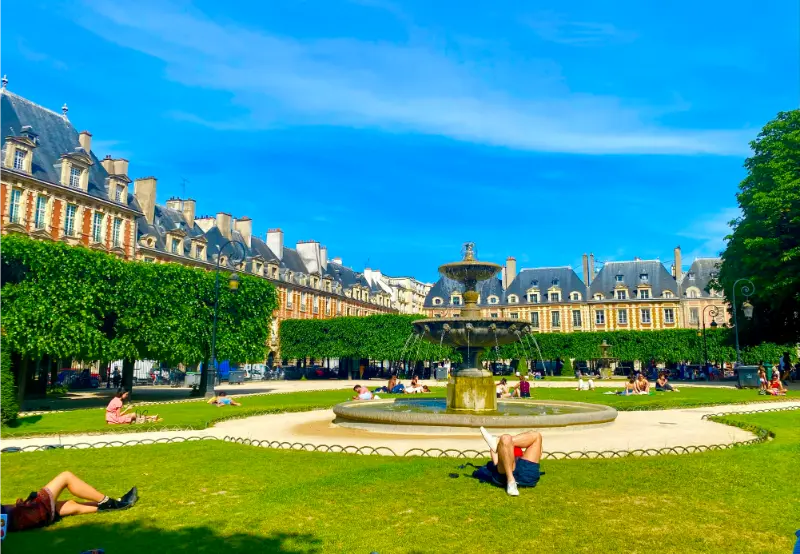
Place des Vosges works best when you stop treating it as a photograph. The square, arcades, garden and surrounding hôtels particuliers reward an hour of slow observation before you continue deeper into the Marais.
Quick planning summary
Why the square matters
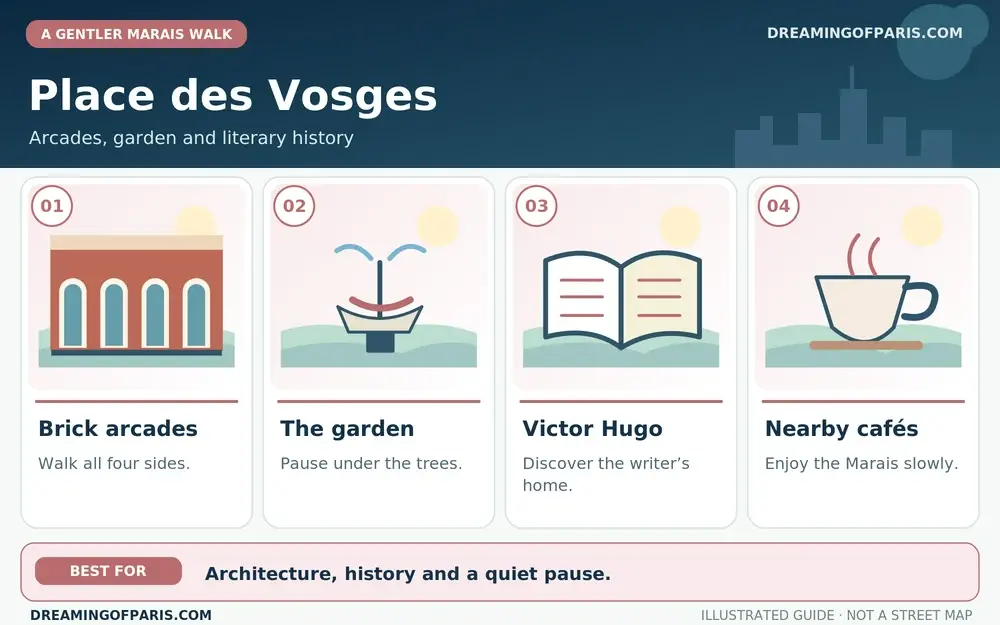
Originally known as Place Royale, Place des Vosges is one of Paris’s oldest monumental squares. Its red-brick façades, stone details, arcades and central garden create a rare sense of architectural unity. Walk all four sides before deciding which view you prefer.
The central garden
The lawn and trees turn the square from architectural set piece into neighborhood space. Sitting for fifteen minutes changes the experience: you notice residents, children, musicians and the way the arcades frame movement. In good weather it is one of the easiest places to reset during a Marais walk.
Arcades
The covered arcades are useful in rain and worth exploring slowly. Galleries, shops and cafés occupy many units, but the architectural rhythm itself is the attraction. Look toward the corners and entrances rather than only photographing the central Louis XIII statue.
Maison de Victor Hugo
Victor Hugo lived at No. 6, and the house museum provides literary context without the scale of a major museum. Permanent collections in Paris municipal museums are generally free, though temporary exhibitions can have separate ticketing. Check the current program and opening day before visiting.
How to combine with Carnavalet
Musée Carnavalet is a natural next stop because it explains the history of Paris itself. Place des Vosges gives you an outdoor architectural pause; Carnavalet provides indoor context. Together they create a stronger Marais experience than a shopping-only route.
Picasso Museum
Musée Picasso is also close, but doing both Picasso and Carnavalet plus a full neighborhood walk can become too much. Choose the museum that best matches your interests and let the square remain an unhurried break.
Jewish Marais
Rue des Rosiers and surrounding streets are nearby and add a different historical and contemporary layer. The area is more than a single food stop; synagogues, memorial history, businesses and changing community life are all part of the district’s complexity.
Best time
Early morning is calmest for architecture; late afternoon is lively and works well before dinner. Midday on weekends can be crowded. The square remains enjoyable because you can retreat under the arcades or into side streets rather than staying in the center.
Bastille connection
Exit east toward Bastille if you want to continue into the 11th arrondissement or Faubourg Saint-Antoine. This creates a useful transition from aristocratic Marais architecture to streets shaped by artisans and revolutionary history.
Photography without blocking the arcades
The corners give strong diagonal compositions, while the center emphasizes symmetry. Be mindful of residents and businesses under the arcades. A wide-angle photograph is not worth stopping pedestrian flow in a narrow passage.
How this article fits into the Dreaming of Paris cluster
For a deeper plan, continue with Le Marais, Musée Carnavalet, Musée Picasso, Bastille and Faubourg Saint-Antoine. These guides are linked because they share geography or a real planning decision, not simply because they mention Paris.
Official information
For the details most likely to change, use the Paris je t’aime Place des Vosges page. Recheck it shortly before the visit rather than relying on a screenshot saved weeks earlier.
Practical checklist before you leave the hotel
- Recheck opening hours, closures or transport work.
- Save the exact entrance or meeting point, not only the attraction name.
- Carry water and keep enough phone battery for navigation.
- Know one nearby alternative in case the main plan changes.
- Allow more time if you have luggage, children or reduced mobility.
- Avoid scheduling another major timed attraction immediately afterward.
Is Place des Vosges free?
Yes, the square and central garden are free to enter.
Is Maison de Victor Hugo free?
The permanent collections of Paris municipal museums are generally free, while temporary exhibitions can have separate fees.
How long should I spend at Place des Vosges?
Allow at least 30–45 minutes for the square itself; 60–120 minutes works better with Victor Hugo or nearby streets.
What should I combine with Place des Vosges?
Le Marais, Musée Carnavalet, Musée Picasso and Bastille are the most natural nearby additions.
Final planning advice
The best way to use this guide to Place des Vosges is to place it inside a coherent day rather than treat it as an isolated checklist item. Paris becomes easier when every reservation has a reason, every journey has a nearby second purpose and at least one part of the day remains flexible. That approach protects you from queues, weather changes and simple fatigue while leaving space for the unplanned café, street or view that often becomes the strongest memory.
How to adjust for crowds
Crowds are rarely uniform across a district. If one entrance or viewpoint is overloaded, move to the next nearby stop and return later rather than standing in a line simply because the itinerary said this was the correct moment. Early starts help at famous monuments, but late afternoon can be equally effective once day groups leave. Timed tickets solve only part of the problem; pedestrian bottlenecks, security and public transport still need margin.
Spend time under the arcades before leaving the square
Place des Vosges is often photographed from one corner and then abandoned. Walk at least one full side under the arcades. The rhythm of brick, stone and repeated arches is the architectural experience; the central garden is only one layer. From the arcades you also understand how shops, galleries and residential entrances coexist around the square.
Maison de Victor Hugo adds meaning when you are interested in the writer or nineteenth-century domestic interiors. The permanent presentation can be a compact visit, which makes it useful in a Marais day without consuming the afternoon. Check current exhibition and access information because temporary displays can affect what is visible.
Build a Marais route without zigzagging
From Place des Vosges, choose either a westward route toward Musée Carnavalet, the Jewish quarter and Hôtel de Ville, or a north/west route toward Musée Picasso. Trying to include both museums, Place des Vosges, shopping and a long lunch in a single short afternoon usually turns the Marais into a checklist.
For the history route, use Musée Carnavalet; for a broader walk, use our Le Marais guide. Early morning is best for architecture and photographs, while later in the day the square is better for sitting and people-watching.
A practical decision check for Place des Vosges and Maison de Victor Hugo
Place des Vosges works best as the calm center of a Marais route, not a destination requiring half a day. Before you give it a fixed slot, compare that reason with the strongest alternative already on your itinerary. If the alternative matters more, move this stop to an optional block instead of forcing both into the same half-day. That simple choice keeps the article useful for different travelers rather than implying that every reader needs the same Paris.
A realistic way to fit it into the day
Walk the arcades, sit in the garden, add Maison de Victor Hugo if interested, then choose one museum or one food/shopping zone for the rest of the half-day. Keep the previous and following stops close enough that a delay of twenty or thirty minutes does not create a cascade of missed reservations. Paris days become much easier when the route can absorb a longer lunch, a queue or a weather change without requiring a taxi across the city.
The trade-off worth making explicit
The trade-off is sitting time versus checklist pressure. The square becomes memorable when you actually use it, not when you photograph four corners and leave. Making that trade-off deliberately is more useful than adding another item to a checklist. Ask what you would remove if this experience takes longer than expected; if the answer is “nothing,” the day is probably already too full.
Small details that prevent avoidable problems
Maison de Victor Hugo has its own exhibition/access conditions, so check the museum page if it is the priority rather than assuming every room is always open. Save the exact address or entrance you intend to use, keep enough phone battery for the return route and recheck any time-sensitive information on the official site. These are small steps, but they protect the part of the experience that actually matters from being swallowed by logistics.
Where it belongs in the wider Paris cluster
Carnavalet creates a history-focused route; Picasso creates an art-focused route. Do not try to make both the same short afternoon. Treat that pairing as a geographic or thematic cluster, not an obligation to complete everything. One strong connection is enough to make the day coherent; two or three distant add-ons usually reduce the value of the place you came to see.
Why the square feels different early
Before shops and cafés fully animate the arcades, the symmetry of Place des Vosges is much easier to read. Later, the garden becomes more social and the arcades more active. Neither time is objectively better: early morning favors architecture and photography, while afternoon favors sitting and neighborhood atmosphere. Choose based on the role the square plays in your Marais day.