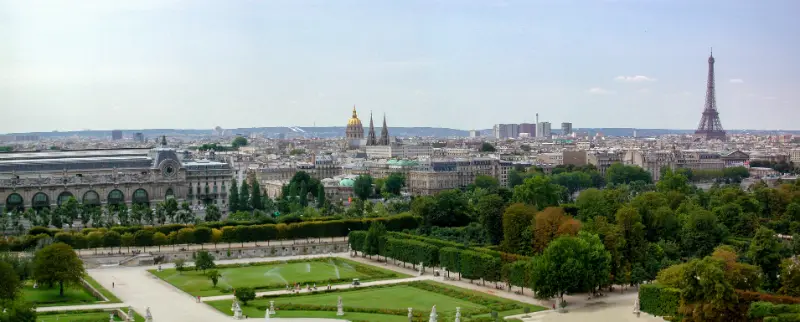
The Tuileries is more than the empty space between the Louvre and Place de la Concorde. Used well, it becomes the recovery zone that makes a museum-and-monuments day sustainable.
Quick planning summary
Seasonal opening hours
The Louvre publishes seasonal hours for the garden: in 2026 it opens longer in summer and closes earlier in winter. Entry is free year-round, but visitors are asked to leave before the official closing time. Check the current hours on the day, especially if you are planning a late-evening walk.
Why walk west after the Louvre
After two or three hours inside the Louvre, your eyes and attention need a different environment. The Tuileries provides benches, long views, trees and open sky while keeping you on the historic axis toward Concorde and the Champs-Élysées. It is a better transition than immediately descending into the Metro.
A simple east-to-west route
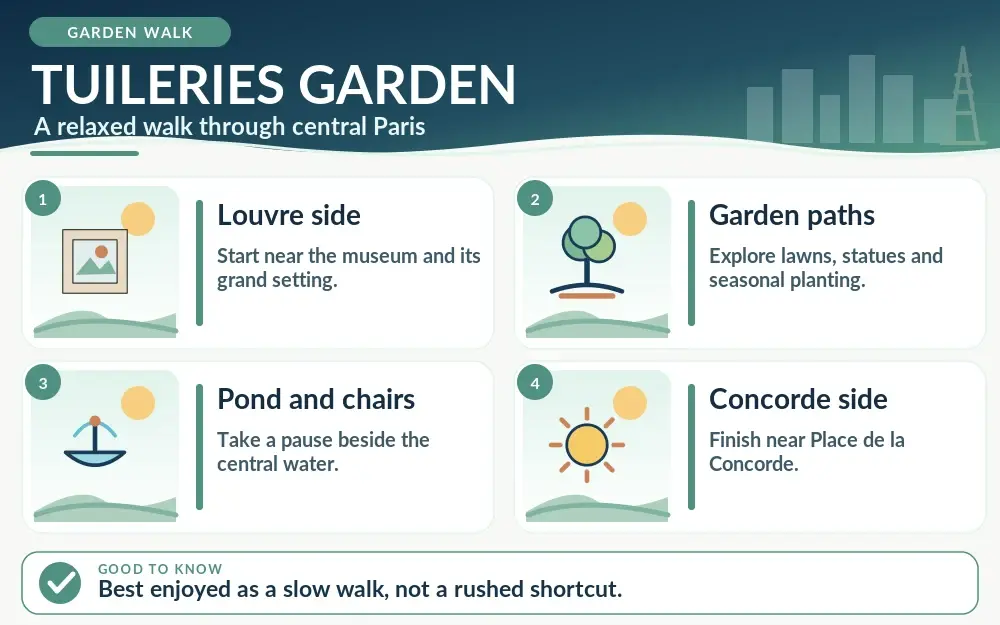
Enter from the Louvre side, pause near the large basins and move gradually west. Do not rush straight down the central path; side alleys are often calmer. Near the western end, decide whether to continue to Concorde, visit Orangerie or turn toward Rue de Rivoli.
Orangerie connection
Musée de l’Orangerie sits at the southwest corner and can be a beautiful complement to the garden, especially for Monet. But avoid stacking it immediately after an exhausting Louvre visit unless Impressionism is a priority. The smaller scale helps, but museum fatigue still applies.
Chairs, benches and real rest
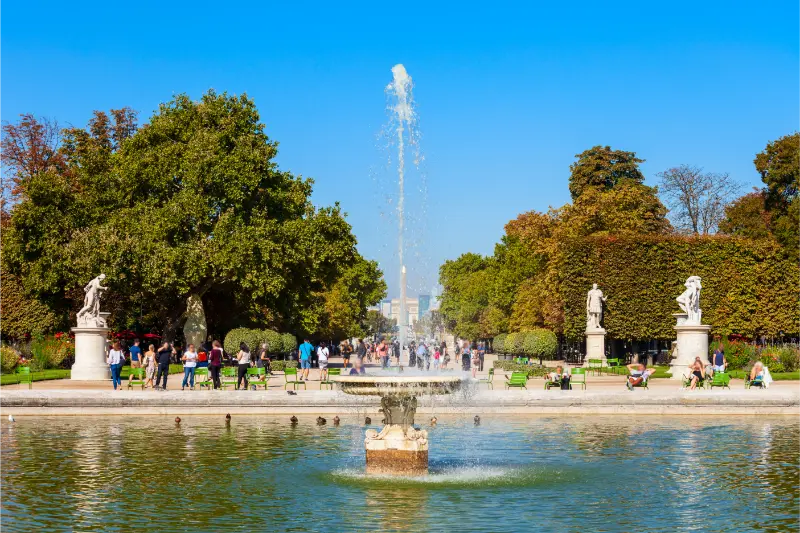
The movable chairs around basins are part of the garden’s usefulness. Build ten or fifteen minutes of sitting into the itinerary. Travelers often schedule a ‘garden visit’ as another walk, missing the fact that the most Parisian function of the space is simply to stop.
Families
The open space works well for children after museums, although the garden has designated paths, lawns and activity areas, so not every section functions as a play space. In summer, temporary attractions can change the atmosphere around parts of the garden. Keep the family plan flexible.
Toilets
The Louvre’s official information lists free public toilets within the garden, including near Place de la Concorde and Rue de Rivoli entrances. This sounds minor until you are traveling with children or moving between timed visits; it is one reason the Tuileries is a practical connector.
Morning versus late afternoon
Morning is quieter and pairs naturally with an early Louvre slot. Late afternoon gives softer light and transitions well toward Concorde or an evening walk. Midday can feel exposed in hot weather, so use shaded paths and do not underestimate summer heat.
Photography
The garden’s strongest photographs often use long sightlines—Louvre, Arc de Triomphe du Carrousel, obelisk and western axis—rather than trying to isolate one flowerbed. Move to the edges for layered views and remember that seasonal planting changes the scene.
Where to continue
From the west end, you can head to Place de la Concorde and the Champs-Élysées, cross toward Madeleine, or return along Rue de Rivoli and covered arcades. Use geography to choose the next stop rather than automatically following the avenue all the way to the Arc de Triomphe.
How this article fits into the Dreaming of Paris cluster
For a deeper plan, continue with Louvre guide, Musée de l’Orangerie, Champs-Élysées route, Paris picnic guide. These guides are linked because they share geography or a real planning decision, not simply because they mention Paris.
Official information
For the details most likely to change, use the Louvre official Tuileries Garden page. Recheck it shortly before the visit rather than relying on a screenshot saved weeks earlier.
Practical checklist before you leave the hotel
- Recheck opening hours, closures or transport work.
- Save the exact entrance or meeting point, not only the attraction name.
- Carry water and keep enough phone battery for navigation.
- Know one nearby alternative in case the main plan changes.
- Allow more time if you have luggage, children or reduced mobility.
- Avoid scheduling another major timed attraction immediately afterward.
Is the Tuileries Garden free?
Yes, access is free year-round.
What are the Tuileries opening hours?
Hours vary by season; the Louvre publishes the current schedule and asks visitors to leave before closing.
How long should I spend in the Tuileries?
About 45–90 minutes works well, longer if you want a real rest or are visiting with children.
Can I combine the Tuileries with the Louvre and Orangerie?
Yes, but consider museum fatigue. For many travelers, Louvre plus garden is enough for one half-day.
Final planning advice
The best way to use this guide to Tuileries Garden is to place it inside a coherent day rather than treat it as an isolated checklist item. Paris becomes easier when every reservation has a reason, every journey has a nearby second purpose and at least one part of the day remains flexible. That approach protects you from queues, weather changes and simple fatigue while leaving space for the unplanned café, street or view that often becomes the strongest memory.
Walk the Tuileries as a transition, not a box to tick
The Tuileries are most useful when they connect two parts of a day. After the Louvre, walking west through the garden lets your eyes and attention reset before the Orangerie, Place de la Concorde or Champs-Élysées. In the opposite direction, the garden creates a calm approach to the Louvre without arriving directly from a crowded Metro platform.
Use the chairs. The movable green chairs are part of how the garden functions, and a twenty-minute pause can be more valuable than another loop around the ponds. Families should identify toilets before children need them; visitors with limited mobility should remember that gravel surfaces can be slower than paved streets.
Season changes the best route
Opening times vary through the year, and temporary events can occupy parts of the garden. In summer, cross exposed areas earlier or later in the day and use shaded alleys during the hottest period. After heavy rain, gravel and puddles can make the shortest diagonal route less comfortable.
For art, the Musée de l’Orangerie is the natural stop at the western end. For architecture and arcades, leave the garden on the Louvre side and continue to Palais-Royal. The garden becomes more useful when it is part of one of these geographic clusters rather than an isolated attraction.
A practical decision check for Tuileries Garden
The Tuileries are most valuable as recovery space between high-intensity sights. Before you give it a fixed slot, compare that reason with the strongest alternative already on your itinerary. If the alternative matters more, move this stop to an optional block instead of forcing both into the same half-day. That simple choice keeps the article useful for different travelers rather than implying that every reader needs the same Paris.
A realistic way to fit it into the day
Walk one main axis, sit by a pond or in the chairs, add Orangerie only if booked, then continue to Concorde or return toward Palais-Royal. Keep the previous and following stops close enough that a delay of twenty or thirty minutes does not create a cascade of missed reservations. Paris days become much easier when the route can absorb a longer lunch, a queue or a weather change without requiring a taxi across the city.
The trade-off worth making explicit
The trade-off is directness versus rest. The fastest line across the garden is not necessarily the best use of a place designed for strolling. Making that trade-off deliberately is more useful than adding another item to a checklist. Ask what you would remove if this experience takes longer than expected; if the answer is “nothing,” the day is probably already too full.
Small details that prevent avoidable problems
Temporary events and seasonal opening hours can change circulation. Check the Louvre garden page when your visit falls during major installations. Save the exact address or entrance you intend to use, keep enough phone battery for the return route and recheck any time-sensitive information on the official site. These are small steps, but they protect the part of the experience that actually matters from being swallowed by logistics.
Where it belongs in the wider Paris cluster
Louvre + Tuileries + Orangerie is a natural cluster; Palais-Royal is the best architectural detour on the east side. Treat that pairing as a geographic or thematic cluster, not an obligation to complete everything. One strong connection is enough to make the day coherent; two or three distant add-ons usually reduce the value of the place you came to see.
Do not overlook the west end
The Orangerie, terraces near Concorde and the transition toward the Champs-Élysées gardens make the western Tuileries more than the final stretch after the Louvre. If you are tired, this is where you can end the walk without continuing up the avenue. A garden route is successful when it gives you permission to stop, not when it forces another kilometer because the map continues.