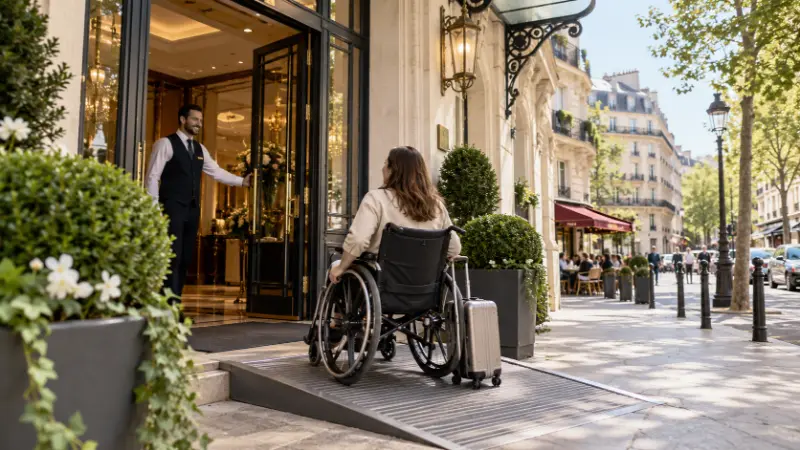
Accessibility in Paris is uneven. Many museums, buses, trams and newer infrastructure work well, while the historic Metro remains a major constraint for independent wheelchair travel.
Quick planning summary
Start with the transport reality
RATP states that accessibility differs sharply by mode. Tramways and most Paris buses are broadly accessible, and many RER A and B stations can be used with appropriate facilities. The historic Metro is much more limited; line 14 is the key fully accessible line for independent travel.
Do not plan from the Metro map alone
A route that looks simple on a standard map may fail because the station lacks a lift, the accessible entrance is on another street or equipment is temporarily unavailable. Use official accessibility tools for the exact origin and destination and keep a bus or taxi alternative.
Buses can be more useful than visitors expect
Because surface buses avoid stairs and provide city views, they can be a practical backbone for wheelchair users. Traffic can slow them, so leave margins for timed tickets. Check stop accessibility and service disruptions before relying on one exact bus connection.
RER and airport arrivals
Parts of the RER network are accessible, but assistance procedures and lift status matter. Airport transfers should be planned in advance, particularly with luggage. A regulated accessible taxi or prearranged service can be worth the cost if the public-transport chain contains uncertain links.
Museums and monuments
Major institutions have accessibility information, lifts and adapted services, but historic monuments vary. Even when a site is technically accessible, the visitor route may differ from the standard route and some levels may remain unavailable. Read the venue’s accessibility page rather than relying on a generic attraction listing.
Historic streets
Cobblestones, narrow pavements and slopes can create more fatigue than map distance suggests. Montmartre is the obvious example, but old streets throughout the center can be uneven. Build shorter days, identify accessible cafés and toilets, and use transport to avoid unnecessary gradients.
Hotels
Ask precise questions: step-free street entrance, lift dimensions, bathroom layout, bed height and whether the accessible room shown online is guaranteed. ‘Accessible’ is too broad a word to rely on. Request written confirmation for the features you need.
Compare hotels for your stay in Paris
Check current availability, location and prices before choosing the exact neighborhood.
Check Paris hotels on Booking.com
Affiliate link: we may earn a commission at no extra cost to you.
Public toilets and practical services
Paris tourism resources include information on adapted toilets and practical services. Save relevant maps before going out. This is especially useful when a long garden or riverside route has fewer indoor alternatives than a museum district.
Sensory and cognitive accessibility
Accessibility is not only mobility. Some institutions offer tactile materials, sign-language interpretation, audio description, quiet visits or adapted tours. Check current programming because availability can depend on dates and reservations.
Build geographic days
Accessibility improves when each day stays within one area. A Louvre/Tuileries day, a Marais day and a modern western-Paris day reduce transfers and give you more fallback options. Keep one flexible block in case a lift outage or weather forces a route change.
How this article fits into the Dreaming of Paris cluster
For a deeper plan, continue with Paris public transport, Louvre, Petit Palais, where to stay. These guides are linked because they share geography or a real planning decision, not simply because they mention Paris.
Official information
For the details most likely to change, use the Paris je t’aime accessibility portal. Recheck it shortly before the visit rather than relying on a screenshot saved weeks earlier.
Practical checklist before you leave the hotel
- Recheck opening hours, closures or transport work.
- Save the exact entrance or meeting point, not only the attraction name.
- Carry water and keep enough phone battery for navigation.
- Know one nearby alternative in case the main plan changes.
- Allow more time if you have luggage, children or reduced mobility.
- Avoid scheduling another major timed attraction immediately afterward.
Is the Paris Metro wheelchair accessible?
Only a limited part of the network is independently wheelchair accessible; RATP identifies line 14 as the key fully accessible Metro line and recommends checking each route.
Are Paris buses accessible?
Most buses in Paris and the inner suburbs are broadly wheelchair accessible, but check the exact stop and service.
Are major museums accessible?
Many are, but routes and accessible areas vary. Always read the venue’s current accessibility information.
Where can I find official accessibility information?
Use Paris je t’aime’s disability portal and RATP accessibility tools for current transport and visitor information.
Final planning advice
The best way to use this guide to accessible Paris is to place it inside a coherent day rather than treat it as an isolated checklist item. Paris becomes easier when every reservation has a reason, every journey has a nearby second purpose and at least one part of the day remains flexible. That approach protects you from queues, weather changes and simple fatigue while leaving space for the unplanned café, street or view that often becomes the strongest memory.
Build accessible days from verified stations and entrances
Accessibility in Paris cannot be inferred from a Metro map. RATP states that the historic Metro remains only partially accessible and that line 14 is the line currently accessible for independent wheelchair travel throughout its stations. Paris buses and trams are substantially more accessible, while RER accessibility depends on station facilities and the journey. Check the exact origin and destination shortly before travel because lifts can be temporarily out of service.
For museums, “accessible” can still mean a different entrance, lift route or need to speak with staff. Read the venue’s accessibility page before arrival and save the entrance address rather than only the monument name. Historic churches, cemeteries and cobbled streets often require more detailed planning than modern museums.
Allow extra time without turning the trip into a medical schedule
Accessible planning works best when each day is geographically compact. A bus may be more useful than a technically faster Metro route if stairs make the latter impractical. Build one or two dependable indoor stops around an accessible route, then add optional nearby sights rather than scheduling four fixed tickets.
Travelers with sensory, hearing, visual or cognitive accessibility needs should also check venue-specific adapted tours, quiet times, tactile resources or easy-to-read materials where available. The RATP accessibility pages provide disability-specific travel guidance. Because equipment status changes, current official information should always take priority over any static article—including this one.
A practical decision check for Accessible Paris
Accessible Paris planning must be route-specific: a venue can be accessible while the journey to it is not. Before you give it a fixed slot, compare that reason with the strongest alternative already on your itinerary. If the alternative matters more, move this stop to an optional block instead of forcing both into the same half-day. That simple choice keeps the article useful for different travelers rather than implying that every reader needs the same Paris.
A realistic way to fit it into the day
Choose an accessible transport spine, confirm lift/entrance status, build two nearby attractions around it and keep a bus or taxi backup. Keep the previous and following stops close enough that a delay of twenty or thirty minutes does not create a cascade of missed reservations. Paris days become much easier when the route can absorb a longer lunch, a queue or a weather change without requiring a taxi across the city.
The trade-off worth making explicit
The trade-off is theoretical speed versus reliable access. A direct bus can be a better choice than a Metro route that requires stairs or an uncertain lift. Making that trade-off deliberately is more useful than adding another item to a checklist. Ask what you would remove if this experience takes longer than expected; if the answer is “nothing,” the day is probably already too full.
Small details that prevent avoidable problems
Save disability-specific venue information and contact details before the day. Temporary lift outages can change a route even when the station is normally accessible. Save the exact address or entrance you intend to use, keep enough phone battery for the return route and recheck any time-sensitive information on the official site. These are small steps, but they protect the part of the experience that actually matters from being swallowed by logistics.
Where it belongs in the wider Paris cluster
Line 14, accessible RER stations, buses and trams form the core transport toolkit; historic streets and older monuments need venue-by-venue checks. Treat that pairing as a geographic or thematic cluster, not an obligation to complete everything. One strong connection is enough to make the day coherent; two or three distant add-ons usually reduce the value of the place you came to see.
Hotel accessibility needs its own verification
A hotel that advertises an accessible room may have several room types, entrance configurations or bathroom layouts. Contact the property with the exact requirements that matter to you—step-free entrance, roll-in shower, bed clearance, lift dimensions or proximity to accessible transport—and keep the confirmation. A generic accessibility icon cannot replace a conversation about the features you personally need.
Planning for an older traveler
Accessibility and age are not the same thing, but pacing, stairs and transport can overlap. Our Paris for senior travelers guide focuses on comfort, seating, museums, buses, taxis and realistic day planning.