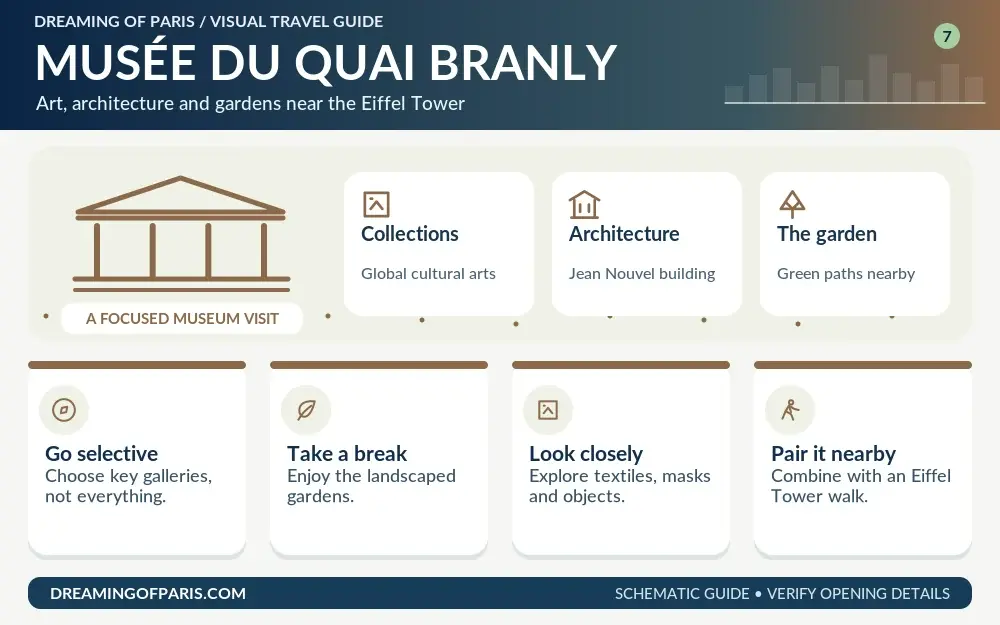
Musée du quai Branly – Jacques Chirac is the museum to choose when you want a major Paris collection that does not repeat the Louvre or Orsay. Its permanent display brings together arts and cultural objects from Africa, Asia, Oceania and the Americas, while the building and garden create an experience that feels deliberately separate from the monumental axis nearby. The museum currently describes the permanent plateau as presenting around 3,500 works.
Its location is deceptively convenient: a short walk from the Eiffel Tower, yet the museum deserves more than being treated as a rainy-day add-on. If you are already planning the 7th arrondissement, combine this guide with our 7th arrondissement guide and Trocadéro route. A focused two- to three-hour visit works well; trying to absorb every object usually does not.
Check tickets and Paris experiences
Compare current tours, timed-entry tickets and experiences before fixing your itinerary.
GetYourGuideTiqetsCivitatisViatorAffiliate links: we may earn a commission at no extra cost to you.
This guide contains affiliate links. If you book through them, Dreaming of Paris may earn a commission at no extra cost to you.
What makes the museum different from Paris’s big art museums
The Quai Branly is organized around cultural regions and objects rather than a conventional European fine-art chronology. That changes how you should visit. You are not moving from Renaissance to Impressionism; you are encountering masks, sculpture, textiles, ritual objects, architectural elements and everyday forms from very different societies and periods.
The collection is also inseparable from questions of collecting history, colonialism, classification and representation. Read the labels and temporary interpretation rather than treating objects only as beautiful forms. The most rewarding visit is one where you give a few sections enough time to understand context instead of racing across continents to say you saw everything.
A realistic route for a first visit
Start by accepting that the permanent plateau is large. Pick two or three geographic areas that genuinely interest you, then allow the route to expand only if your attention remains strong. This is the opposite of a checklist museum. The low light, dense displays and long curving path can be immersive, but they can also create fatigue if you never stop.
I would spend the first hour moving slowly through one major section, take a break, then choose a second area. Leave time for the garden and building itself. If you are visiting with someone whose interests differ from yours, agree on a meeting point rather than forcing both people to follow the same sequence for three hours.
Current 2026 opening hours and prices
At the time of this September 2026 update, the museum is open Tuesday, Wednesday, Friday, Saturday and Sunday from 10:30 a.m. to 7 p.m., and Thursday from 10:30 a.m. to 10 p.m.. Monday is the normal closing day, with some special Monday openings during shorter school holidays. It closes on May 1 and December 25, with earlier closing on December 24 and 31.
The current full-price museum ticket is €14 and the reduced rate is €11, covering the permanent collections and temporary exhibitions under the museum’s current ticket structure. The first Sunday of each month is free for everyone, but the museum states that timed tickets are still required. These details can change, so use the official site before fixing your day.
The garden and Jean Nouvel building are part of the visit
Even visitors who come for the collection should leave time for the transition from the street into the museum. The building by Jean Nouvel is raised above a landscaped garden, creating a buffer between Quai Branly traffic and the exhibition spaces. The architecture intentionally changes your sense of pace before you reach the collection plateau.
This makes the museum unusually easy to combine with an outdoor break. Do not schedule an Eiffel Tower slot five minutes after your estimated museum finish. Give yourself time to come back into daylight, walk through the garden and decide whether you still have energy for another major attraction.
How long should you spend?
For most first-time visitors, two to three hours is enough to make the museum worthwhile without turning the day into endurance. A specialist could spend much longer, especially with a temporary exhibition. Families may prefer ninety minutes plus the garden. The Thursday late opening is useful for travelers who want to keep daylight for the Seine or Eiffel Tower and move the museum into the evening.
If you tend to experience museum fatigue, use the same strategy described in our Musée d’Orsay focused route: decide what you most want to understand before entering, rather than trying to justify the ticket by seeing every gallery.
Pairing the museum with the Eiffel Tower and western Paris
The obvious combination is the Eiffel Tower, but sequence matters. If you have a timed tower ticket, build the museum around it rather than assuming both will run exactly to schedule. Our Eiffel Tower guide explains ticket and viewpoint choices. You can also pair the museum with Trocadéro, a Seine walk or Invalides if you prefer a cultural day without climbing the tower.
There is also a current combined ticket option with the Musée Rodin listed by the Quai Branly at €23, valid under its stated conditions. If both museums are priorities, compare that against separate admission and read our Musée Rodin guide before buying. Pricing can change, so verify the offer on the official rates page.
Families and accessibility
The museum publishes family guides and programming, and the variety of objects can work well with older children when you choose a short route. Younger children may respond better to a focused theme than a long cultural survey. The garden gives you a useful reset before or after the galleries.
For visitors with disabilities, the museum currently provides free admission for the visitor and one accompanying person with proof, plus accessibility resources. It recommends the entrance at 222 rue de l’Université for people with reduced mobility or requiring specific arrangements. The museum also notes that Pont de l’Alma RER C station did not yet have a lift at the time of its current accessibility guidance, with works underway, so check transport status close to your visit.
What I would not do
- Do not treat it as a 45-minute gap filler between Eiffel Tower reservations.
- Do not attempt every display case; depth beats coverage here.
- Do not assume Monday opening without checking the specific date.
- Do not rely on an old free-entry rule; verify eligibility and timed-ticket requirements.
- Do not carry bulky luggage; the museum restricts large bags and suitcases.
- Do not skip contextual labels; interpretation is essential to understanding what you are seeing.
The museum is strongest when it changes the kind of cultural experience you are having in Paris. If you have already spent hours with European painting, this can be a genuinely different next museum rather than “another collection.”
Compare bookable experiences nearby
If you want to add a guided visit, Eiffel Tower experience or another ticketed activity, compare live availability rather than relying on an old static price. Check the exact meeting point, cancellation terms and what admission is included before paying.
Official information to check before your trip
Check the official Musée du quai Branly practical information page for opening times and access, and the official rates page for current prices, reductions and free-entry conditions. The practical details above were verified against those pages for September 2026.
The Musée du Quai Branly is worth prioritizing for travelers interested in world cultures, anthropology, material culture, design and the history of collecting. It is less suitable for someone who only has one museum slot and primarily wants canonical European masterpieces; that traveler should probably choose the Louvre or Orsay first.
Give it two or three focused hours, use the garden as a buffer, and pair it with the Eiffel Tower only if you leave enough breathing room between reservations. The combination works because the two places offer completely different experiences within the same part of Paris.
A final way to fit this museum into your Paris itinerary
Do not judge the visit only by the number of galleries or the ticket price. Think about what comes immediately before and after it. A museum is more rewarding when you arrive with enough attention to read, look and pause, rather than after a three-hour walking tour or immediately before another timed attraction across the city.
Build in a short buffer after the visit. That gives you time for the shop, a garden or café break, and protects the next reservation if security, queues or an exhibition hold your attention longer than expected. In Paris, the most exhausting museum days usually fail because of over-scheduling rather than because one museum is inherently too large.
If you are deciding between this venue and another museum, choose by collection and mood rather than by reputation alone. A focused two-hour visit that matches your interests is usually better than forcing yourself through a more famous institution simply because it appears on every first-time checklist.
Before finalizing the plan, save the exact address, nearest transport entrance and cancellation deadline in the same trip note as your reservations. That small step makes it much easier to compare alternatives rationally and prevents a good booking from becoming inconvenient because one practical detail was overlooked. Recheck the plan a few days before travel as well: opening conditions, construction, transport works and neighborhood events can change the practical value of a location even when the address itself has not changed. A quick verification protects the time you have already invested in planning.