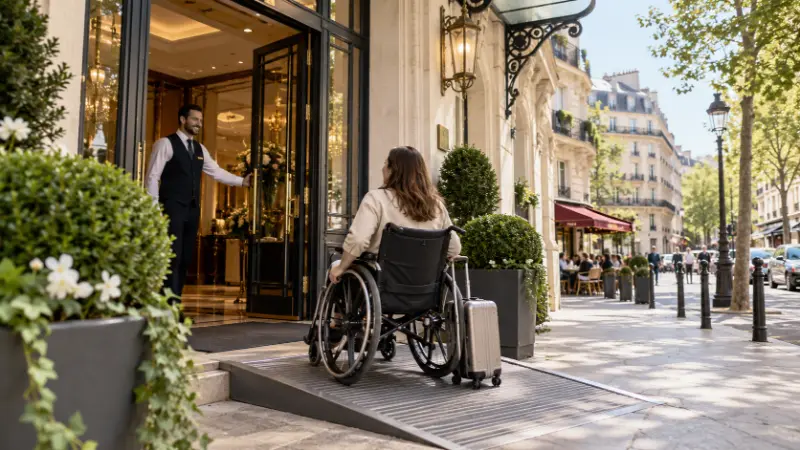
Accessibility in Paris has to be planned at the level of the exact hotel entrance, room and transport route. A listing marked “accessible” does not tell you whether the shower is roll-in, whether the lift reaches every floor, whether there is a step at reception or whether the nearest Metro station has a lift. The safest approach is to choose a workable area first, then verify the property with specific questions in writing.
Compare hotels for your stay in Paris
Check current availability, location and prices before choosing the exact neighborhood.
Check Paris hotels on Booking.comAffiliate link: we may earn a commission at no extra cost to you.
This guide complements our detailed accessible Paris travel guide. It does not attempt to certify individual hotels. Accessibility features can change and needs differ. Instead, it explains which areas tend to simplify sightseeing and what information to request before you commit to a room.
This guide contains affiliate links. If you book through them, Dreaming of Paris may earn a commission at no extra cost to you.
Start with surface transport and direct routes, not only “central” location
For many travelers with reduced mobility, a slightly less central hotel beside a useful bus or accessible rail connection is easier than a historic-center property surrounded by steps, narrow pavements and inaccessible Metro stations. Paris buses have become a crucial part of accessible travel, and modern rail infrastructure can be easier than older Metro sections. The best base depends on the specific journeys you expect to repeat.
Use our transport guide as an overview, then verify step-free status with Île-de-France Mobilités close to travel. Station works, lift outages and accessibility arrangements can change, so a hotel description written months earlier should never be your only source.
The 12th: a practical base for modern transport and flatter routes
The 12th can work well because parts of the district have broad pavements, newer developments and strong transport around Gare de Lyon and Bercy. It also offers parks and the Coulée Verte, although access points to elevated sections vary. The 12th arrondissement guide gives the neighborhood context.
For a wheelchair user or traveler who tires easily, staying near a transport hub can reduce transfers. The station itself is large, so do not judge convenience only by map distance; check the accessible entrance and route from platform to street. A hotel two blocks from the correct entrance can be easier than one technically closer on the wrong side.
The 13th: modern streets and Line 14 can simplify some itineraries
The 13th around Bibliothèque François-Mitterrand and newer Seine-side development offers wider streets and more recent buildings than many historic districts. Line 14 is particularly useful for step-free travel across several important hubs. See the 13th arrondissement guide for how the modern riverfront differs from Butte-aux-Cailles and older streets.
The trade-off is distance from some classic attractions. If your plan includes several days around the Louvre, Marais and western Paris, calculate the repeated journey. For travelers who value modern building access, larger rooms and direct transport, the 13th can still be a very strong compromise.
The 15th: residential services and a wider choice of larger rooms
The 15th is worth checking because it has many newer or renovated hotels and aparthotels, everyday shops, pharmacies and quieter streets. The 15th arrondissement guide helps narrow a very large arrondissement to the sectors that match your transport needs.
Do not assume residential automatically means accessible. Some Metro stations in the area still involve stairs and older hotel buildings can have threshold problems. The advantage is choice: you may find larger rooms and bathrooms than in the 5th or Marais at the same price, which can be important when maneuvering space matters.
Central historic areas: excellent proximity, inconsistent buildings
The 1st, 4th, 5th and 6th can reduce the distance to major sights, but historic building stock creates variability. A hotel may advertise a lift but still have a step at the front door, a narrow lift cabin or a short staircase between levels. Cobblestones and crowded pavements can add fatigue.
Central proximity can still be valuable, especially if you plan to use taxis or buses rather than the Metro. The 1st arrondissement guide and 4th arrondissement guide show how much sightseeing can be clustered within a small area. The key is verifying the hotel rather than rejecting the neighborhood.
Questions to ask the hotel before booking
- Is there step-free access from pavement to reception and from reception to the room?
- What are the lift-door and cabin dimensions?
- What is the narrowest door width on the route to the room and bathroom?
- Is the shower truly roll-in, and are grab rails fixed in the required positions?
- What is the bed height and is there clear space beside the bed?
- Is the accessible room guaranteed by room type, or only requested after booking?
- Can the hotel provide photos of the entrance, bathroom and route to the room?
- What happens if the lift is out of service?
Ask only the questions that matter to your needs, but ask them specifically. “Wheelchair accessible?” is too broad to protect you from a room that technically meets one criterion but fails another essential one.
Use official accessibility labels and directories carefully
The Paris tourist office maintains accessibility information and points users toward properties with documented features, including establishments holding the French Tourisme & Handicap label. This is more useful than relying only on a booking-platform checkbox. Even then, the tourist office itself advises contacting accommodation directly for the most current and accurate information.
A label or directory entry can narrow the search, but personal requirements are specific. Someone who walks with a cane, someone using a manual wheelchair and someone using a large powered chair may need very different room and transport conditions.
Plan the hotel around the hardest day, not the easiest one
Look at the day with the most demanding transport: airport arrival with luggage, a major museum with a timed ticket, Versailles, or an evening return after a show. If the hotel makes that day manageable, ordinary sightseeing days are usually easier. Also plan rest points and avoid stacking attractions simply because they look close on a map.
Our advance-booking guide can help identify which visits need fixed times. When mobility is limited, fewer fixed bookings usually create a more resilient itinerary if a lift outage or fatigue changes the day.
Compare accommodation before you commit
Hotel prices in Paris move sharply with exhibitions, school holidays, fashion events and major weekends. Use Booking.com to compare current room inventory, but compare the exact street, nearest station, cancellation terms, room size and air-conditioning rather than ranking properties only by headline price. A cheaper room that adds two awkward changes to every journey is not always the cheaper trip.
Official information to check before your trip
The official Paris je t’aime accessibility accommodation page was updated in June 2026 and explicitly recommends contacting accommodation directly for the most up-to-date accessibility information. Use it together with current transport accessibility information from Île-de-France Mobilités.
There is no universally “most accessible arrondissement.” The best base combines a verified room, a step-free entrance, a reliable transport plan and the sights you personally care about. The 12th, 13th and 15th can be practical, while central districts can still work very well when the exact hotel has suitable access.
Book only after the property answers the questions that matter to you, and keep those answers in writing. Accessibility is too important to leave to a generic icon on a booking page.
One final planning check before you book
Open the map and trace the three journeys you are most likely to repeat: the first morning, the longest sightseeing day and the return after dinner. Then check the route from the station or bus stop to the hotel door, not only the station name. Paris blocks, hills, large intersections and station exits can make a short map distance feel very different with luggage or after a long day.
Compare the flexible rate with the cheapest non-refundable rate. If the saving is small, flexibility is often worth more than the discount because train times, flights, family plans and event dates can move. A good accommodation decision should still look good after the itinerary changes once or twice; that resilience is part of value, not an optional luxury.
Also check the most recent reviews for issues that are difficult to judge from official photographs: street noise after midnight, lift reliability, room temperature, construction nearby and how staff handle luggage before check-in. Look for repeated patterns rather than one angry review. When three or four recent guests mention the same practical problem, treat it as useful evidence and decide whether that compromise matters to your trip.
Finally, remember that Paris hotel pricing is highly date-sensitive. A neighborhood that looks expensive for one weekend may be competitive a week later, and the opposite can happen during trade fairs, fashion events, concerts or school holidays. Compare the same dates across several districts before deciding that one area is categorically outside your budget.
Before finalizing the plan, save the exact address, nearest transport entrance and cancellation deadline in the same trip note as your reservations. That small step makes it much easier to compare alternatives rationally and prevents a good booking from becoming inconvenient because one practical detail was overlooked. Recheck the plan a few days before travel as well: opening conditions, construction, transport works and neighborhood events can change the practical value of a location even when the address itself has not changed. A quick verification protects the time you have already invested in planning.