Disclosure: This article contains affiliate links or booking widgets. If you book through them, Dreaming of Paris may earn a commission at no extra cost to you. How our affiliate links work.
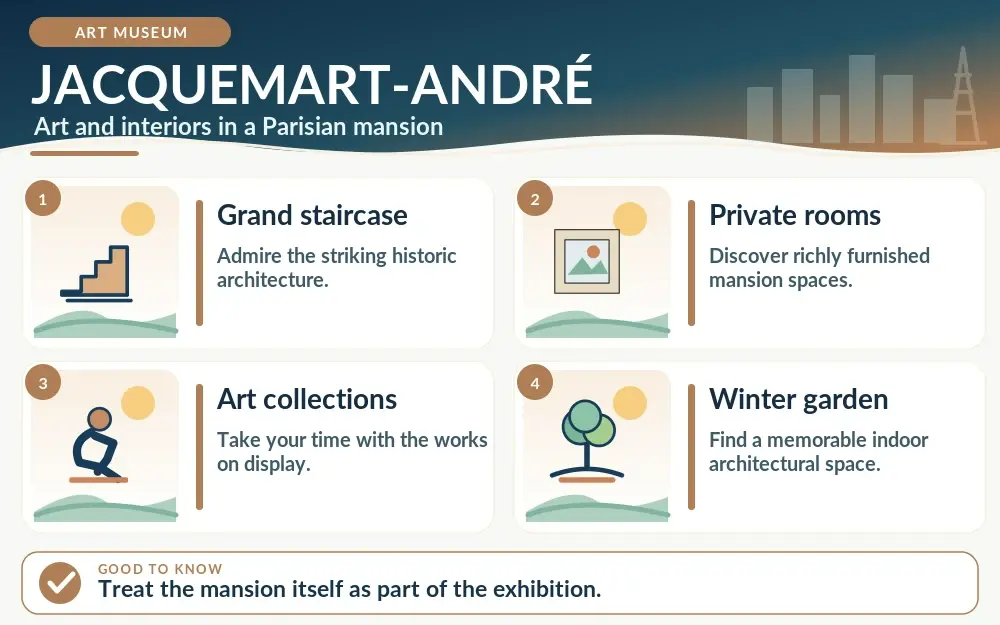
Musée Jacquemart-André is most rewarding when you stop thinking of it as a small art museum and start treating the house itself as part of the collection. Édouard André and Nélie Jacquemart built a private world around collecting, receiving guests and displaying art; the staircases, salons, winter garden and room sequence explain as much about late-19th-century elite Paris as the paintings do.
Check tickets and Paris experiences
Compare current tours, timed-entry tickets and experiences before fixing your itinerary.
GetYourGuideTiqetsCivitatisViatorAffiliate links: we may earn a commission at no extra cost to you.
That is why it pairs so well with Parc Monceau and the surrounding mansion district. You are not making a random museum stop—you are seeing the inside of the social world suggested by the façades outside.
2026 hours and ticket reality
| Day | Hours |
|---|---|
| Monday–Thursday | 10:00–18:00 |
| Friday | 10:00–22:00 |
| Saturday–Sunday | 10:00–19:00 |
| Last admission | 30 minutes before closing |
| Autumn 2026 exhibition ticket | Full rate €19 for permanent collections + Tintoretto exhibition |
The museum’s price often reflects the temporary exhibition running with the permanent rooms. In autumn 2026, the “Timeless Tintoretto” exhibition runs from 11 September 2026 to 24 January 2027 and the full combined admission is €19. That means an old blog post quoting a generic permanent-collection price may be useless for your date.
Start with the mansion, not the masterpieces
The central stair architecture and ceremonial rooms establish how the house worked. Look at sightlines: spaces were designed to impress guests and move them through a sequence of reception rooms. The winter garden and double staircase are not decorative background for selfies; they are part of a carefully staged domestic theater.
Only after understanding that should you move into the more concentrated art displays. The Italian collection is one of the museum’s defining strengths, but the experience is richer when you remember these works were assembled for a private home rather than a state museum.
A focused 90-minute route
- 20 minutes: entrance sequence, grand salons, stair and winter garden.
- 30 minutes: concentrate on the Italian collection and a few works you actually study.
- 25 minutes: temporary exhibition if one is included in your ticket.
- 15 minutes: return to one favorite room or use the café rather than forcing another entire museum afterward.
Friday evening is a real planning advantage
Friday opening until 22:00 can solve a common Paris problem: major daytime hours are already occupied by Louvre, Versailles or neighborhood walks. A 19:00 Jacquemart-André visit gives you a high-quality cultural evening without using the same time block as the big state museums. It also fits naturally into our Paris at night strategy for travelers who prefer culture to clubs.
The café is part of the appeal—but do not assume instant seating
Le Nélie, the museum’s restaurant/tea room, operates on broad hours aligned with the museum and is known for using the mansion setting as part of the experience. Treat it as a meal or pastry stop you actually want, not an obligatory add-on. On weekends and exhibition peaks it can be busy, so do not build a tight train or timed-ticket connection immediately afterward.
Practical restrictions people miss
The museum states that wheelchairs are accommodated, but buggies are not permitted inside and can be left at the cloakroom. Suitcases are not allowed. That is important for families arriving after hotel checkout or travelers tempted to combine the museum with a station transfer. Use a proper luggage-storage plan instead.
Best pairing: Parc Monceau, not three more museums
Walk Parc Monceau before a 10:00 museum opening or afterward while there is daylight. The garden’s 18th-century follies and the wealthy 19th-century neighborhood create context for the house. If you still want more art, the Petit Palais offers a very different public-museum experience and free permanent collections.
Who should prioritize Jacquemart-André
- Travelers who like historic interiors as much as paintings.
- Repeat visitors who already know the Louvre and Orsay.
- Architecture and decorative-arts travelers interested in the private mansion culture of the 8th arrondissement.
- Visitors who need a strong Friday-evening museum option.
Who may prefer another museum
If your priority is Impressionism, Musée d’Orsay or Marmottan Monet is more direct. If you want a free collection and grand Beaux-Arts architecture, Petit Palais is a better fit. Jacquemart-André wins on intimacy, domestic setting and the relationship between collecting and social life.
Official information
Official hours and access and current rates.
Bottom line
Jacquemart-André is not “a smaller Louvre.” It is a house-museum where architecture, collecting and social ambition belong together. Give it 90 unhurried minutes, pair it with Parc Monceau, and use the Friday late opening if your daytime itinerary is already full. That is a more distinctive Paris experience than adding another giant museum simply because it is famous.
Frequently asked questions
Is the museum good if I do not know much about art?
Yes, because the mansion itself provides a clear narrative about collecting and elite domestic life.
Can I take a stroller inside?
The museum states that buggies are not permitted inside and can be left in the cloakroom.
What is the best day for a late visit?
Friday, when the museum currently stays open until 22:00.
How to use the temporary exhibition without losing the house
Temporary exhibitions can attract the biggest crowd and absorb most of your attention. Visit at least the main mansion sequence first, then enter the exhibition. If you reverse that order, fatigue can turn the permanent rooms into a hurried exit route—even though they are the part that makes Jacquemart-André unique among Paris museums.
Why the house matters as much as the paintings
Édouard André and Nélie Jacquemart assembled the collection inside a purpose-built private mansion, so the museum is fundamentally about the relationship between collecting, architecture and social display. Treat the grand staircase, reception rooms and domestic circulation as exhibits. If you rush directly to individual paintings, you miss the question the museum answers better than the Louvre: what did elite private collecting look like when the house itself was part of the performance?
A room strategy that prevents “beautiful-room blur”
On the first pass, look at architecture and function: where would guests arrive, circulate, dine and be impressed? On the second, choose five works rather than twenty. Finally, use the Italian Museum spaces to see how Jacquemart’s collecting interests extended beyond French salon display. This layered method takes roughly 90 minutes and produces more memory than photographing every gilded ceiling.
2026 practical schedule: the late Friday option is genuinely useful
The museum’s current schedule is Monday–Thursday 10:00–18:00, Friday 10:00–22:00, and Saturday–Sunday 10:00–19:00, with last admission 30 minutes before closing. A Friday evening visit is therefore not just a marketing “late night”: it can free an entire daylight museum slot and pair naturally with dinner in the 8th or 9th arrondissement.
Autumn 2026: Tintoretto changes crowd patterns
From 11 September 2026 to 24 January 2027, the museum is presenting a Tintoretto exhibition. Temporary exhibitions can draw visitors who would not otherwise come for the permanent mansion, so book with more care during the opening weeks and weekends. The current combined full-price ticket is listed at €19; always check the live ticket page for concessions and exhibition-specific conditions.
The café: use it as part of the visit, not an obligation
The museum café is famous because it occupies one of the mansion’s decorative spaces, but that also means demand can peak around lunch and weekend tea time. If the room is important to you, arrive early and ask about current service arrangements. If food quality or speed matters more than setting, there are many alternatives around Boulevard Haussmann; do not let a café queue distort a museum visit you were enjoying.
Strollers, luggage and accessibility are unusually important here
The museum’s practical information states that strollers are not permitted inside and that suitcases are not accepted. That is not a minor footnote for families or travelers between hotel check-in and departure. Plan luggage storage elsewhere and use a carrier if visiting with a baby. The museum itself provides wheelchair-access information, but historic-house circulation can still require staff routing, so mention access needs on arrival.
A useful comparison: Jacquemart-André vs Musée Nissim de Camondo
Both help you understand elite domestic interiors, but they tell different collecting stories and operate under different museum systems. Jacquemart-André is stronger when you want art plus the spectacle of a collector’s mansion and a major temporary exhibition. If your trip has room for only one private-house museum, decide from the collection and current exhibition rather than assuming “small Paris mansion museum” is one interchangeable category.
A half-day built around the museum
Start with Parc Monceau around 9:00, walk through the surrounding mansion streets, then take a late-morning Jacquemart-André slot. Afterward continue toward Boulevard Haussmann and the Palais Garnier or department-store district. This route connects park, private mansion and grand commercial/operatic Paris without unnecessary Metro zigzags.
When to skip it
Skip Jacquemart-André on a first two-day trip if the Louvre and Orsay are still personal priorities. Choose it when you want a quieter scale, a specific temporary exhibition, decorative arts, or the experience of a collection inside its original social setting. The museum is valuable because it is specific—not because every visitor must tick it off.