
Disclosure: This article contains affiliate links or booking widgets. If you book through them, Dreaming of Paris may earn a commission at no extra cost to you. How our affiliate links work.
A week in Paris is the point at which you can stop treating the city like an airport connection between famous monuments. Seven days gives you enough time to see the major first-time sights, but also to understand how different the Marais, Montmartre, the Latin Quarter, the 11th arrondissement and eastern Paris feel.
Book the practical parts of your Paris trip
Compare accommodation first, then check tickets and experiences for the fixed parts of your itinerary.
Check Paris hotelsGetYourGuideTiqetsCivitatisAffiliate links: we may earn a commission at no extra cost to you.
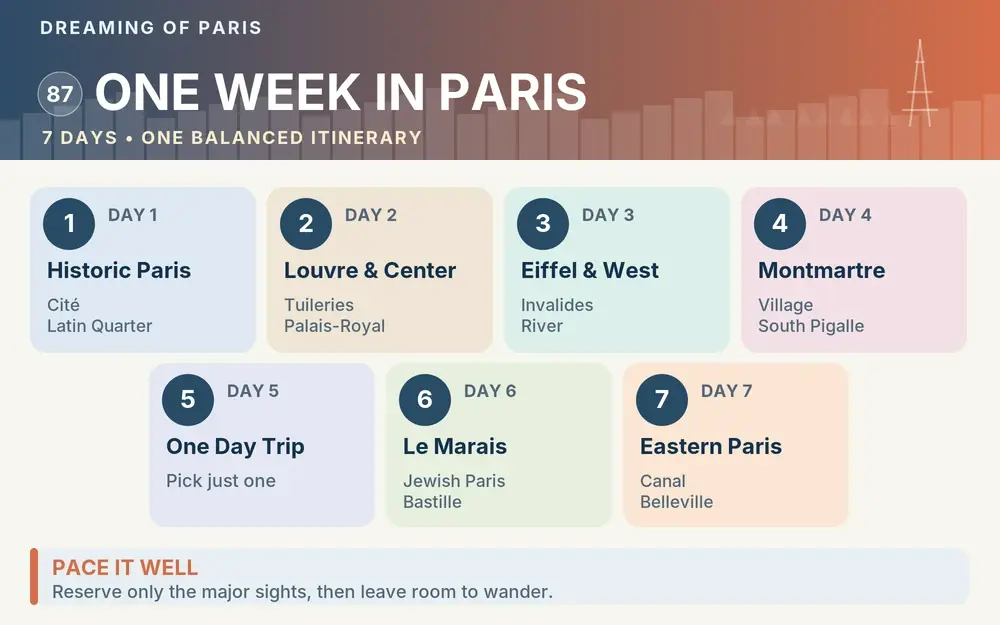
This plan assumes seven full days. It uses one day for a day trip and groups the other six geographically. If you prefer to stay entirely in Paris, replace the excursion with museums, neighborhoods or a slower repeat of your favorite area. For shorter stays, use our 5-day itinerary or 3-day itinerary.
Before the week starts: choose your fixed reservations
Do not reserve every day from breakfast to dinner. Fix only the attractions that genuinely require a time: Eiffel Tower if you want the summit, Louvre, Sainte-Chapelle or Notre-Dame Towers, Catacombs if they are a priority, and your chosen day-trip tickets. Then build flexible neighborhoods around those anchors.
Our 2026 booking strategy explains why different attractions should be booked at different times. A week is long enough to recover from rain or a closure, but only if you leave some room to move things.
Day 1: historic Paris — Île de la Cité, Latin Quarter and Saint-Germain
Begin with Notre-Dame and Île de la Cité. If you are climbing the reopened towers, use a morning reservation; otherwise visit the cathedral interior and continue to Sainte-Chapelle. Add the Conciergerie only if medieval or Revolutionary history interests you. Our Sainte-Chapelle and Conciergerie guide explains how to combine them without spending the morning in queues.
Cross to the Latin Quarter for lunch, then walk toward the Panthéon and Luxembourg Gardens. In late afternoon continue into Saint-Germain-des-Prés rather than jumping to another arrondissement. This creates a coherent first day: cathedral island, Left Bank university district, formal garden and evening cafés.
Day 2: Louvre, Tuileries, Palais-Royal and the covered passages
Book the Louvre for the morning when your concentration is highest. Limit yourself to roughly three hours. The focused Louvre guide is designed to prevent museum fatigue.
After lunch, walk the Tuileries, then turn toward Palais-Royal. The garden and arcades are free, and they connect naturally to Galerie Vivienne and other covered passages. This is a strong example of why a week works better than a rushed weekend: the afternoon is not another ticketed monument, but a sequence of architecture, streets and pauses.
Finish around Montorgueil or the 2nd arrondissement for dinner. Our Montorgueil and Les Halles guide is useful if you want a food-focused evening.
Day 3: Eiffel Tower, Invalides and the western axis
Start at Trocadéro, then cross the river to the Eiffel Tower. If you have a tower ticket, allow the time it deserves. If you do not, walk the Champ de Mars and continue toward Invalides. The Army Museum is large; choose it only if the collection interests you, not because it appears on every map.
Later take the metro to the Arc de Triomphe. Climb near late afternoon if the weather is clear, then walk only the most interesting stretch of the Champs-Élysées. You do not need to march all the way to Concorde after already covering the Tuileries on Day 2.
For a more local dinner, leave the avenue and eat in the 8th, 9th or a neighborhood closer to your hotel. Tourist geography and restaurant geography do not need to be identical.
Day 4: Montmartre, South Pigalle and a lighter evening
Montmartre deserves most of a day when you have a week. Begin on the quieter northern or western side, work gradually toward the hilltop and delay Sacré-Cœur until later. Our Montmartre beyond Sacré-Cœur route covers village streets, artists’ history and less crowded corners.
After lunch, continue downhill through Rue des Abbesses or Rue des Martyrs toward South Pigalle. If you like food shops, use the Rue des Martyrs walk. If you want nightlife, save your energy for the evening instead of adding another museum.
Day 5: choose one day trip, not three ideas
Your best day trip depends on what you want from the week. Versailles is the essential palace-and-gardens choice. Giverny is strongest for Monet and gardens. Fontainebleau offers a vast royal palace with fewer tour groups. Reims works for cathedral plus Champagne cellars. Provins is medieval. Disneyland Paris or Parc Astérix is a full family/theme-park day. Loire Valley and Mont-Saint-Michel are longer and more logistically demanding.
Use our day trips comparison rather than choosing by Instagram image. A day trip should add something Paris cannot give you, not merely produce another long transfer.
Day 6: Le Marais, Jewish Paris, Picasso/Carnavalet and Bastille
Start in Le Marais before lunch. Walk Place des Vosges, the mansion-lined streets and the Jewish quarter around Rue des Rosiers. Pick one museum: Carnavalet if you want Paris history, Picasso if you want a focused art collection. Trying to do both plus every boutique turns a neighborhood day back into a checklist.
Continue southeast toward Bastille and Faubourg Saint-Antoine. The historic craft courtyards and passages make a strong contrast with the Marais. If you still have energy, walk part of the Coulée Verte René-Dumont rather than taking a taxi to another famous monument.
Day 7: eastern Paris — Canal Saint-Martin, Belleville or Père-Lachaise
Use your final day for the Paris many short-stay visitors never reach. Begin around Canal Saint-Martin or Marché d’Aligre depending on your interests. Continue to Belleville for street art and viewpoints, or visit Père-Lachaise if cemetery history appeals to you. The point is not to collect all three; it is to spend time in a part of the city where daily life is more visible.
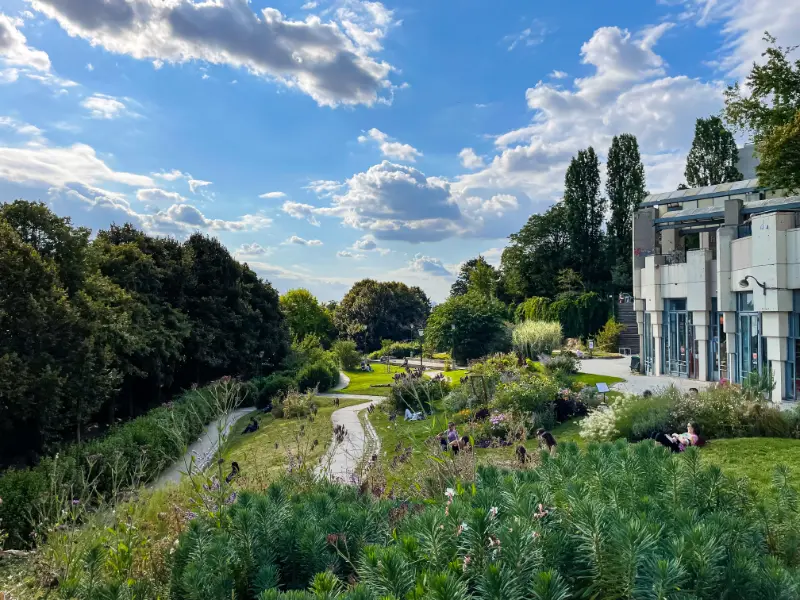
A good final afternoon is deliberately flexible. Revisit a café, buy food gifts, return to the Seine, or add a small museum you skipped earlier. A week should end with choice, not with a 17:20 reservation you made six months ago.
Alternative Day 7 for families
Families may prefer Jardin des Plantes and the Grande Galerie de l’Évolution, the Cité des Sciences, Jardin d’Acclimatation or Bois de Vincennes. Choose by the children’s ages and energy rather than by adult rankings. Our Paris with kids guide and Paris with teenagers guide separate those needs.
How many museums in one week?
For most travelers, four major museum interiors in seven days is already a lot. Louvre, Orsay and one or two smaller museums create variety; Louvre, Orsay, Orangerie, Picasso, Rodin, Carnavalet, Cluny and Pompidou-related exhibitions can easily make the week feel like an indoor course. Mix collections with gardens, markets and streets.
A rainy-day reshuffle that actually works
If heavy rain hits your Montmartre or canal day, move a museum-heavy day forward and save the outdoor neighborhood for later. Because your itinerary has only a few fixed tickets, you can swap Days 4, 6 and 7. Do not automatically use every rainy hour for a famous museum: covered passages, churches, markets and café time can absorb bad weather without creating ticket stress.
Where to put a Seine cruise
Do not make the cruise a separate “day.” Place it after the Eiffel Tower, after the Louvre/Tuileries day, or on the evening before your day trip when you want to rest your feet. Sunset cruises are attractive but popular; daylight departures give better architectural detail. Our Seine cruise guide compares the trade-offs.
What to do with an eighth morning or late departure
Use it for something small and close to your hotel: a market, Palais-Royal, Parc Monceau, a bakery breakfast, the Musée de la Vie Romantique area, or a final walk along the Seine. Do not place Versailles on departure day or trust an airport transfer to behave like an urban metro ride.
How to pace a seven-day trip without needing a vacation afterward
A useful rule is to alternate one high-input day with one lower-input day. Louvre day is mentally dense, so the next day should not begin with another three-hour museum. Versailles is physically demanding, so do not put it between two evenings that end after midnight. Montmartre involves slopes; pair it with a slower dinner rather than an ambitious cross-city night.
Build one unplanned two-hour block into the middle of the week. Use it for laundry, a long lunch, shopping, a nap, or returning to a neighborhood you liked. This sounds unromantic when planning from home, but it is one of the reasons a seven-day itinerary can feel better than a five-day checklist.
What to pre-book and what to leave open
Reserve the Eiffel Tower, Louvre, Sainte-Chapelle/Notre-Dame Towers if important, and the day trip. Leave most markets, gardens, neighborhood walks, cafés and smaller museums open. That structure gives you four or five movable half-days if weather changes. If you reserve an activity every morning and afternoon, the supposed freedom of a one-week stay disappears.
One-week budget reality
A week creates more opportunities to spend, but also more ways to save. You do not need a paid attraction every day. Palais-Royal, parks, churches, markets, the Seine, neighborhoods and many municipal museum collections can fill substantial time. Spend on the experiences that are hard to replicate—your chosen tower viewpoint, one major day trip, perhaps a food tour or evening show—then let free urban life do more of the work.
Frequently asked questions
Is seven days too long for Paris?
No. It is long enough to balance major sights with neighborhoods and one excursion. The city becomes more interesting once you stop scheduling a monument every two hours.
Should I stay in one hotel for the whole week?
Usually yes. Paris is compact enough that changing hotels wastes more time than it saves. Choose a well-connected area using our where to stay guide.
Do I need a weekly transport pass?
It depends on your exact dates and airport/day-trip plans. Fare products change, so use the current options in our Paris transport guide rather than relying on old advice about ticket carnets.
Longer excursions for a one-week stay
A seven-day trip gives you more room for a long excursion than a short city break. Compare the Loire Valley without a car with Mont-Saint-Michel from Paris before sacrificing a full day to travel.