
Three days in Paris is enough for a strong first trip if you stop trying to fit five days of attractions into it. The key is geographic clustering. Day one stays around the historic center and Left Bank, day two combines the western icons with one major museum or river experience, and day three uses Montmartre plus a flexible neighborhood or museum block. The itinerary deliberately leaves several famous places for another trip because a city experienced well is more valuable than a checklist completed badly.
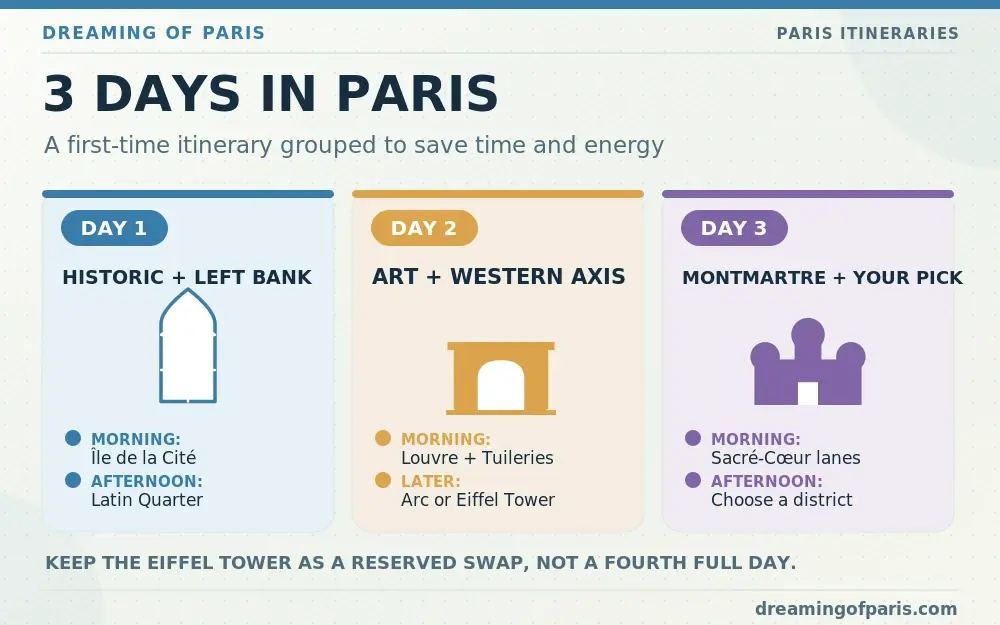
Day 1 morning: Île de la Cité and the historic center
Begin with Notre-Dame and the island while energy is high. If Sainte-Chapelle is a priority, make it the timed anchor and allow security buffer. Cross toward the Left Bank only after you have finished the island rather than bouncing between river sides.
Book the practical parts of your Paris trip
Compare accommodation first, then check tickets and experiences for the fixed parts of your itinerary.
Check Paris hotelsGetYourGuideTiqetsCivitatisAffiliate links: we may earn a commission at no extra cost to you.
The easiest way to make a Paris itinerary feel relaxed is to group sights geographically. Crossing the city is simple, but repeated cross-city journeys create invisible fatigue. Keep each half-day in one broad zone and use a single transport jump when you deliberately change neighborhoods.
Day 1 afternoon: Latin Quarter and Saint-Germain
Continue through the Latin Quarter, choosing either the Panthéon area or a slower bookshop-and-street route. Then drift west toward Saint-Germain-des-Prés. Keep dinner nearby so the day ends on foot instead of with another transport transfer.
Build the day around opening patterns rather than around a rigid ranking of attractions. Early mornings, late openings and neighborhood meal times can change what works. Keep one indoor alternative and one free outdoor alternative available so weather or queues do not derail the whole plan.
Day 2: Louvre/Tuileries to the western axis
Choose the Louvre only if it is genuinely important and use a focused two-to-three-hour strategy. Walk through the Tuileries afterward, then continue toward Place de la Concorde. Later, use the Arc de Triomphe or Eiffel Tower as the day’s major viewpoint rather than buying both summit experiences.
Leave unassigned time. Paris rewards the small discoveries between the headline sights: a bakery queue full of locals, a courtyard glimpsed through an open gate, a river view at a different angle. A plan with breathing room gives those moments somewhere to happen.
Day 2 evening: Seine without another museum
A river walk or cruise is an efficient way to see monuments from a different perspective when legs are tired. Book a cruise only if it adds value to your schedule; a free riverside walk can be just as memorable in good weather.
Day 3 morning: Montmartre before the busiest period
Start on the hill, but use the quieter village-side streets rather than only the direct Sacré-Cœur corridor. Rue des Martyrs can connect naturally into or out of the neighborhood if food shopping and local streets interest you.
Day 3 afternoon: choose one personality
This final block should reflect your interests: Musée d’Orsay or Orangerie for art, Le Marais for streets and shopping, Canal Saint-Martin/Belleville for a different city texture, or a small museum for a calmer finish. Do not try to do all four.
Where the Eiffel Tower fits
The tower works best on day two with the western sights, but ticket availability may force a different slot. If so, move the whole western half-day rather than crossing Paris twice just to preserve an arbitrary schedule.
Airport days are not bonus sightseeing days
Arrival and departure often contain immigration, baggage, hotel check-in and airport transport uncertainty. If you gain usable time, treat it as a bonus for a walk or meal. Do not make a non-refundable major attraction depend on a flight arriving exactly on schedule.
Useful connections on Dreaming of Paris
For a longer version, use our 4-day first-time Paris plan. Before choosing a base, compare where to stay in Paris and review public transport in 2026.
Is three days enough for Paris?
It is enough for a satisfying first introduction if you prioritize a few major sights and group neighborhoods intelligently. It is not enough to see everything, and that should not be the goal.
Should I do Versailles during a three-day first trip?
Only if Versailles is one of your highest priorities. It consumes a large part of a day, so you will need to remove a substantial Paris block rather than squeeze it in.
Do I need a transport pass for this itinerary?
Not necessarily. The route intentionally favors walking within clusters. Compare your actual airport and city journeys with current ticket/pass rules before buying.
A final planning note
Three days works when each day has a clear geography and one or two anchors. Protect that structure, move whole blocks when timed tickets force changes and leave at least one reason to return to Paris.
For 3 days in Paris, one more practical point is worth keeping in mind. Build the day around opening patterns rather than around a rigid ranking of attractions. Early mornings, late openings and neighborhood meal times can change what works. Keep one indoor alternative and one free outdoor alternative available so weather or queues do not derail the whole plan. Use this as a decision rule rather than a rigid instruction: the best version of the day is the one that keeps the route coherent and leaves enough energy for the place itself.
For 3 days in Paris, one more practical point is worth keeping in mind. Leave unassigned time. Paris rewards the small discoveries between the headline sights: a bakery queue full of locals, a courtyard glimpsed through an open gate, a river view at a different angle. A plan with breathing room gives those moments somewhere to happen. Use this as a decision rule rather than a rigid instruction: the best version of the day is the one that keeps the route coherent and leaves enough energy for the place itself.
For 3 days in Paris, one more practical point is worth keeping in mind. The easiest way to make a Paris itinerary feel relaxed is to group sights geographically. Crossing the city is simple, but repeated cross-city journeys create invisible fatigue. Keep each half-day in one broad zone and use a single transport jump when you deliberately change neighborhoods. Use this as a decision rule rather than a rigid instruction: the best version of the day is the one that keeps the route coherent and leaves enough energy for the place itself.
Shorter and longer itinerary versions
Compare this plan with our one-day Paris itinerary and the more spacious five-day Paris itinerary.
Only two days or a full week?
If your schedule is tighter, use our 2-day Paris itinerary. If you have longer, the 7-day Paris itinerary adds neighborhoods and a day trip without turning the week into a checklist.
Use one anchor per half-day
Three days is enough for a strong first trip only if each half-day has one clear anchor. Day 1 can center on Île de la Cité and the historic core; Day 2 can center on the Louvre/Tuileries western axis; Day 3 can center on the Eiffel Tower/Invalides area or Montmartre depending on interests. What breaks the itinerary is adding a second major museum because it appears close on a map.
Reservations should support that structure. If you book the Louvre in the morning, keep the afternoon flexible around the Tuileries, Palais-Royal or Seine. If the Eiffel Tower is booked for late afternoon, use the earlier part of that day for Invalides, Rodin or a neighborhood lunch nearby—not for Montmartre. Geographic discipline saves more time than almost any transport trick.
Three sample swaps
- Art-heavy trip: replace a shopping or viewpoint block with Musée d’Orsay or Orangerie, not both plus the Louvre.
- Neighborhood trip: keep Montmartre and add Le Marais while reducing museum interiors.
- Family trip: shorten formal sightseeing, add a park or cruise and protect an early dinner.
Do not treat restaurant reservations as separate from sightseeing. A dinner across the city can add an hour of travel at exactly the point everyone is tired. Choose evening neighborhoods that continue naturally from the final attraction. The same principle applies to your hotel: a central or well-connected base can make a three-day trip noticeably easier even if the room costs more.
If you have only two days, use our 2-day itinerary rather than deleting random stops from this plan. If you have four days, the 4-day first-time itinerary gives neighborhoods and museums more breathing room. The goal is not to prove how much can fit into 72 hours; it is to leave Paris understanding the shape of the city and still wanting to return.
A practical decision check for 3 Days in Paris
A three-day first trip is for choosing a coherent version of Paris, not proving you can visit every famous place. One major interior per half-day is the upper limit for most travelers. Before you give it a fixed slot, compare that reason with the strongest alternative already on your itinerary. If the alternative matters more, move this stop to an optional block instead of forcing both into the same half-day. That simple choice keeps the article useful for different travelers rather than implying that every reader needs the same Paris.
A realistic way to fit it into the day
Day 1 historic core, Day 2 Louvre/western axis, Day 3 choose Eiffel/Invalides plus Montmartre or another personal priority. Move dinner into the same area as the final stop. Keep the previous and following stops close enough that a delay of twenty or thirty minutes does not create a cascade of missed reservations. Paris days become much easier when the route can absorb a longer lunch, a queue or a weather change without requiring a taxi across the city.
The trade-off worth making explicit
The trade-off is icons versus neighborhoods. Every extra museum usually removes a café, market or street walk; decide consciously which type of memory you want. Making that trade-off deliberately is more useful than adding another item to a checklist. Ask what you would remove if this experience takes longer than expected; if the answer is “nothing,” the day is probably already too full.
Small details that prevent avoidable problems
Book only the hardest-to-get anchors first, then build everything else around geography. Never let an afternoon reservation force a cross-city sprint after lunch. Save the exact address or entrance you intend to use, keep enough phone battery for the return route and recheck any time-sensitive information on the official site. These are small steps, but they protect the part of the experience that actually matters from being swallowed by logistics.
Where it belongs in the wider Paris cluster
Use the 2-day plan if arrival/departure removes time; use the 4- or 5-day plan if you want both major museums and deeper neighborhoods. Treat that pairing as a geographic or thematic cluster, not an obligation to complete everything. One strong connection is enough to make the day coherent; two or three distant add-ons usually reduce the value of the place you came to see.