
Disclosure: This article contains affiliate links or booking widgets. If you book through them, Dreaming of Paris may earn a commission at no extra cost to you. How our affiliate links work.
Five days gives you enough time to see the essential Paris without turning every day into a race. The key is assigning each day to a geographic cluster and leaving one block flexible for weather, energy or a personal interest.
Book the practical parts of your Paris trip
Compare accommodation first, then check tickets and experiences for the fixed parts of your itinerary.
Check Paris hotelsGetYourGuideTiqetsCivitatisAffiliate links: we may earn a commission at no extra cost to you.
Quick planning summary
Day 1: historic Paris
Begin with Notre-Dame and Île de la Cité, continue through the Latin Quarter or Saint-Germain, and finish along the Seine. This day establishes the map in your head. Add Sainte-Chapelle only if you have timed entry and enough energy; otherwise save it for another morning.
Day 2: Louvre, Tuileries and the western axis
Use our focused Louvre strategy rather than trying to see the entire museum. Afterward, recover in the Tuileries, then continue toward Place de la Concorde. The Arc de Triomphe can work near sunset if your legs still cooperate. Avoid adding another large museum.
Day 3: Eiffel Tower, Invalides and Rodin
Keep the day on the Left Bank/western side. Choose one major interior—Eiffel summit, Invalides or Rodin—and use the others selectively. A Seine cruise can close the day without requiring another neighborhood change.
Day 4: Montmartre plus local food
Visit Montmartre earlier than the heaviest crowds, then walk down through South Pigalle and Rue des Martyrs. This day is deliberately street-focused after several monument-heavy days. End with a café, food tour or evening around Pigalle depending on your interests.
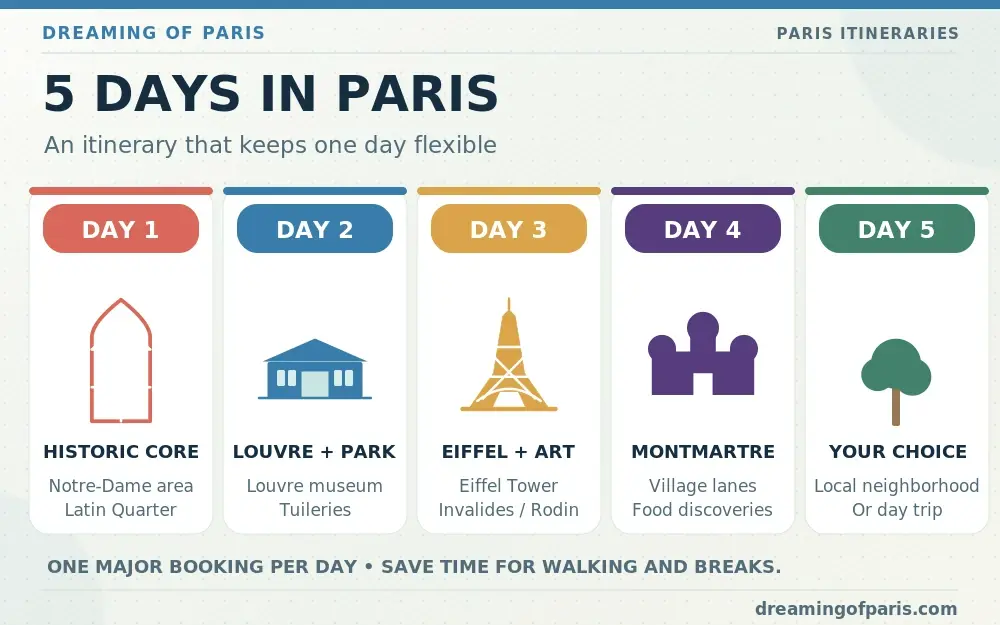
Day 5: choose your Paris
Use the final day for Le Marais, Canal Saint-Martin, Belleville, the 11th, a small museum or a half-day shopping block. This is where the trip becomes personal. Repeat visitors often wish they had allowed more time for precisely these neighborhoods.
Where a day trip fits
Versailles can replace Day 5, but understand the trade-off: you lose a large portion of Paris neighborhood time. With only five days, I would choose a day trip only if the destination is a genuine priority rather than an obligation.
Museum pacing
Large museums on consecutive days can blur together. Alternate interiors with walking days. If rain forces a change, use smaller museums or covered passages instead of automatically replacing outdoor time with another three-hour collection.
Restaurant planning
Reserve two or three meals that matter, not every dinner. Keep the rest flexible around the neighborhood of the day. This reduces cross-city travel and lets you adjust appetite after food tours, museum cafés or long lunches.
Transport strategy
Most days should involve one main Metro ride out and one back rather than constant hopping. Walking within a cluster makes the city legible and reveals the spaces between monuments. Use public transport aggressively only when it prevents unnecessary backtracking.
Build a buffer
Keep at least one half-day unbooked across the five days. Weather, strikes, attraction closures or simple fatigue can change priorities. A flexible block lets you move a cruise, revisit a neighborhood or take a long lunch without feeling that the itinerary is failing.
How this article fits into the Dreaming of Paris cluster
For a deeper plan, continue with 3 days in Paris, 4-day first-time plan, where to stay, day trips from Paris. These guides are linked because they share geography or a real planning decision, not simply because they mention Paris.
Compare current bookable experiences
Official information
For the details most likely to change, use the Paris je t’aime official tourism site. Recheck it shortly before the visit rather than relying on a screenshot saved weeks earlier.
Practical checklist before you leave the hotel
- Recheck opening hours, closures or transport work.
- Save the exact entrance or meeting point, not only the attraction name.
- Carry water and keep enough phone battery for navigation.
- Know one nearby alternative in case the main plan changes.
- Allow more time if you have luggage, children or reduced mobility.
- Avoid scheduling another major timed attraction immediately afterward.
Is five days enough for Paris?
Yes for a strong first visit that includes the main sights plus several neighborhoods, provided you organize by geography.
Should I spend one of five days at Versailles?
Only if Versailles is a high priority; otherwise keep the fifth day for Paris neighborhoods and smaller museums.
How many museums should I visit in five days?
Two or three major museums is usually enough for most travelers, with smaller collections added selectively.
Where should I stay for a five-day first trip?
Choose a well-connected central or near-central neighborhood that makes evenings pleasant and reduces daily transport.
Final planning advice
The best way to use this guide to 5 days in Paris is to place it inside a coherent day rather than treat it as an isolated checklist item. Paris becomes easier when every reservation has a reason, every journey has a nearby second purpose and at least one part of the day remains flexible. That approach protects you from queues, weather changes and simple fatigue while leaving space for the unplanned café, street or view that often becomes the strongest memory.
Use Day 5 as a choice, not as overflow
The advantage of five days is not fitting in two more monuments per day. It is having one day that reflects your interests. Decide before arrival whether Day 5 is for Versailles, contemporary art, food, neighborhoods, family activities or a slower repeat of a favorite area. That decision prevents the first four days from becoming overloaded “just in case.”
If you choose a day trip, keep the preceding evening light and avoid a non-refundable late event. Versailles, Disneyland, Giverny and Chantilly all create different transport and walking demands. A day trip should replace a Paris day rather than being added to the end of one.
How many museums is too many?
For most first-time visitors, one substantial museum on a given day is enough. The Louvre plus Orsay plus Orangerie across five days is realistic; all three in forty-eight hours is usually not. Use smaller museums when they fit a neighborhood rather than as a quota. A compact museum can also be the best rainy-day substitute when the original plan was mostly outdoors.
By Day 4, use what you have learned. If you loved the Marais, return for dinner. If central Paris felt too crowded, use Day 5 for Canal Saint-Martin, Belleville or Bois de Vincennes. The 7-day itinerary is useful if you want to see how these optional layers expand without compressing the core sights.
A practical decision check for 5 Days in Paris
Five days lets you add depth: it should not look like a three-day itinerary with twice as many attractions. Before you give it a fixed slot, compare that reason with the strongest alternative already on your itinerary. If the alternative matters more, move this stop to an optional block instead of forcing both into the same half-day. That simple choice keeps the article useful for different travelers rather than implying that every reader needs the same Paris.
A realistic way to fit it into the day
Use four structured days for historic core, major art, western Paris and Montmartre/local food, then make Day 5 a deliberate choice: day trip, hidden neighborhoods, family or contemporary art. Keep the previous and following stops close enough that a delay of twenty or thirty minutes does not create a cascade of missed reservations. Paris days become much easier when the route can absorb a longer lunch, a queue or a weather change without requiring a taxi across the city.
The trade-off worth making explicit
The trade-off is day trip versus deeper Paris. Leaving the city costs one of only five days, so choose Versailles or another excursion only if it outranks a missing Paris priority. Making that trade-off deliberately is more useful than adding another item to a checklist. Ask what you would remove if this experience takes longer than expected; if the answer is “nothing,” the day is probably already too full.
Small details that prevent avoidable problems
By the fourth day, adjust based on real experience. Repeat a favorite district or remove a museum if the trip is becoming tiring. Save the exact address or entrance you intend to use, keep enough phone battery for the return route and recheck any time-sensitive information on the official site. These are small steps, but they protect the part of the experience that actually matters from being swallowed by logistics.
Where it belongs in the wider Paris cluster
The 7-day itinerary shows how to add day trips and neighborhoods without compressing the core. Treat that pairing as a geographic or thematic cluster, not an obligation to complete everything. One strong connection is enough to make the day coherent; two or three distant add-ons usually reduce the value of the place you came to see.
Protect one completely unscheduled evening
Five days is long enough to leave an evening open. Do not reserve dinner, a cruise and a show every night before you know your energy level. The free evening can absorb a rainy-day museum change, a restaurant recommendation discovered locally or a return to the neighborhood you liked most. Flexibility becomes more valuable as the trip gets longer, not less.