Disclosure: This article contains affiliate links or booking widgets. If you book through them, Dreaming of Paris may earn a commission at no extra cost to you. How our affiliate links work.
One day in Paris is enough for a memorable introduction but not enough for a complete city. The best plan uses one museum at most, follows the Seine and protects time for walking instead of commuting between distant icons.
Book the practical parts of your Paris trip
Compare accommodation first, then check tickets and experiences for the fixed parts of your itinerary.
Check Paris hotelsGetYourGuideTiqetsCivitatisAffiliate links: we may earn a commission at no extra cost to you.
Quick planning summary
The rule: choose one interior priority
Your biggest decision is whether the day includes the Louvre, Eiffel Tower summit, Sainte-Chapelle or another timed interior. Pick one main reservation and treat everything else as flexible. Two or three major timed attractions create a day controlled by queues and transfers.
08:00–09:30: Île de la Cité
Start around Notre-Dame before the center reaches full daytime density. Walk the cathedral area, river edges and nearby streets. If you have a reserved cathedral or Sainte-Chapelle entry, use it here; otherwise keep moving and enjoy the exterior urban context.
09:30–11:00: walk west along the Seine
Cross toward the Right Bank or continue via the river, depending on crowds. The point is to understand Paris geographically: islands, bridges, the Louvre axis and the relationship between Left and Right Banks. Avoid taking the Metro for a distance that is itself part of the experience.
11:00–13:00: Louvre choice
If the Louvre is your priority, use a focused two-hour route and a timed ticket. If not, appreciate the courtyards and architecture from outside and continue to the Tuileries. Trying to ‘pop into’ the Louvre for 30 minutes rarely works once security and navigation are included.
13:00–14:00: simple lunch
This is not the day for a long cross-city restaurant pilgrimage. Eat near the route, ideally somewhere you researched in advance but can reach on foot. A bakery, market-style lunch or simple bistro keeps the day moving without reducing food to fuel.
14:00–16:00: Tuileries to the western axis
Walk through the Tuileries toward Place de la Concorde. From here you can continue toward the Champs-Élysées or use transport to reach the Eiffel Tower area. The garden gives your feet a different rhythm after stone interiors and busy streets.
16:00–18:30: Eiffel Tower area
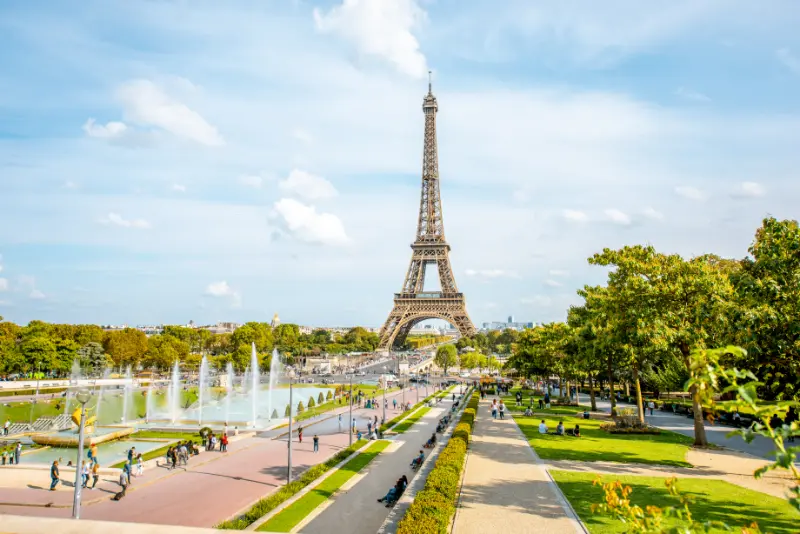
A tower ticket is optional. If you have one, make it the afternoon anchor. If not, use Champ de Mars, river viewpoints and nearby streets, then save a paid panorama for another trip. The monument is visible from many angles; the day does not fail because you did not go to the summit.
Evening: cruise or neighborhood dinner
A Seine cruise works particularly well on a one-day visit because it lets you see several monuments while resting. Alternatively, choose dinner in Saint-Germain, the Marais or near your hotel. Do not travel to a far neighborhood purely for a social-media restaurant after a 12-hour day.
What to skip
Skip Versailles, Disneyland, Montmartre plus the Louvre plus the Eiffel summit in one day. Any itinerary promising all of that is counting checkmarks, not experience. Montmartre can replace the Louvre or Eiffel block if it matters more to you, but it should not simply be added on top.
If you arrive by train
Build the route from your arrival station and luggage plan. Gare du Nord, Gare de Lyon and Montparnasse connect differently to the center. Our stations guide explains the network; leave margin if you must catch an evening train because Paris transport disruptions can erase a tightly scheduled finale.
How this article fits into the Dreaming of Paris cluster
For a deeper plan, continue with Notre-Dame and Île de la Cité, Louvre strategy, Eiffel Tower, Seine cruise. These guides are linked because they share geography or a real planning decision, not simply because they mention Paris.
Compare current bookable experiences
Official information
For the details most likely to change, use the Paris je t’aime official tourism site. Recheck it shortly before the visit rather than relying on a screenshot saved weeks earlier.
Practical checklist before you leave the hotel
- Recheck opening hours, closures or transport work.
- Save the exact entrance or meeting point, not only the attraction name.
- Carry water and keep enough phone battery for navigation.
- Know one nearby alternative in case the main plan changes.
- Allow more time if you have luggage, children or reduced mobility.
- Avoid scheduling another major timed attraction immediately afterward.
Can I see Paris in one day?
You can see a strong introduction, not the whole city. Choose one major interior attraction and connect the rest on foot.
Should I visit the Louvre with only one day?
Only if art is a top priority. Otherwise the time may be better spent walking through central Paris.
Is a Seine cruise worth it on a day trip?
Yes, especially late afternoon or evening, because it combines sightseeing with a physical break.
Should I include Montmartre?
You can, but it should replace another major block rather than being added to an already full schedule.
Final planning advice
The best way to use this guide to one day in Paris is to place it inside a coherent day rather than treat it as an isolated checklist item. Paris becomes easier when every reservation has a reason, every journey has a nearby second purpose and at least one part of the day remains flexible. That approach protects you from queues, weather changes and simple fatigue while leaving space for the unplanned café, street or view that often becomes the strongest memory.
The one-day rule: see Paris, not a collection of ticket scanners
With one day, every interior visit has an opportunity cost. Pick one: Louvre, Sainte-Chapelle, Eiffel Tower summit, Musée d’Orsay or another personal priority. The rest of the day should use streets, bridges, gardens and viewpoints that connect naturally. Two major timed interiors can work only if they are close and you are willing to sacrifice neighborhood time.
A visitor arriving by train should also count station-to-center travel as part of the day. Gare du Nord, Gare de Lyon and Montparnasse create different starting points. Store luggage before sightseeing rather than dragging it through security lines. If you have a flight the same evening, work backward from the airport arrival time and remove the final attraction instead of hoping transport will be perfect.
A decision example
If the Louvre is your priority, book a morning slot, spend a focused two to three hours, walk through the Tuileries and continue west. If the Eiffel Tower is the priority, spend the morning on Île de la Cité and along the Seine, then move west after lunch. If you are not interested in museum interiors, skip both and use the day for Notre-Dame exterior/interior access, river walking, Montmartre or a cruise.
Do not add Montmartre just because a one-day checklist says it is essential. It is geographically separate from the historic core. Add it only if the neighborhood matters more to you than the Louvre/Tuileries western axis. For a less compressed trip, move directly to the 2-day itinerary.
A practical decision check for One Day in Paris
A one-day itinerary should answer one question: which interior matters enough to justify the queue and security time? Before you give it a fixed slot, compare that reason with the strongest alternative already on your itinerary. If the alternative matters more, move this stop to an optional block instead of forcing both into the same half-day. That simple choice keeps the article useful for different travelers rather than implying that every reader needs the same Paris.
A realistic way to fit it into the day
Historic core early, one major interior late morning, westward outdoor route in the afternoon, then one evening experience near the final stop. Keep the previous and following stops close enough that a delay of twenty or thirty minutes does not create a cascade of missed reservations. Paris days become much easier when the route can absorb a longer lunch, a queue or a weather change without requiring a taxi across the city.
The trade-off worth making explicit
The trade-off is completeness versus coherence. Montmartre, Louvre and Eiffel Tower can all fit on paper but usually create too much transport and too little city experience. Making that trade-off deliberately is more useful than adding another item to a checklist. Ask what you would remove if this experience takes longer than expected; if the answer is “nothing,” the day is probably already too full.
Small details that prevent avoidable problems
Day-trippers must include luggage storage and station/airport margin in the schedule. Those are not optional minutes at the end. Save the exact address or entrance you intend to use, keep enough phone battery for the return route and recheck any time-sensitive information on the official site. These are small steps, but they protect the part of the experience that actually matters from being swallowed by logistics.
Where it belongs in the wider Paris cluster
Move to the 2-day itinerary if you want both Montmartre and the Louvre at a reasonable pace. Treat that pairing as a geographic or thematic cluster, not an obligation to complete everything. One strong connection is enough to make the day coherent; two or three distant add-ons usually reduce the value of the place you came to see.