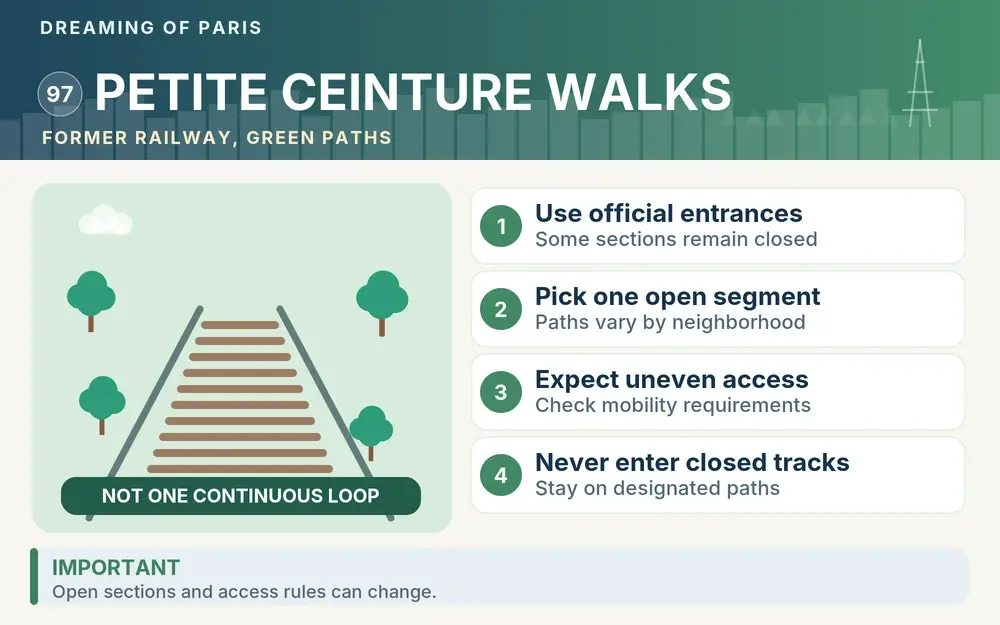
The Petite Ceinture is not a single continuous public walking trail around Paris. That misunderstanding causes many visitors to search for unofficial entrances or assume a map of the old railway equals a legal walking route. The former circular railway is around 32 km long, but only selected sections have been converted for public access. In August 2026 the City opened a new connection in the 15th arrondissement, creating a continuous roughly 2 km walk between Parc Georges-Brassens and the Balard area; the City says around 12–13 km of the overall line are now open to the public, with more planned.
Think in official sections, not one loop
Each open segment has its own entrances, landscape and relationship with the surrounding arrondissement. Plan one section that fits your day. Attempting to ‘complete’ the Petite Ceinture as if it were a marked circular footpath will lead to closures, active or inaccessible infrastructure and unnecessary detours.
The 15th-arrondissement section changed in 2026
The new link opened in early August 2026 connects previously separated public stretches, making a continuous walk of about two kilometres between Georges-Brassens and Balard. That makes the southwest segment one of the easiest choices for visitors who want a meaningful linear walk.
Other open sections feel different
Public segments in other arrondissements can be shorter, more ecological, more urban or more closely integrated into neighborhood parks. The value is not only railway nostalgia; vegetation and the unusual cut-through perspective reveal the city from behind ordinary streets.
Do not enter closed railway areas
Fences, closed tunnels and inaccessible stretches are not invitations to explore. Conditions can be dangerous and legal access matters. Use official entrances listed by the City and stay within opened landscaped sections.
Pair a segment with its neighborhood
In the 15th, combine the railway walk with Parc Georges-Brassens or nearby residential streets. In other districts, use the segment as a connector rather than traveling across Paris solely for a five-minute photo stop.
Expect the network to keep changing
The City has been progressively opening more stretches, so older blogs and maps can become obsolete in both directions: they may describe areas now open or routes no longer configured the same way. Check current municipal information shortly before the walk.
Useful connections on Dreaming of Paris
Compare the more continuous Coulée Verte René-Dumont. For more no-cost ideas, use free things to do in Paris.
Can I walk the entire Petite Ceinture?
No. Only selected sections are officially open to the public; it is not one continuous legal walking loop.
How much is open in 2026?
The City stated in August 2026 that around 12–13 km are currently open to the public, with further openings planned.
What changed in the 15th arrondissement?
A new connection opened in August 2026, creating a continuous roughly 2 km public route from the Georges-Brassens area toward Balard.
A final planning note
The Petite Ceinture is most rewarding when you accept its fragmented nature. Choose one official section, connect it to the neighborhood around it and let the old railway offer a different angle on Paris without crossing fences or chasing abandoned-track mythology.
For Petite Ceinture Paris 2026, one more practical point is worth keeping in mind. Shoes matter more than they appear on a map. Cobblestones, slopes, stairs, gravel and wet surfaces can all occur within a short walk. If mobility is a concern, check entrances and accessible alternatives before setting out; several greenways and heritage spaces have access points that are not equivalent. Use this as a decision rule rather than a rigid instruction: the best version of the day is the one that keeps the route coherent and leaves enough energy for the place itself.
For Petite Ceinture Paris 2026, one more practical point is worth keeping in mind. Use public transport to connect the beginning and end rather than forcing the walk into a loop. That preserves energy for the interesting section and makes it easier to combine the route with another neighborhood without retracing the same streets. Use this as a decision rule rather than a rigid instruction: the best version of the day is the one that keeps the route coherent and leaves enough energy for the place itself.
For Petite Ceinture Paris 2026, one more practical point is worth keeping in mind. This route is best treated as a sequence of short discoveries, not as a distance challenge. Paris is dense, and a detour of one or two streets can change the atmosphere completely. Build in time to sit, look back and change direction rather than measuring the day only by kilometres covered. Use this as a decision rule rather than a rigid instruction: the best version of the day is the one that keeps the route coherent and leaves enough energy for the place itself.
2026 changed the most useful section in the 15th
The Petite Ceinture still cannot be walked as a continuous 32-kilometer loop. The important 2026 change is in the 15th arrondissement, where the opening of a secured 300-meter tunnel connected two previously separate sections. The City of Paris now describes a continuous walk of about 2 kilometers between the Georges-Brassens area and Place Balard—the longest uninterrupted public section currently available.
This matters for planning because older maps and blogs may still show a break. The city also states that roughly 12 to 13 kilometers of the former railway are open to the public overall, spread across different arrondissements. Treat each legal segment as a neighborhood park or promenade with its own entrances and opening rules, not as proof that the track between them is accessible.
Which section should you choose?
Choose the 15th if you want the longest continuous official walk and an easy pairing with Parc Georges-Brassens or Parc André-Citroën. Choose another section if it fits a neighborhood you are already visiting. The best segment is the one that removes travel time from the day, not necessarily the one with the most dramatic abandoned-railway photographs.
Never enter fenced tunnels, active infrastructure or closed track because a map app appears to show a route. Some unofficial photos online were taken in areas that are not public paths. Besides safety and legality, trespassing undermines the conservation agreements that made public sections possible.
For a more landscaped linear route, use the Coulée Verte René-Dumont. For the Petite Ceinture, check the City of Paris page for the exact segment on the day of your visit: openings are expanding, which means a 2026 guide should be treated as a snapshot rather than a permanent map.
A practical decision check for Petite Ceinture in 2026
The Petite Ceinture is for travelers interested in urban ecology, rail history and neighborhood-scale walks. It is not an abandoned railway adventure route. Before you give it a fixed slot, compare that reason with the strongest alternative already on your itinerary. If the alternative matters more, move this stop to an optional block instead of forcing both into the same half-day. That simple choice keeps the article useful for different travelers rather than implying that every reader needs the same Paris.
A realistic way to fit it into the day
Choose one officially open section, enter at a published access point, walk that section and then continue into the surrounding neighborhood. Do not attempt to connect sections on the tracks. Keep the previous and following stops close enough that a delay of twenty or thirty minutes does not create a cascade of missed reservations. Paris days become much easier when the route can absorb a longer lunch, a queue or a weather change without requiring a taxi across the city.
The trade-off worth making explicit
The trade-off is railway atmosphere versus convenience. Some sections preserve stronger rail character; others are more landscaped. Choose by location and accessibility, not only photographs. Making that trade-off deliberately is more useful than adding another item to a checklist. Ask what you would remove if this experience takes longer than expected; if the answer is “nothing,” the day is probably already too full.
Small details that prevent avoidable problems
Because openings are expanding, save the City of Paris page for the chosen section. A map from even one year earlier may miss a new entrance or connection. Save the exact address or entrance you intend to use, keep enough phone battery for the return route and recheck any time-sensitive information on the official site. These are small steps, but they protect the part of the experience that actually matters from being swallowed by logistics.
Where it belongs in the wider Paris cluster
The 15th works with Georges-Brassens/André-Citroën; other sections pair with their own arrondissements. Coulée Verte is the better choice if you want a continuous designed promenade. Treat that pairing as a geographic or thematic cluster, not an obligation to complete everything. One strong connection is enough to make the day coherent; two or three distant add-ons usually reduce the value of the place you came to see.
Do not use distance as the main goal
The open sections are interesting because railway infrastructure, spontaneous vegetation and neighborhood edges meet in unusual ways. Walking a shorter official stretch slowly lets you notice platforms, retaining walls and changes in planting. Trying to maximize kilometers can reduce the experience to exercise and may tempt visitors toward closed connections. The city’s gradual reopening strategy makes patience part of using the Petite Ceinture responsibly.