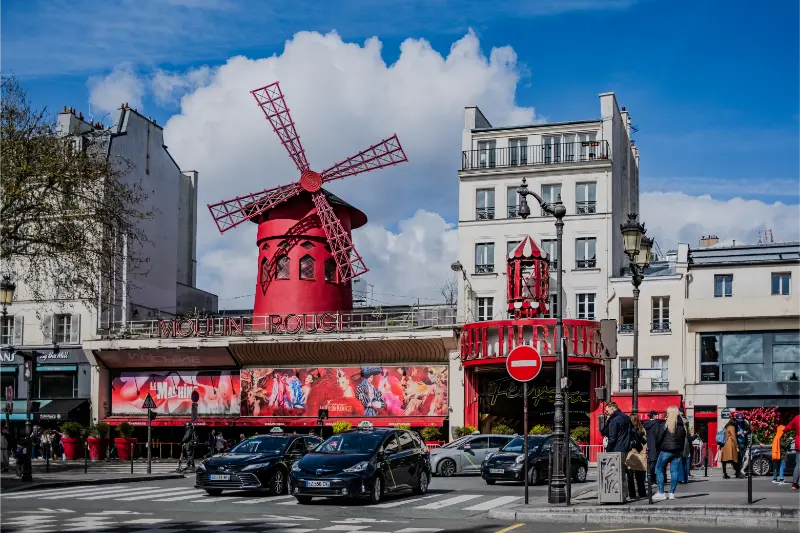
The best Paris nightlife hotel is usually one street away from the nightlife you came for. Stay too far away and you spend every night checking the last convenient train. Stay directly above the busiest bars and you may discover that “lively neighborhood” means bass and deliveries outside the window until morning. The ideal base gives you walkable evenings with a quiet enough room to recover.
Compare hotels for your stay in Paris
Check current availability, location and prices before choosing the exact neighborhood.
Check Paris hotels on Booking.comAffiliate link: we may earn a commission at no extra cost to you.
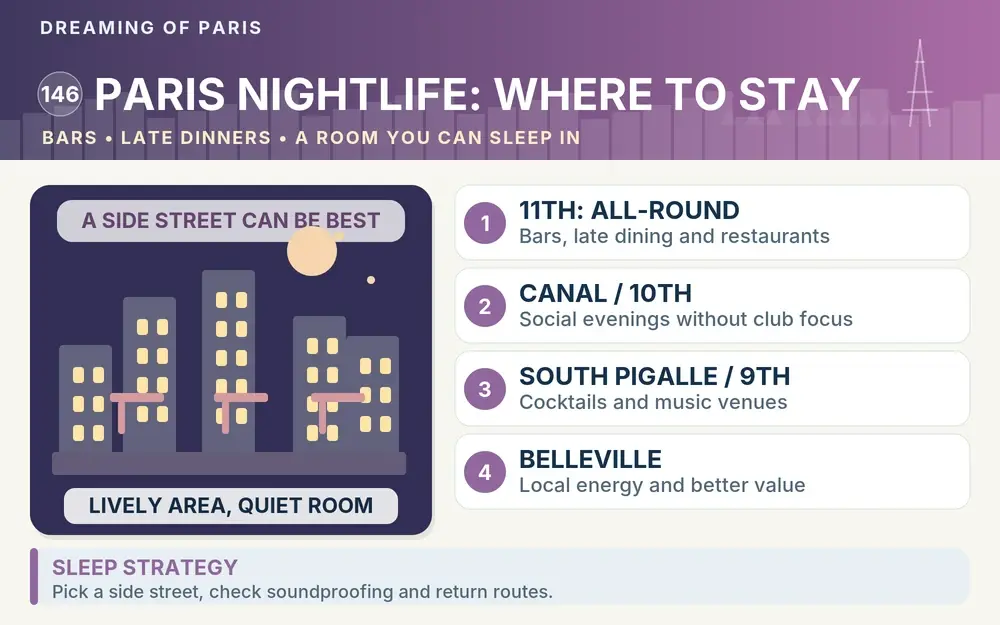
This guide pairs with our Paris nightlife guide. The strongest accommodation areas are the 11th for bars and late restaurants, Canal Saint-Martin for social evenings, South Pigalle for cocktails and music, the Marais for central nightlife, and Belleville/Ménilmontant for a more local east-Paris scene.
This guide contains affiliate links. If you book through them, Dreaming of Paris may earn a commission at no extra cost to you.
The 11th: the best all-round nightlife base
Bastille, Oberkampf and Charonne give the 11th a concentration of bars, restaurants and late-night energy without reducing the whole district to one strip. You can eat, move to a wine bar or cocktail bar, and walk back to the hotel. Our 11th arrondissement guide and Oberkampf guide show how quickly the mood changes between busy avenues and residential side streets.
For accommodation, I would avoid choosing purely by proximity to one famous nightlife street. A hotel two or three blocks away can preserve the walkability while dramatically improving sleep. Look for double glazing and recent noise reviews. The 11th is particularly good for couples and groups who want late dinners more than formal clubs.
Canal Saint-Martin and the 10th: social evenings without committing to a club district
The canal suits travelers who want drinks, casual restaurants and an active public-space atmosphere rather than a nightclub every night. It also connects naturally to République and the 11th. Our 10th arrondissement guide separates the canal from the busier station area.
This is a good base for friends and solo travelers because there is enough to do nearby without forcing a late cross-city journey. On warm evenings the canal itself can stay lively, so check whether the hotel room faces the water or a quieter internal courtyard.
South Pigalle and the 9th: cocktails, music and a more polished evening
South Pigalle is one of the strongest choices for travelers who want cocktail bars, music venues, restaurants and easy access to Montmartre. The 9th arrondissement guide shows how the area differs from the more commercial Opéra district.
The advantages are evening density and good transport; the disadvantages are weekend noise and higher rates than the 11th or 20th. Lower Montmartre can also work, but remember that hillier streets are less fun with luggage and after a late night. Choose the route you will actually walk at 1 a.m., not only the daytime map.
The Marais: central nightlife with a high room-price premium
The Marais offers bars, restaurants, LGBTQ+ nightlife and central walking, especially around the 3rd and 4th. You can combine a late evening with a daytime itinerary around Notre-Dame, museums and the Seine. The Marais guide is useful for understanding which areas become busiest.
This is the expensive nightlife choice. Rooms can be small, and central streets may stay active late. The benefit is that you can walk to many daytime attractions as well, making the premium more defensible on a short trip. For a longer nightlife-focused stay, the 11th may offer better room value.
Belleville and Ménilmontant: local nightlife and better value
Eastern Paris around Belleville and Ménilmontant works for travelers who prefer independent bars, live music and a less polished atmosphere. Our Belleville and Ménilmontant guide explains the hills and neighborhood transitions.
Rates can be lower, but this is not the most convenient first-time base if all your daytime priorities are west of the Seine. It is much stronger for repeat visitors or travelers who specifically want eastern Paris. Hills also matter after a late night, so check the hotel elevation and nearest station rather than only the arrondissement number.
What about Saint-Germain and the Latin Quarter?
The Left Bank has evening life, wine bars, jazz, restaurants and student energy, but it is not the same nightlife proposition as Oberkampf or Pigalle. Couples who want late dinners and a beautiful walk home may prefer Saint-Germain. Travelers looking for clubs or a dense bar crawl may find better value elsewhere. See the 6th arrondissement guide and 5th arrondissement guide for the daytime trade-off.
The advantage is that these districts remain excellent sightseeing bases. If nightlife is only one part of your trip rather than the main purpose, a central Left Bank hotel can be the better overall choice.
Sleep strategy: nightlife area does not have to mean noisy room
- Choose a side street within five to ten minutes of the bars rather than a room directly above them.
- Ask about courtyard-facing rooms if noise is a concern.
- Read recent weekend reviews, not only weekday comments.
- Check air-conditioning so you are not forced to sleep with windows open in summer.
- Verify reception access after midnight if the property uses codes or limited staffing.
- Do not assume higher floors are silent; rooftop venues and street echoes can still matter.
A hotel that lets you sleep well will improve the next day more than an extra five minutes of nightlife proximity. Paris nights are enjoyable precisely because you can combine them with daytime museums, walks and food; exhaustion ruins that balance quickly.
Late transport and the “walk home” advantage
Night buses and late Metro service can help, but timetables and engineering works change. If nightlife is important, a walkable base removes one variable. Use the public transport guide and official transport information close to travel rather than assuming the last train will match an old timetable.
The best nightlife districts also have daytime value. That is why the 11th, 9th and Marais usually outperform a hotel chosen only because it is beside one club. You want the neighborhood to work at 10 a.m. as well as midnight.
Compare accommodation before you commit
Hotel prices in Paris move sharply with exhibitions, school holidays, fashion events and major weekends. Use Booking.com to compare current room inventory, but compare the exact street, nearest station, cancellation terms, room size and air-conditioning rather than ranking properties only by headline price. A cheaper room that adds two awkward changes to every journey is not always the cheaper trip.
Official information to check before your trip
Neighborhood nightlife changes faster than monuments. Use the official Paris je t’aime accommodation guide for current hotel listings and check venue calendars separately for the dates of your stay.
For the strongest all-round nightlife base, choose the 11th. Pick South Pigalle for cocktails and music, Canal Saint-Martin for social evenings, the Marais for central nightlife and Belleville/Ménilmontant for a more local east-Paris scene. Then move one street away from the loudest action.
Nightlife should make your hotel location easier, not harder. The goal is to walk home when you want to, sleep when you need to and still wake up in a neighborhood that has something to offer before the bars reopen.
One final planning check before you book
Open the map and trace the three journeys you are most likely to repeat: the first morning, the longest sightseeing day and the return after dinner. Then check the route from the station or bus stop to the hotel door, not only the station name. Paris blocks, hills, large intersections and station exits can make a short map distance feel very different with luggage or after a long day.
Compare the flexible rate with the cheapest non-refundable rate. If the saving is small, flexibility is often worth more than the discount because train times, flights, family plans and event dates can move. A good accommodation decision should still look good after the itinerary changes once or twice; that resilience is part of value, not an optional luxury.
Also check the most recent reviews for issues that are difficult to judge from official photographs: street noise after midnight, lift reliability, room temperature, construction nearby and how staff handle luggage before check-in. Look for repeated patterns rather than one angry review. When three or four recent guests mention the same practical problem, treat it as useful evidence and decide whether that compromise matters to your trip.
Finally, remember that Paris hotel pricing is highly date-sensitive. A neighborhood that looks expensive for one weekend may be competitive a week later, and the opposite can happen during trade fairs, fashion events, concerts or school holidays. Compare the same dates across several districts before deciding that one area is categorically outside your budget.
Before finalizing the plan, save the exact address, nearest transport entrance and cancellation deadline in the same trip note as your reservations. That small step makes it much easier to compare alternatives rationally and prevents a good booking from becoming inconvenient because one practical detail was overlooked. Recheck the plan a few days before travel as well: opening conditions, construction, transport works and neighborhood events can change the practical value of a location even when the address itself has not changed. A quick verification protects the time you have already invested in planning.