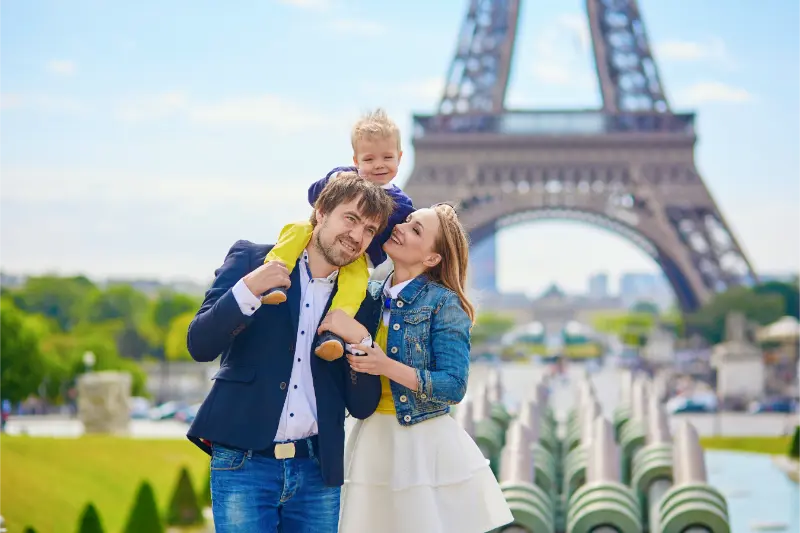
Paris can be excellent with children, but only if you stop planning it like an adult city break. The city has world-class museums, gardens, boats, science attractions and visual landmarks that children recognize instantly. The problem is usually pace: too many queues, too much walking, meals scheduled too late and no place to run after two hours of “be careful, don’t touch.”
A successful family day in Paris often needs only one major attraction, one outdoor space and one flexible treat. Adults may feel they are “doing less,” but children usually remember more—and everyone has enough energy for dinner.
The family rule that changes everything: plan by energy, not by distance
On a map, the Louvre to the Eiffel Tower does not look far. For a six-year-old after a museum visit, it may feel enormous. Paris days accumulate stairs, cobbles, station corridors and standing time. Build breaks before children ask for them.
If your child still naps, stay somewhere that makes returning to the hotel realistic. Our where to stay in Paris guide explains why a central or direct-line location can be worth more to families than saving a small amount on a distant room.
Paris by age: what tends to work
Ages 0–3: protect sleep and simplify transport
For babies and toddlers, gardens, short river cruises, neighborhood walks and one compact museum session are more reliable than a full attraction list. A lightweight foldable stroller is useful because many historic metro stations have stairs. Carriers can be easier on Montmartre and in old buildings.
Plan meal flexibility and do not rely on every café having high chairs or large restroom changing spaces. Apartments or rooms with a small kitchenette can make breakfast and emergency snacks much easier.
Ages 4–7: alternate “look” with “do”
Children in this age group often love the Eiffel Tower, boats, carousels, playgrounds and obvious visual stories. A museum works better when it has a mission: find Egyptian animals, count crowns, choose the strangest sculpture. Follow with a garden where they can move freely.
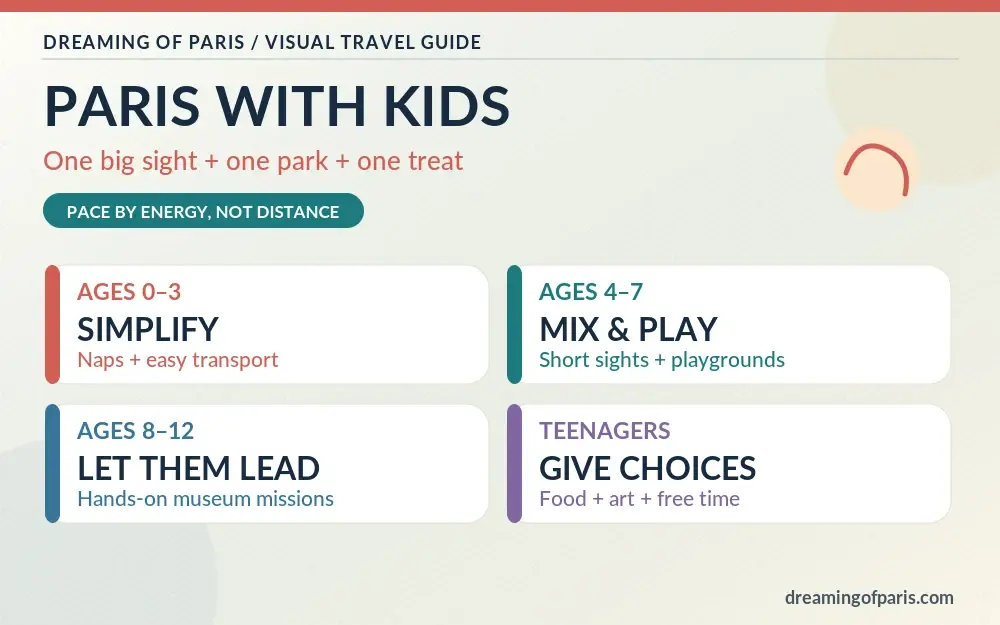
Ages 8–12: give them ownership
Let children choose one attraction or neighborhood. Science museums, the Catacombs for children comfortable with the subject and age restrictions, interactive exhibitions, towers and food exploration can work well. They can also navigate part of the metro route with supervision, turning transport into a game rather than dead time.
Teenagers: stop over-curating
Teens may enjoy street art, fashion, photography, food, sports culture and neighborhoods more than a sequence of monuments. Belleville, Canal Saint-Martin, the Marais and covered passages can be stronger than another formal museum. Give them unstructured time and a budget for a snack or shop.
Eiffel Tower with kids: choose the ticket around the child
The Tower is exciting because children understand it before they arrive. But the visit includes security, waiting, wind and height. The stairs to the second floor involve 674 steps, which can be fun for an active older child and miserable for a tired younger one. The summit adds another elevator sequence.
Large luggage is not accepted and the Tower has no left-luggage facility. Only foldable strollers are accepted under the official guidance. Read our Eiffel Tower guide before booking; a second-floor elevator ticket can be a better family choice than the summit if your priority is a smooth visit rather than reaching the highest possible point.
The Louvre with kids: 90 minutes can be a success
Children under 18 have free admission to the Louvre, and the museum offers family activities and educational resources. That does not mean children should stay all day. Pick one or two themes and leave before attention collapses. Our Louvre strategy guide recommends focused visits even for adults.
Ancient Egypt, monumental sculpture and palace interiors often work well because the scale and stories are immediate. If your child wants to see the Mona Lisa, make it one stop rather than the reward at the end of three exhausting hours.
Gardens are not filler—they are infrastructure for a family trip
Jardin du Luxembourg is one of the easiest family resets in central Paris. Tuileries can break up a Louvre day. Parc de la Villette offers wide spaces and nearby science/cultural attractions. Buttes-Chaumont gives hills and landscape, though current safety closures can affect some paths and the central island area.

Use parks deliberately. A forty-minute outdoor break can rescue the second half of the day. Adults get to sit; children stop being museum visitors and become children again.
Science and hands-on options
Paris je t’aime highlights a wide range of family-oriented learning attractions, including science and nature experiences. Cité des Sciences et de l’Industrie in La Villette is a major option, especially in bad weather. The Natural History Museum complex around Jardin des Plantes can also work well because it combines indoor galleries with outdoor space.
Always check age bands and current exhibition reservations. Some children’s spaces use timed entry and can sell out during school holidays.
Boat rides: useful when everyone is tired
A Seine cruise is one of the few sightseeing activities where the family can sit for an hour while Paris comes to you. It can be ideal late in the day after extensive walking. Canal cruises are slower and more local, with locks and bridges that may interest children who like how things work.
Choose the departure point based on your itinerary. A “perfect” boat company is less important than avoiding a 45-minute cross-city trip with tired children just to reach the dock.
Public toilets: the information every family guide should include
Paris has hundreds of free automatic public toilets, known as sanisettes. Paris je t’aime reports around 400 across the city, with many open from early morning to late evening and a group available 24 hours. They are designed to be accessible to people with disabilities.
Use the official City of Paris map or Paris je t’aime information rather than hoping to find a café at the right moment. When traveling with young children, knowing the next toilet is a logistical tool, not a minor detail.
Drinking water and snacks
Carry a refillable bottle. Wallace fountains are an iconic part of Paris street furniture and provide drinking water at designated locations. The city also has many other public drinking-water points. For snacks, bakeries, supermarkets and markets make it easy to keep something simple in your bag.
Do not wait until everyone is hungry to choose lunch. Paris restaurants may have different service rhythms from what children are used to. A picnic lunch in a garden can sometimes be more enjoyable than forcing a formal meal between two reservations.
Metro with children
The network is extensive but not uniformly step-free. Many older stations have stairs, narrow corridors and busy platforms. Metro Line 14 and newer stations are easier, but always check accessibility if you need elevators. A compact stroller is more practical than a heavy one.
In 2026, transport fares are simplified: a standard Metro-Train-RER ticket is €2.55 and a Bus-Tram ticket is €2.05, while airport journeys use a special ticket. Child reductions depend on the product. Our 2026 Paris transport guide explains the options and why a family should not buy a pass without doing the math.
A realistic 3-day family plan
Day 1: river + historic center + garden
Start around Île de la Cité and Notre-Dame, walk a manageable stretch of the Seine, then use Jardin du Luxembourg as the main afternoon break. Add a short boat ride if energy remains. Avoid a major museum on arrival day.
Day 2: Eiffel Tower + open space
Book the Tower in the morning if possible. Afterward, keep the day on the Left Bank or around Champ de Mars. Choose one smaller museum only if the children are still engaged. End with an easy dinner near the hotel.
Day 3: Louvre mission + Tuileries + covered passages
Spend 90 minutes to two hours in the Louvre with a specific family mission. Exit to Tuileries for movement and lunch. If weather turns bad, use our covered passages route for a sheltered afternoon.
A realistic 5-day family plan
Add a Montmartre morning using the funicular if needed, and one science/park day around La Villette or Jardin des Plantes. Versailles can be added for older children who enjoy palaces and large outdoor spaces, but it is a long day. Our Versailles guide explains how to reduce unnecessary walking and why the Trianon estate may interest some families more than another hour inside formal state rooms.
Rainy-day backup plan
Do not let bad weather turn into an emergency. Keep two indoor options in mind before the trip: a museum that works for your child’s interests and a sheltered walk such as the covered passages. Avoid buying non-refundable tickets for every hour of every day; flexibility is valuable with children.
Hot-weather plan
Paris summers can be hot, especially on stone and asphalt. Move demanding outdoor sights to morning, use museums or shaded parks in the hottest hours, refill water and return to the hotel if needed. A family that takes a two-hour mid-afternoon break may enjoy the evening far more than one that pushes continuously until dinner.
Food with children: remove the pressure
You do not need a “kids’ restaurant” for every meal. Bakeries, crêperies, casual brasseries and markets give you flexible options. For dinner, check opening times and whether reservations are wise. If your children eat early, adapt your schedule rather than assuming every restaurant will serve a full dinner at your preferred time.
Keep one familiar snack in the day bag. Travel is not the moment to prove that every child should love every French food.
Family mistakes to avoid
- Booking the Eiffel Tower, Louvre and a dinner cruise on the same day.
- Using walking time from an adult map as if children move at the same pace.
- Skipping parks because they are not “sights.”
- Taking a large stroller into a trip built around stairs and historic stations.
- Scheduling every meal and attraction so tightly that a toilet stop creates stress.
- Making children pose at every landmark instead of letting them experience it.
Paris with kids FAQ
Is Paris stroller-friendly?
Street level is generally manageable, but cobbles, stairs and older metro stations can be difficult. A lightweight foldable stroller is much easier than a large model.
Are museums free for children?
Many national museums offer free admission to under-18s, but rules vary by institution and special exhibition. Reserve required time slots even when admission is free.
How many attractions per day?
For young children, one major attraction plus one garden or flexible activity is a good baseline. Older children and teens can handle more if they are involved in choosing.
Is Versailles good with children?
It can be, especially for children interested in history, bikes, gardens or grand spaces. The estate is huge, so prioritize rather than trying to cover everything.
A family trip to Paris becomes easier when you plan less and sequence better. Give children movement after museums, food before they are starving and one choice of their own each day. You will still see the city—just without turning everyone into exhausted passengers.
Family excursion option
For a full theme-park day, see our updated Disneyland Paris from Paris 2026 guide, including Disney Adventure World and one-versus-two-park planning.
For older children and science fans
Families with older children can continue with our Paris with teenagers guide; younger families can plan Cité des Sciences with kids.
For babies and toddlers
If your children are under about four, use our dedicated Paris with babies and toddlers guide for stroller, Metro, nap and meal logistics.
A science-and-garden family day
For a museum day that still gives children outdoor space, see our Jardin des Plantes and Grande Galerie de l’Évolution guide.
Paris with kids cluster: choose by age, not by a generic family checklist
For a child-focused outdoor ride day use the Jardin d’Acclimatation. For a full theme-park day compare Disneyland Paris with Parc Astérix. If mobility is part of the family plan, also check our accessibility guide before choosing transport and attractions.
Three more family attractions to compare
For animal-focused days, compare the full outdoor Paris Zoo with the compact indoor Aquarium de Paris. For an entertainment-first indoor stop with celebrity wax figures and historic theatrical interiors, see the Musée Grévin guide.