Disclosure: This article contains affiliate links or booking widgets. If you book through them, Dreaming of Paris may earn a commission at no extra cost to you. How our affiliate links work.
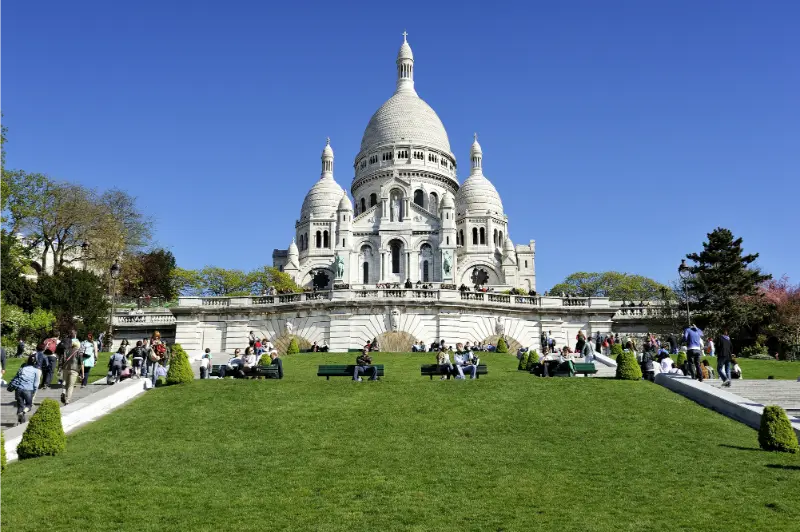
Sacré-Cœur is both one of Paris’s most visited viewpoints and an active basilica. Treating it only as a photo stop misses the building; treating it only as a church ignores how strongly the hill, steps, streets and dome shape the visit. The smartest plan separates three experiences: the free basilica interior, the paid dome climb and the wider Montmartre walk.
Check tickets and Paris experiences
Compare current tours, timed-entry tickets and experiences before fixing your itinerary.
GetYourGuideTiqetsCivitatisViatorAffiliate links: we may earn a commission at no extra cost to you.
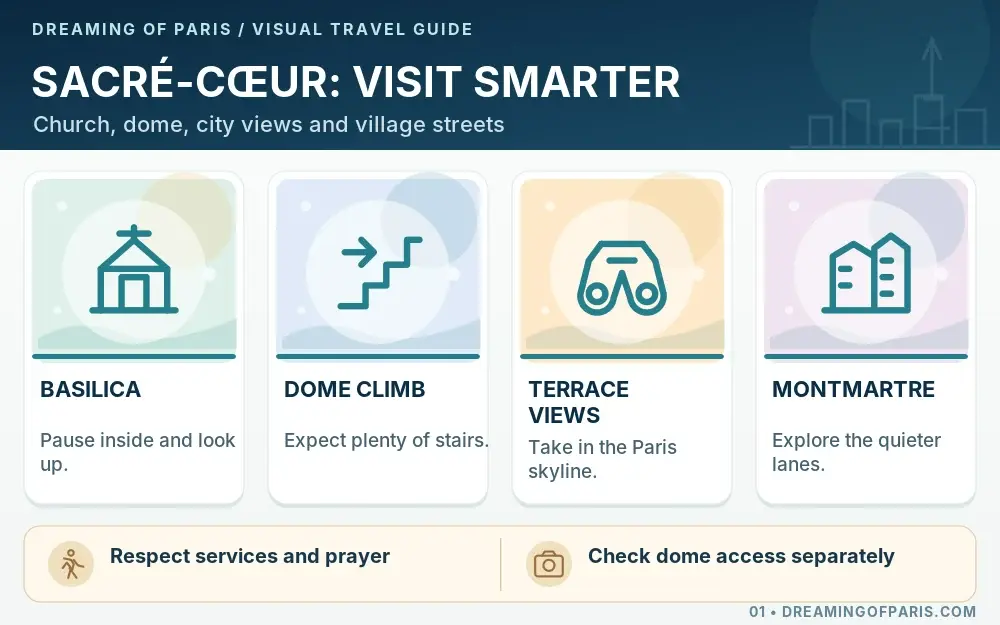
The basilica is currently open every day without exception from 6:30 a.m. to 10:30 p.m., and entry to the church itself is free. The dome is a separate paid visit with nearly 300 steps and no elevator. Dome hours vary seasonally and can change for weather or maintenance, so check the official site shortly before you go.
What is free and what costs money
You do not need a ticket to enter the basilica. This is important because some visitors mistake third-party tour offers for mandatory admission. You may encounter a security check before entry, and the building remains a functioning place of worship with services and continuous religious activity.
The dome is different. It has a separate entrance outside the basilica, on the left after security, and requires a long staircase. The reward is a 360-degree view across Paris. If mobility, claustrophobia or stair climbing is a concern, do not treat the dome as essential; the terraces and city views around Montmartre already give you a strong sense of elevation.
The best time to visit depends on which Sacré-Cœur you want
For the quietest interior, early morning is the strongest option. The square and steps become far busier later in the day. Sunset is popular for obvious reasons, but “popular sunset” also means crowds, street activity and less contemplative space. If photography is your priority, consider early morning light or a later evening visit rather than assuming sunset is automatically superior.
Our early-morning Paris guide explains why Montmartre is one of the few areas where getting up early can genuinely change the atmosphere rather than simply put you outside a closed attraction.
How to reach Sacré-Cœur without choosing the most exhausting route by accident
Anvers metro is common because it leads toward the classic approach from below, but the final climb can feel steep and crowded. Abbesses puts you into the neighborhood differently, while Lamarck-Caulaincourt can be useful if you want to approach through quieter northern streets. The Montmartre funicular helps with part of the elevation near the basilica and uses the Paris transport ticketing system.
The route matters more than the station name. If Sacré-Cœur is only one stop in a half-day walk, begin or end via Rue des Martyrs or follow our Montmartre beyond Sacré-Cœur route so you experience the hill as a neighborhood.
Inside the basilica: slow down before looking up
The vast apse mosaic is one of the interior’s dominant features, but Sacré-Cœur remains a sanctuary as well as a major visitor site. Services, prayer and adoration continue while visitors enter, so roped areas, photography limits and visitor circulation can change during worship; the basilica’s current signage is the best reference on the day.
The basilica’s official site also notes restoration work on the great organ extending into 2027. That is exactly the kind of detail that can affect the experience without making the basilica “closed.” Check current notices if music or the organ is a specific reason for your visit.
The dome climb: what 300 steps actually means
The dome route has almost 300 steps and no elevator. It is not a broad ceremonial staircase; expect a physical climb with confined sections. The official basilica advises against the climb for visitors with mobility difficulties or health fragility. Wear stable shoes and avoid carrying bulky bags if possible.
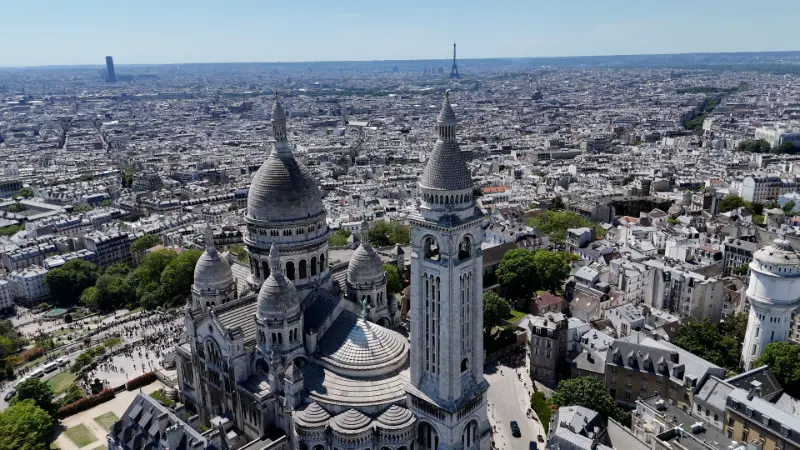
At the top, the view differs from the Eiffel Tower and Arc de Triomphe because you are looking from the northern hill across the central city. If your trip already includes several paid viewpoints, compare them in our best views of Paris guide before paying simply because another viewpoint exists.
A better 2–3 hour Montmartre sequence
Start before the busiest period, visit the basilica interior, decide whether the dome is worth your energy, then leave the parvis instead of staying on the same few streets. Continue toward Place du Tertre only if you genuinely want it, then use smaller streets around the hill, residential corners and the western side of Montmartre.
For food and local commerce, descend via Rue des Abbesses or connect to Rue des Martyrs. For a longer route, include the Montmartre Cemetery or the streets around Lamarck-Caulaincourt. The point is to make Sacré-Cœur the anchor of a neighborhood walk, not the entire walk.
Crowd and scam awareness without paranoia
The steps and approaches around Sacré-Cœur are busy, which makes normal big-city awareness useful. Keep valuables secure, do not engage with unwanted bracelet or petition approaches, and ignore anyone who tries to turn an unsolicited interaction into an obligation. Most visits are uneventful; the goal is simply to avoid being distracted in a dense tourist area.
Our Paris scams and tourist mistakes guide explains common situations across the city without treating every stranger as a threat.
Should you book a Montmartre tour?
You do not need a tour to enter Sacré-Cœur. A guided walk can, however, add value if you want the hill’s artistic history, urban development and small streets explained rather than simply navigating between photo stops. Compare the route carefully: some tours spend most of their time in the busiest core, while others go deeper into the neighborhood.
Official information before you go
Check the official Sacré-Cœur website for basilica notices and the separate dome information page for current opening hours. Dome hours can change with season, maintenance and weather, so a fixed time copied from an old guide is not reliable enough.
Frequently asked questions
Is Sacré-Cœur free?
Yes, the basilica interior is free. The dome is a separate paid visit.
How many steps are there to the dome?
Nearly 300, with no elevator. It is a physical climb and not a good choice for every visitor.
Is Sacré-Cœur better at sunrise or sunset?
Early morning is better for calm; sunset is better for atmosphere but much busier. Choose based on what you value rather than assuming one is universally best.
How long should I spend?
Allow about 45–60 minutes for the basilica and immediate surroundings, longer if you climb the dome. For Montmartre as a neighborhood, plan at least two to three hours.
Visiting during services and prayer
Sacré-Cœur remains an active place of worship as well as one of Paris’s major monuments. Services, prayer and adoration continue while visitors enter, so access, aisle use and photography can change during liturgy. Clothing expectations and any restricted areas are best checked against the basilica’s current guidance; outside active services, the interior is generally easier to appreciate at a quieter pace.
Accessibility and the dome are separate questions
The basilica provides accessibility arrangements for the main sanctuary, but the dome’s stair-only route is a different product. A traveler who can visit the church comfortably may still be unable to climb the dome. Plan those two experiences separately and do not let a paid panorama determine whether Sacré-Cœur is worth visiting.
The funicular: useful, not a tourist attraction in itself
The Montmartre funicular covers the steepest section between the lower streets and the basilica level. It can be practical for families, older travelers or anyone saving energy for the dome. Because it is integrated into the normal Paris public-transport system, treat it as mobility rather than a separate sightseeing ride.
Photography without blocking the steps
The broad steps below the basilica look like a natural photo studio, but they are also circulation space. Move to the side, take the photograph and keep pathways clear. For skyline images, the parvis gives a broad city view; the paid dome gives a higher 360-degree perspective. They are different experiences, so you do not need both for the same picture.
Place du Tertre: decide whether it matches your interests
Place du Tertre is famous for portrait artists and a concentrated tourist atmosphere. Some visitors love the theatrical Montmartre image; others find it too busy. There is no need to avoid it on principle, but do not let it consume an hour if what you really want is quieter streets, architecture and neighborhood history.
A route for visitors with limited stamina
Approach from a higher or gentler station, visit the basilica interior, skip the dome and descend gradually through Montmartre rather than climbing every staircase. This produces a satisfying visit with much less physical demand. The neighborhood has enough texture at street level that the dome should never be treated as a test you must pass.
A final neighborhood decision
If you have only one Montmartre visit, decide in advance whether your priority is the basilica, the view, artistic history, food streets or simply atmosphere. That decision determines the route. Visitors who try to maximize all five usually spend most of the time in the busiest few hundred meters. A narrower goal often produces a deeper visit and leaves energy for another Paris neighborhood.