Disclosure: This article contains affiliate links or booking widgets. If you book through them, Dreaming of Paris may earn a commission at no extra cost to you. How our affiliate links work.
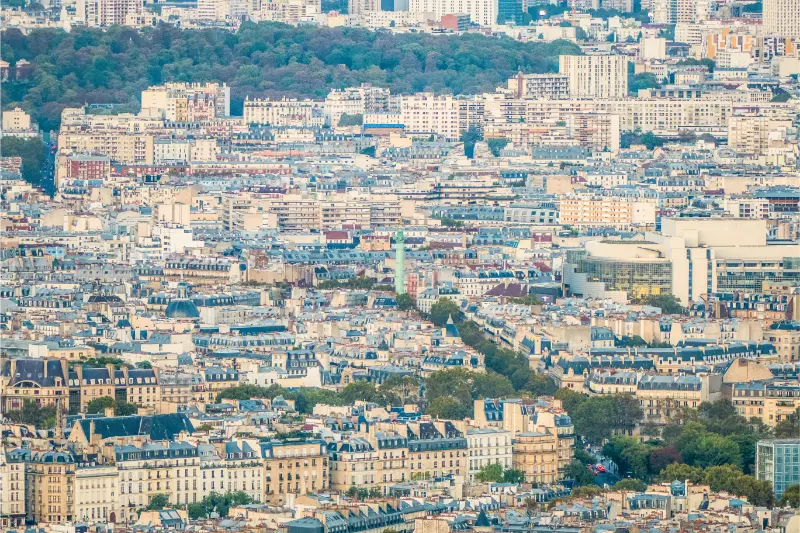
The 11th is one of the best districts for visitors who want Paris to feel lived-in: political history, former workshops, small restaurants, street art and nightlife overlap without a single monument controlling the day.
Check tickets and Paris experiences
Compare current tours, timed-entry tickets and experiences before fixing your itinerary.
GetYourGuideTiqetsCivitatisViatorAffiliate links: we may earn a commission at no extra cost to you.
Quick planning summary
Why the 11th feels different
Much of the arrondissement is residential and social rather than ceremonial. You come for streets, courtyards, food, bars and the transition from afternoon to evening. That makes it especially useful on a second trip or after several museum-heavy days.
Start at Bastille
Place de la Bastille gives historical context and excellent transport connections. From here, move east rather than lingering only around the traffic circle. The Port de l’Arsenal, rue de la Roquette and Faubourg Saint-Antoine reveal very different layers within a few minutes.
Workshop history and hidden courtyards
The broader Faubourg Saint-Antoine area was shaped by craftsmen, especially furniture makers. Some courtyards and passages still hint at that working history. Access is not guaranteed: many are private or protected by codes, so appreciate open passages without treating residents’ spaces as tourist attractions.
Oberkampf by day
Before nightlife starts, rue Oberkampf and surrounding streets are useful for cafés, lunch and observing the mix of older businesses and newer venues. Side passages such as Cité du Figuier add texture, but remain respectful because these are lived spaces.
Street art
Oberkampf and nearby Belleville connect naturally with Paris’s street-art scene. Works change, so an old mural list becomes obsolete quickly. Look for sanctioned walls, shutters and changing interventions rather than expecting one permanent outdoor museum.
Food
The 11th has become one of the city’s strongest restaurant districts precisely because it is not dependent on monument footfall. Booking can still be necessary at sought-after addresses. If you are flexible, eat slightly earlier or later and keep a shortlist within the same few streets.
From aperitif to nightlife
The neighborhood’s strength is progression: coffee in late afternoon, dinner, then bars or music without a long ride. Rue Oberkampf, Jean-Pierre Timbaud and Parmentier are key axes. The atmosphere can become loud; move a street or two away if you want a quieter drink.
Atelier des Lumières
The immersive art venue is nearby and can work as an indoor anchor, particularly in rain or with teenagers. Treat it as a separate contemporary experience rather than a replacement for traditional museums. Check the current program and timed-entry conditions.
Père-Lachaise extension
Continue east to Père-Lachaise if you start early. The cemetery needs respectful pacing and closes earlier than nightlife venues, so visit it first, then return toward Oberkampf for dinner. Our dedicated cemetery guide helps with route planning.
Who should stay here
The 11th suits travelers who value restaurants and evenings more than postcard views outside the hotel window. It can be excellent for repeat visitors and younger couples, but a first-time visitor with only two days may prefer a more central base. Compare neighborhood trade-offs in our where-to-stay guide.
How this article fits into the Dreaming of Paris cluster
For a deeper plan, continue with Père-Lachaise, Paris street art, Canal Saint-Martin, where to stay. These guides are linked because they share geography or a real planning decision, not simply because they mention Paris.
Compare current bookable experiences
Official information
For the details most likely to change, use the Paris je t’aime Oberkampf page. Recheck it shortly before the visit rather than relying on a screenshot saved weeks earlier.
Practical checklist before you leave the hotel
- Recheck opening hours, closures or transport work.
- Save the exact entrance or meeting point, not only the attraction name.
- Carry water and keep enough phone battery for navigation.
- Know one nearby alternative in case the main plan changes.
- Allow more time if you have luggage, children or reduced mobility.
- Avoid scheduling another major timed attraction immediately afterward.
Is the 11th arrondissement touristy?
Parts are popular, but much of the appeal comes from ordinary neighborhood life, restaurants and nightlife rather than major monuments.
Is Oberkampf good at night?
Yes for bars, music and a lively atmosphere; choose side streets if you want something quieter.
Can I combine the 11th with Père-Lachaise?
Yes. Visit the cemetery earlier in the day, then walk back toward Oberkampf or Bastille for dinner.
Is the 11th a good place to stay?
It is strong for food and nightlife, especially for repeat visitors, but less convenient than the center for a very short first trip.
Final planning advice
The best way to use this guide to 11th arrondissement Paris is to place it inside a coherent day rather than treat it as an isolated checklist item. Paris becomes easier when every reservation has a reason, every journey has a nearby second purpose and at least one part of the day remains flexible. That approach protects you from queues, weather changes and simple fatigue while leaving space for the unplanned café, street or view that often becomes the strongest memory.
An immersive-art stop in the 11th
The Atelier des Lumières guide explains the rotating 2026 projection program and how to fit the venue naturally into an Oberkampf/11th day.
Use Bastille as the start and Oberkampf as the finish
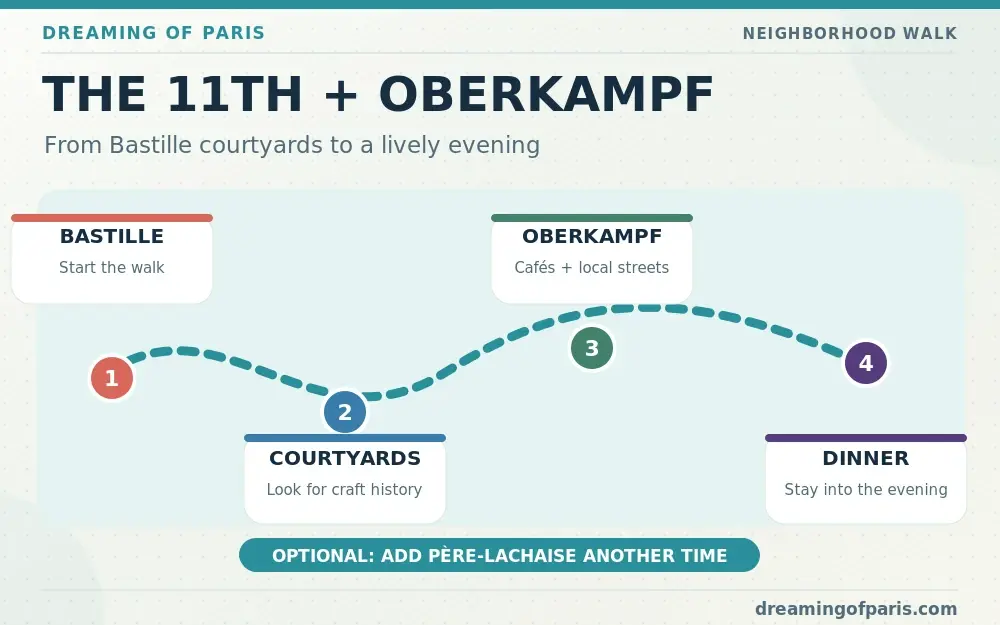
The 11th arrondissement is easier to experience as a directional walk than as a list of restaurants. Start near Bastille while the streets are still in daytime mode, move through side streets and former craft areas, then let the route become more food- and nightlife-focused as you approach Oberkampf. This creates a natural progression rather than making you travel into the district only after dinner.
Look beyond the busiest boulevard. Courtyards, small workshops, independent shops and residential streets are part of the arrondissement’s character, but remember that many courtyards are private. An open doorway is not an invitation to enter. Street-level observation is enough unless a business, event or public passage clearly welcomes visitors.
Food and nightlife without reservations everywhere
Choose one meal you care enough to reserve and leave the rest flexible. The area is dense with bars and restaurants, so an over-engineered plan works against its strengths. If you have a concert or timed evening activity, eat nearby instead of crossing back to the center.
The Atelier des Lumières can fit naturally into this cluster when its current program interests you. For the western side of the same broader area, our Bastille and Faubourg Saint-Antoine guide focuses more on craft history, courtyards and the axis toward Aligre.
A practical decision check for The 11th Arrondissement and Oberkampf
The 11th is best when you want contemporary neighborhood life, food and nightlife linked to a daytime walk. Before you give it a fixed slot, compare that reason with the strongest alternative already on your itinerary. If the alternative matters more, move this stop to an optional block instead of forcing both into the same half-day. That simple choice keeps the article useful for different travelers rather than implying that every reader needs the same Paris.
A realistic way to fit it into the day
Start Bastille, move through side streets and craft-history areas, stop for a late lunch or café and arrive near Oberkampf as bars begin to fill. Keep the previous and following stops close enough that a delay of twenty or thirty minutes does not create a cascade of missed reservations. Paris days become much easier when the route can absorb a longer lunch, a queue or a weather change without requiring a taxi across the city.
The trade-off worth making explicit
The trade-off is famous sights versus atmosphere. There are fewer postcard monuments, so the visit only works if ordinary streets and local businesses interest you. Making that trade-off deliberately is more useful than adding another item to a checklist. Ask what you would remove if this experience takes longer than expected; if the answer is “nothing,” the day is probably already too full.
Small details that prevent avoidable problems
Avoid publishing or following lists of private courtyards as if they were attractions. Access changes and residents deserve privacy. Save the exact address or entrance you intend to use, keep enough phone battery for the return route and recheck any time-sensitive information on the official site. These are small steps, but they protect the part of the experience that actually matters from being swallowed by logistics.
Where it belongs in the wider Paris cluster
Bastille/Faubourg Saint-Antoine is the historical extension; Atelier des Lumières is the cultural anchor when the current program appeals. Treat that pairing as a geographic or thematic cluster, not an obligation to complete everything. One strong connection is enough to make the day coherent; two or three distant add-ons usually reduce the value of the place you came to see.
Best time for the transition
Late afternoon is especially useful if you want to feel the district change from daytime neighborhood to evening destination. Start while shops and ordinary street activity are still visible, eat before the busiest bar period, then decide whether to stay. Arriving only at midnight gives you nightlife but removes the context that makes the 11th more than a collection of bars.