
The Musée de l’Orangerie is compact enough to tempt visitors into rushing and important enough to deserve the opposite. Its two oval Water Lilies rooms are the headline, but the museum also contains the Walter-Guillaume Collection with major early-20th-century painting. Current official information lists opening 9:00–18:00 Monday and Wednesday through Sunday, Tuesday closed, with last admission at 17:15. Current standard pricing is €12.50 online and €11 at the museum, subject to change; Friday late openings operate during selected exhibition periods, so check the calendar for your date.
Begin with the Water Lilies, but slow down
The panoramic Nymphéas were designed for sustained looking, not a quick photograph. Walk the two oval rooms once to understand the sequence, then choose a bench or standing position and stay. The light, scale and relationship between panels become clearer after several minutes.
Check tickets and Paris experiences
Compare current tours, timed-entry tickets and experiences before fixing your itinerary.
GetYourGuideTiqetsCivitatisViatorAffiliate links: we may earn a commission at no extra cost to you.
Photography is not the same as seeing
The rooms can fill quickly because visitors naturally stop in the same central positions. Take any permitted photograph efficiently, then put the phone away. Moving closer to individual passages and farther back for the full curve reveals how radically the paintings change with distance.
Do not skip the lower galleries
The Walter-Guillaume Collection changes the museum from a single-master pilgrimage into a broader art visit. Build in time for Cézanne, Renoir, Modigliani, Soutine and others rather than treating the rest of the building as the route to the exit.
Choose the museum for scale
Orangerie is a strong choice on a day when the Louvre feels too large or when you want art without museum fatigue. Around ninety minutes to two hours can be enough for a thoughtful first visit, though temporary exhibitions can extend that.
Use the Tuileries location intelligently
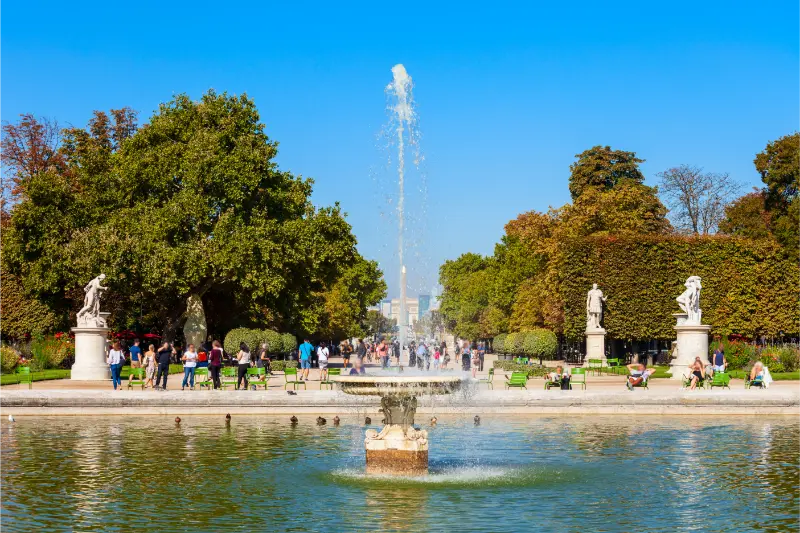
Because the museum sits at the western edge of the Tuileries, it pairs naturally with a garden walk, Place de la Concorde or a later route along the Seine. Avoid adding another huge museum immediately unless art is the main purpose of the day.
Ticket and timing strategy
Timed or online booking can reduce uncertainty during busy periods, but security and gallery crowding still exist. Tuesday closure makes adjacent days potentially more attractive to other visitors, so check the current exhibition program and official ticket page rather than relying on a fixed crowd prediction.
Useful connections on Dreaming of Paris
Compare scale and collections with our Musée d’Orsay guide. For a wider museum strategy, use small museums in Paris.
Is Musée de l’Orangerie closed on Tuesday?
Yes. Current official hours list Tuesday as the regular weekly closing day.
How much is the current standard ticket?
The museum currently lists €12.50 online and €11 on site for general admission, but prices can change, so confirm before booking.
How long should I allow?
About 90 minutes to two hours works for many first-time visitors, longer if a temporary exhibition is important to you.
A final planning note
The Orangerie rewards attention more than endurance. Give the Water Lilies time to become a room rather than a photo backdrop, then let the rest of the collection widen the visit before returning to the Tuileries.
For Musée de l’Orangerie, one more practical point is worth keeping in mind. Timed entry solves only part of the crowd problem. Security, cloakroom restrictions, stairs and the natural bottlenecks around famous works still shape the experience. Arriving prepared for those small frictions is more useful than searching for a mythical completely empty hour. Use this as a decision rule rather than a rigid instruction: the best version of the day is the one that keeps the route coherent and leaves enough energy for the place itself.
For Musée de l’Orangerie, one more practical point is worth keeping in mind. Do not judge value only by visit duration. Some of Paris’s strongest cultural sites are compact. A focused ninety minutes with enough attention is often more rewarding than extending a visit simply because a ticket cost money. Use this as a decision rule rather than a rigid instruction: the best version of the day is the one that keeps the route coherent and leaves enough energy for the place itself.
For Musée de l’Orangerie, one more practical point is worth keeping in mind. A museum or monument is more memorable when it is connected to the streets around it. Before or after the visit, spend twenty minutes in the immediate neighborhood: the change in scale, materials and street pattern often explains more than another room of labels. Use this as a decision rule rather than a rigid instruction: the best version of the day is the one that keeps the route coherent and leaves enough energy for the place itself.
Give the Water Lilies two passes
The oval Water Lilies rooms are easy to “complete” in ten minutes and difficult to really see in ten minutes. On the first pass, walk the perimeter and notice how the panels continue around the curved walls. On the second, sit. Changes in reflection, horizon line and color become more obvious when you stop scanning for the most famous panel. If the rooms are busy, begin downstairs and return later rather than forcing the experience in a crowd.
The lower-level Jean Walter and Paul Guillaume collection is not filler. It places Monet alongside a compact group of works by artists including Renoir, Cézanne, Modigliani, Matisse, Picasso, Soutine and others associated with early twentieth-century collecting. Visitors who skip it miss the reason the Orangerie is more than a single-installation museum.
Timing and ticket choices in 2026
The museum is currently open from 9 a.m. to 6 p.m. and closed on Tuesdays, with last admission before closing; Friday late openings can operate during exhibition periods. Prices differ between online and on-site purchase, and the museum also sells a combined Orsay/Orangerie ticket. Check the official page on your date because exhibitions and late-night schedules change.
Do not automatically combine the Orangerie with the Louvre merely because both are nearby. The better artistic pairing is often the Musée d’Orsay, while the better geographical pairing is a walk through the Tuileries Garden. Choose one logic and leave enough attention for the museum.
For Monet enthusiasts, the Orangerie shows immersion at monumental scale; Musée Marmottan Monet offers a different, collection-driven experience farther west. Visiting both on separate days makes more sense than treating one as a substitute for the other.
A practical decision check for Musée de l’Orangerie
The Orangerie is ideal when you want one major artistic experience without a huge museum day. Monet fans should prioritize time in the oval rooms, but the downstairs collection deserves attention. Before you give it a fixed slot, compare that reason with the strongest alternative already on your itinerary. If the alternative matters more, move this stop to an optional block instead of forcing both into the same half-day. That simple choice keeps the article useful for different travelers rather than implying that every reader needs the same Paris.
A realistic way to fit it into the day
Book or arrive early, make one slow Water Lilies pass, see the lower galleries, then return to Monet before leaving. Continue through the Tuileries instead of rushing to another museum. Keep the previous and following stops close enough that a delay of twenty or thirty minutes does not create a cascade of missed reservations. Paris days become much easier when the route can absorb a longer lunch, a queue or a weather change without requiring a taxi across the city.
The trade-off worth making explicit
The trade-off is compact scale versus ticket value. The museum is small, but concentration is high; do not judge it by the number of rooms. Making that trade-off deliberately is more useful than adding another item to a checklist. Ask what you would remove if this experience takes longer than expected; if the answer is “nothing,” the day is probably already too full.
Small details that prevent avoidable problems
Friday late openings can change the crowd pattern during exhibition periods. Check the official schedule and choose a time when you are not arriving immediately after a long Louvre visit. Save the exact address or entrance you intend to use, keep enough phone battery for the return route and recheck any time-sensitive information on the official site. These are small steps, but they protect the part of the experience that actually matters from being swallowed by logistics.
Where it belongs in the wider Paris cluster
Pair geographically with Tuileries/Concorde or artistically with Orsay on a different part of the day. Marmottan is the deeper Monet collection on another day. Treat that pairing as a geographic or thematic cluster, not an obligation to complete everything. One strong connection is enough to make the day coherent; two or three distant add-ons usually reduce the value of the place you came to see.
When the museum is crowded
If the Water Lilies rooms are full when you enter, do not spend the visit waiting irritably for empty photographs. Go downstairs first, see the collection, then return to the ovals. Crowd waves often change as timed groups move through. Even when the rooms never empty, sitting still changes the experience because visitors circulate while the paintings remain continuous around you.