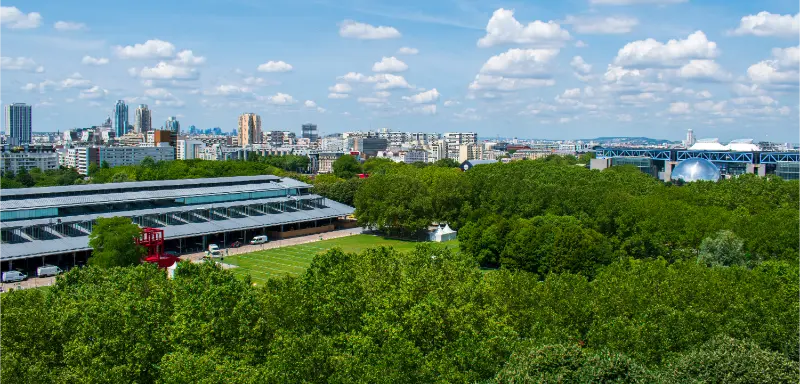
La Villette is not a single attraction but a piece of northeast Paris designed around space. The Cité des Sciences, concert venues, large lawns, architectural follies and Canal de l’Ourcq create a district where a day can shift between culture and open air. It works especially well for families, repeat visitors and anyone who wants a version of Paris that feels less compressed than the historic center.
Decide whether the museum or the park is the anchor
If Cité des Sciences is essential, reserve it first and let the outdoor route wrap around that time. If you mainly want a neighborhood day, start with the canal and use exhibitions as optional weather backups. The distinction prevents you from trying to consume the entire complex.
Walk the canal rather than only crossing it
Canal de l’Ourcq gives the area a strong east-west line. A walk along the water reveals bridges, boats, cafés and changing urban edges. The experience is especially pleasant when you allow time to sit rather than treating the canal as a corridor between attractions.
Parc de la Villette as a design landscape
The park is unusually open and structured, with red follies acting as visual markers. It is not a traditional formal Paris garden. That is precisely why it works for a different type of day: movement, lawns, events and large cultural buildings coexist.
Music and evening possibilities
The Philharmonie and other venues can turn La Villette into an evening destination rather than a daytime excursion. If you hold concert tickets, simplify the afternoon and eat nearby rather than rushing back to central Paris and returning again.
Families: leave time outside
With children, an interactive museum session can already be intense. Follow it with open space, a snack and a simple canal walk. The neighborhood’s strength is that educational activity and decompression are physically close.
How to finish the day
Either continue a short distance along the canal or use the metro to return directly. Do not force a distant western-Paris monument onto the same day. Northeast Paris deserves to be experienced as a cluster rather than as spare time around the Louvre.
Useful connections on Dreaming of Paris
Families should read Cité des Sciences with kids. For another eastern route, see Canal Saint-Martin, Belleville and Buttes-Chaumont.
Is La Villette worth a full day?
Yes if you combine one cultural anchor with the park and canal. If you only want an outdoor walk, a half-day can be enough.
Is it good with children?
Very. The main advantage is the ability to alternate structured museum time with large outdoor spaces.
Is La Villette central Paris?
No. It is in northeast Paris, so group the day geographically rather than repeatedly crossing the city.
A final planning note
La Villette is a useful reminder that Paris is not only compact historic streets. Give the area room, choose one cultural anchor and let the canal and park carry the rest of the day.
For La Villette Paris, one more practical point is worth keeping in mind. Visit at a time that matches the character you want. Residential streets can feel empty in the middle of a workday, while market zones or bar streets become much more animated later. There is no single ‘best’ hour; there is a best hour for the version of the neighborhood you want to see. Use this as a decision rule rather than a rigid instruction: the best version of the day is the one that keeps the route coherent and leaves enough energy for the place itself.
For La Villette Paris, one more practical point is worth keeping in mind. Homes, schools, religious sites and memorials can sit alongside the route, so quieter photography and less intrusive stops tend to fit these areas better. Many of the places that make lesser-known Paris rewarding are ordinary lived-in spaces rather than purpose-built attractions. Use this as a decision rule rather than a rigid instruction: the best version of the day is the one that keeps the route coherent and leaves enough energy for the place itself.
For La Villette Paris, one more practical point is worth keeping in mind. A neighborhood guide works best when you walk through it rather than commute between isolated pins. Start at one edge, follow a clear direction, and let cafés, small parks and ordinary shopping streets become part of the experience. The point is to understand how the area connects, not to claim every landmark. Use this as a decision rule rather than a rigid instruction: the best version of the day is the one that keeps the route coherent and leaves enough energy for the place itself.
Plan La Villette as two different places
La Villette is easier to understand when you separate the indoor cultural campus from the linear waterside landscape. Families and science-focused visitors can make the Cité des Sciences the anchor; walkers and repeat visitors may prefer to treat the canal, lawns, follies and bridges as the main experience. Trying to complete every venue in one day creates unnecessary walking and ticket fatigue.
A practical family plan is museum first, outdoor time second. A practical adult plan can be the reverse: walk the Canal de l’Ourcq and Bassin de la Villette in daylight, stop for a meal, then attend a concert, cinema or event if something on the official program genuinely interests you. The district changes noticeably in the evening, so leave enough flexibility to stay rather than automatically commuting back to the center at 5 p.m.
Understand the distances
The park looks compact on a schematic map but the major venues sit across a broad site. Choose the Metro station according to the first stop, not simply “La Villette.” If you are meeting other people, agree on a named building or bridge rather than “inside the park.” This matters even more after a concert when crowds are moving toward different stations.
To extend eastward, follow our Bassin de la Villette and Canal de l’Ourcq guide. For a hillier neighborhood contrast, Belleville and Ménilmontant work better on a separate half-day rather than being forced onto the end of a long La Villette visit.
Check the individual venue calendar because the park itself is not one attraction with one set of hours. Exhibitions, concerts, children’s sessions and seasonal outdoor activities follow separate schedules. That is also why a good La Villette day starts with one fixed reservation at most; everything else should be able to expand or disappear depending on weather and energy.
A practical decision check for La Villette and Canal de l’Ourcq
La Villette suits travelers who want contemporary urban space, science, music or a less postcard-driven day. It is not a replacement for central monuments; it is a different Paris experience. Before you give it a fixed slot, compare that reason with the strongest alternative already on your itinerary. If the alternative matters more, move this stop to an optional block instead of forcing both into the same half-day. That simple choice keeps the article useful for different travelers rather than implying that every reader needs the same Paris.
A realistic way to fit it into the day
Choose one indoor anchor, walk the park and canal, eat locally and stay for an evening event only if the program interests you. A full day should still contain unbooked outdoor time. Keep the previous and following stops close enough that a delay of twenty or thirty minutes does not create a cascade of missed reservations. Paris days become much easier when the route can absorb a longer lunch, a queue or a weather change without requiring a taxi across the city.
The trade-off worth making explicit
The trade-off is distance versus variety. You spend more time reaching northeast Paris, but once there you can combine culture, green space and water without repeated Metro rides. Making that trade-off deliberately is more useful than adding another item to a checklist. Ask what you would remove if this experience takes longer than expected; if the answer is “nothing,” the day is probably already too full.
Small details that prevent avoidable problems
Save the exact venue name and entrance, because the campus contains multiple institutions and meeting at “La Villette” is too vague. Check event finish times before planning the return. Save the exact address or entrance you intend to use, keep enough phone battery for the return route and recheck any time-sensitive information on the official site. These are small steps, but they protect the part of the experience that actually matters from being swallowed by logistics.
Where it belongs in the wider Paris cluster
Bassin de la Villette and Canal de l’Ourcq extend the water route. Cité des Sciences is the family/science anchor. Belleville is better as a separate half-day. Treat that pairing as a geographic or thematic cluster, not an obligation to complete everything. One strong connection is enough to make the day coherent; two or three distant add-ons usually reduce the value of the place you came to see.