Disclosure: This article contains affiliate links or booking widgets. If you book through them, Dreaming of Paris may earn a commission at no extra cost to you. How our affiliate links work.
Eating in Paris becomes easier once you understand the small rules that are not obvious from a menu. Service is already included in restaurant prices, a tip is optional, tap water with a meal can be requested without paying for bottled water, and kitchens may follow tighter service windows than visitors from some countries expect. None of this requires performing “Parisian etiquette.” It simply helps you avoid confusion.
This guide is about how restaurants work rather than a list of fashionable addresses that will age quickly. Use it alongside our market and food-street articles to build meals around neighborhoods, not around a queue of viral places.
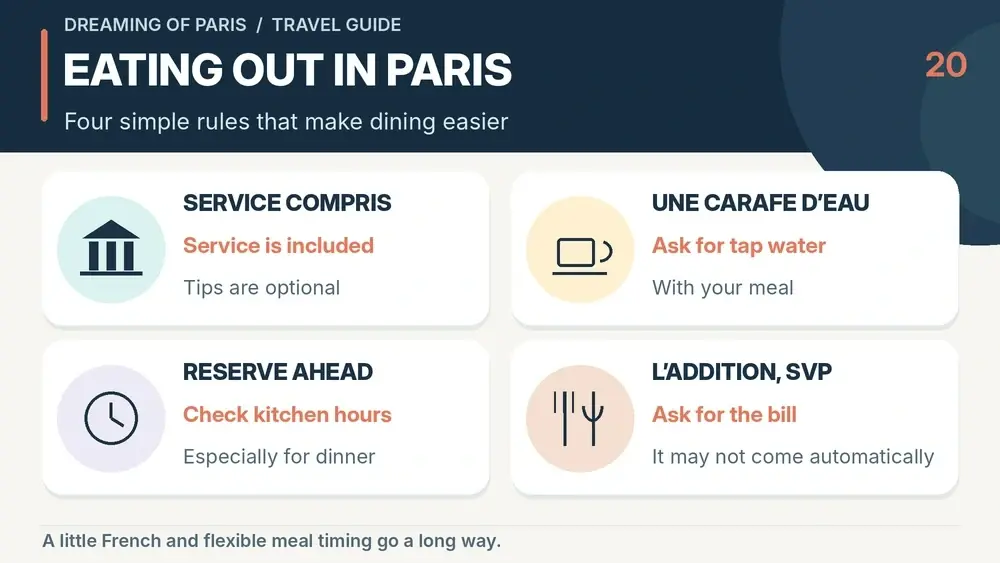
“Service compris” means the service charge is already included
French consumer rules require displayed restaurant prices to include taxes and service. You are not expected to calculate an American-style mandatory percentage on top of the bill. A tip is a voluntary extra when you are pleased with the service.
If you want to tip, rounding up or leaving a few euros is common for a normal meal, while a larger amount can reflect exceptional service. There is no requirement to leave 15–20 percent. The official French consumer authority states clearly that a gratuity cannot be demanded.
Tap water: ask for “une carafe d’eau”
At a restaurant, you do not have to buy bottled still or sparkling water. French consumer guidance confirms that ordinary drinking water served with a meal is included and that establishments must inform customers they can request free potable water. Ask for une carafe d’eau, s’il vous plaît.
This is different from assuming any café must give unlimited free water when you are not dining. The key context is that you are a customer consuming on site.
Bread, cover and surprise charges
In a standard table-service restaurant, the displayed meal price includes the normal cover elements such as bread, ordinary water, cutlery and service. You should not see a separate “cover charge” added as if it were an Italian coperto. Special items you explicitly order, of course, can be charged.
Read menus outside before entering. French rules require restaurant prices and menus to be displayed, which gives you a practical way to compare without sitting down first.
Reservations: Paris is not one continuous dinner service
Some brasseries serve for long hours, but many independent restaurants have defined lunch and dinner services and may close between them. Popular restaurants can fill several days ahead, while a neighborhood lunch on a weekday may be easy to arrange the same day. Check the restaurant’s own website or booking system rather than assuming Google’s hours are current.
If a specific dinner matters, book it. If food is not the centerpiece of the trip, keep one or two reservations and allow the rest to remain flexible. Over-reserving every evening can trap you into cross-city journeys just when you are tired.
What “formule” and “menu” can mean
A lunchtime formule often combines two or three courses at a fixed price and can be one of the best-value ways to eat in Paris. À la carte means choosing items individually. Do not assume a fixed-price menu is available at every service; restaurants may limit it to lunch, weekdays or specific hours.
The printed or posted conditions matter. If a lunch formula ends at a certain time, arriving five minutes late may mean ordering differently.
Café pricing can depend on where you sit
Traditional cafés may price the same drink differently at the counter, at an inside table or on the terrace. Check the displayed menu. Standing at the bar for an espresso can be cheaper and faster; sitting on a terrace means you are paying partly for the table and location.
This is not a scam when the prices are clearly posted. Problems begin when visitors order without looking and assume every seat has the same price.
A few words of French help more than perfect pronunciation
A simple “bonjour” when entering, “s’il vous plaît” when ordering and “merci” when leaving signal ordinary politeness. You do not need to perform a long French conversation if you cannot. Start in French, then switch to English politely if needed.
If you have allergies or serious dietary restrictions, do not rely on improvised language. Carry a clear written explanation in French and confirm ingredients before ordering. “Vegetarian” or “gluten-free” labels may not capture medical cross-contamination needs.
How to ask for the bill
Restaurants do not always rush to bring the bill because lingering at the table is normal. Ask for l’addition, s’il vous plaît when you are ready. Card payment is widespread, but small establishments can have minimums or technical outages, so a modest cash backup is useful.
Do not interpret a slower pace as neglect automatically. Service rhythm in Paris can be less focused on repeatedly checking the table.
Food neighborhoods: build meals into your route
Instead of crossing Paris for every meal, use neighborhoods that already fit your sightseeing. Our markets and food streets guide connects food with place; Rue des Martyrs works naturally with Montmartre; and Marché d’Aligre fits a Bastille/east-Paris day.
This approach also makes it easier to discover places that are good for the neighborhood rather than famous everywhere online.
Food tours: useful when context matters more than a restaurant list
A good food tour can explain cheese, bread, markets, regional products and neighborhood history in a way that a list of “best croissants” cannot. Check group size, how many tastings are included and whether dietary restrictions can be accommodated before booking.
Picnics and self-catering as part of the food experience
Not every memorable meal needs a reservation. Markets, bakeries and specialty shops can support a simple picnic or hotel-room breakfast, especially when restaurant fatigue sets in. Follow park-specific rules and avoid buying perishable foods hours before you can refrigerate them.
Our Paris picnic guide explains where the romantic idea works in practice.
What tourists most often get wrong
The biggest mistakes are expecting dinner service at any hour, tipping by imported rules, assuming bottled water is mandatory, and chasing social-media restaurants across the city. A meal should support the day’s geography and energy. Paris has enough food options that you rarely need to sacrifice two hours of sightseeing to commute to lunch.
Use restaurant research for the meals that matter most, then trust neighborhood exploration for the rest.
Frequently asked questions
Do you have to tip in Paris restaurants?
No. Service is included in the displayed price and tipping is optional. Leave extra only if you want to reward good service.
Is tap water free?
Yes, customers dining in restaurants can request potable tap water. Ask for “une carafe d’eau.”
Do you need reservations?
For popular dinner restaurants, often yes. For casual lunches and brasseries, not always. Check the specific restaurant’s own booking policy and opening days.
Is bread free?
Ordinary bread and table service are normally included in the displayed restaurant price under French consumer rules; separately ordered items can of course be charged.
Lunch can be the strategic meal
If you want one ambitious restaurant experience without giving up an entire evening, lunch can be smart. Some restaurants offer a shorter or better-value midday formula, and you can place the meal between two attractions in the same neighborhood. Dinner then becomes flexible when fatigue and weather are easier to predict.
How to choose without chasing rankings
Look at the menu, recent opening information, price level, booking friction and whether the restaurant fits your route. A shorter seasonal menu can be a positive sign, but no single rule guarantees quality. Avoid making a decision from star ratings alone; read enough recent feedback to understand recurring strengths or problems, then choose the place that fits your day.
Solo dining in Paris
Eating alone is normal, especially at lunch, cafés and many bistros. A busy restaurant may offer a smaller table or seat at the bar, but you do not need to apologize for being solo. Bring a book if you enjoy reading, keep valuables secure and do not feel pressured to order multiple courses unless the restaurant has a fixed menu.
Children in restaurants
Family dining works best when you match the restaurant to the child’s energy and the service style. Brasseries and casual neighborhood restaurants can be easier than a long tasting menu. Ask about child portions or menus when booking, and avoid expecting every kitchen to produce an off-menu plain dish at peak service.
Allergies and dietary needs
For serious allergies, communicate clearly before ordering and ideally before arrival. The EU allergen framework requires information, but kitchen cross-contact risk still varies. A translated allergy card can reduce ambiguity. Vegetarian and vegan options are increasingly common, yet traditional sauces and stocks can contain meat or dairy even when the visible ingredients appear plant-based.
Bakeries, pastry shops and queues
At a busy boulangerie, decide roughly what you want before reaching the counter and keep the line moving. You can point politely if pronunciation is difficult. Not every pastry shop has seating, and eating immediately outside a narrow doorway can block customers; move aside before opening bags or taking photos.
Go deeper into Paris food culture
For the everyday side of eating, continue with our Paris boulangeries and pâtisseries guide, café culture guide and food tour guide.
Go deeper into Paris dining
Once the etiquette is clear, compare the formats in our Paris bistro guide and Paris brasserie guide, then use the Paris wine guide to make the drinks list much easier.
Choose the meal format
For a special reservation, read our fine dining in Paris guide; for the opposite end of the budget, use how to eat cheaply in Paris.
Useful language and payment details
For ordering and everyday courtesy, keep our essential French phrases for Paris handy. For cards, euros and conversion choices, see money in Paris.