Paris becomes much more interesting after you stop using “museum” as a synonym for Louvre or Orsay. Smaller museums can solve three common problems at once: they are easier to fit into a neighborhood day, they usually demand less physical stamina, and several municipal collections are free. They also let you build a trip around specific interests—Paris history, Asian art, sculpture, literature or modern art—rather than global fame.
The free municipal-museum rule most visitors miss
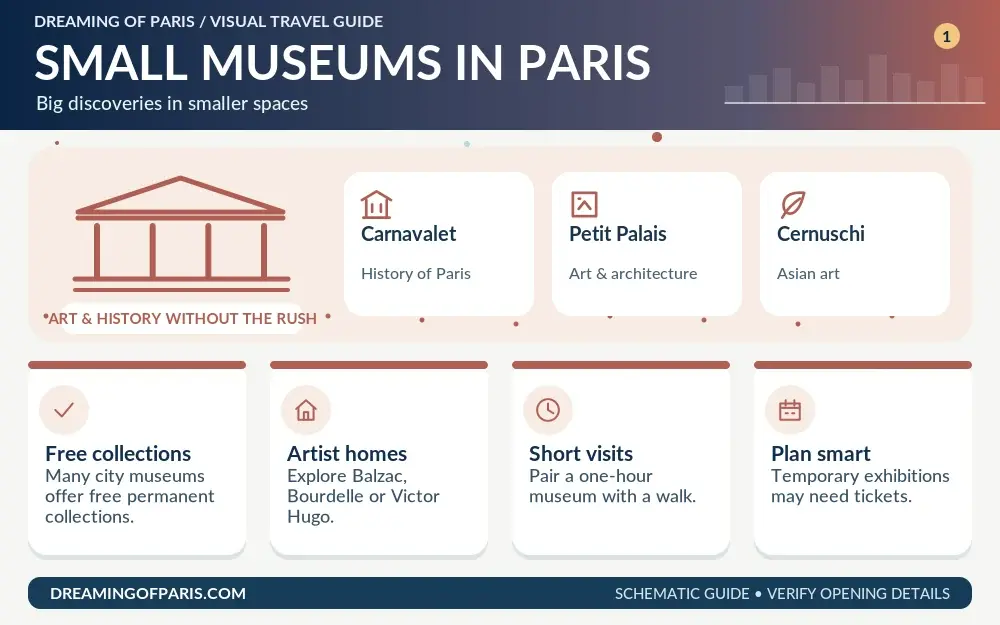
Paris Musées brings together 14 City of Paris museums and heritage sites. The city states that, with the exceptions of the Catacombs, the Archaeological Crypt of Île de la Cité and Palais Galliera, the permanent collections of the municipal museums are free for everyone. Temporary exhibitions can still require tickets. This is one of the most useful budget facts in Paris because it allows a spontaneous 45-minute visit without feeling you must “get your money’s worth.”
Check tickets and Paris experiences
Compare current tours, timed-entry tickets and experiences before fixing your itinerary.
GetYourGuideTiqetsCivitatisViatorAffiliate links: we may earn a commission at no extra cost to you.
Musée Carnavalet: the best museum for understanding Paris itself
Carnavalet belongs naturally in a Le Marais day. Its permanent collection traces the city’s history through rooms, objects, signs, interiors and political change. Because the permanent collection is free, you can visit one section and return on another trip instead of trying to absorb the entire history of Paris in one sitting. Pair it with our Le Marais route.
Petit Palais: art plus architecture in a manageable dose
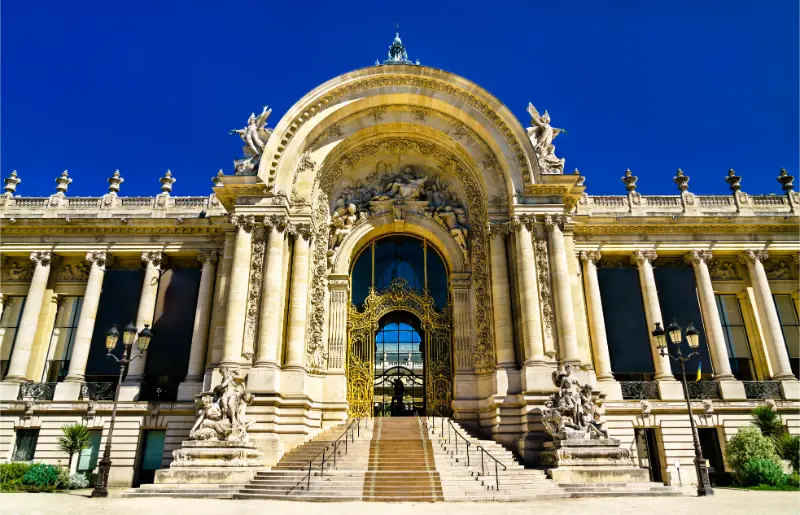
The Petit Palais is easy to underestimate because it sits near some of Paris’s most photographed monumental architecture. Its permanent fine-arts collection is free, and the building and interior garden make it an excellent one-to-two-hour stop. It pairs geographically with the Champs-Élysées, Pont Alexandre III and the Seine without requiring a special cross-city journey.
Musée d’Art Moderne de Paris
For twentieth- and twenty-first-century art, the municipal modern-art museum near the Palais de Tokyo offers a free permanent collection under the city system, while temporary exhibitions are separately ticketed. It is a smart alternative when the major national modern-art options are crowded or undergoing changes.
Musée Cernuschi: Asian art near Parc Monceau
Cernuschi is particularly useful because it creates a reason to visit an elegant part of the 8th arrondissement away from the main monument circuit. Its Asian-art collection fits naturally with Parc Monceau and can also be linked with Batignolles farther north if you enjoy quieter neighborhoods.
Musée Bourdelle: sculpture and studio atmosphere
Near Montparnasse, the Musée Bourdelle offers sculpture in former studio spaces and a setting that feels fundamentally different from a grand encyclopedic museum. The permanent collection falls under the municipal free-access policy. It is ideal when you want art without committing half a day.
Maison de Victor Hugo
On Place des Vosges, the writer’s house provides a literary layer to a Marais visit. Because its permanent collection is free, it works well as a spontaneous stop if the weather changes or you find yourself nearby with an hour before dinner. Check temporary exhibitions and capacity rules on your date.
Musée de la Vie Romantique
At the foot of Montmartre, this small museum offers a very different scale from the Louvre. Its setting and nineteenth-century focus make it a natural transition between the grand boulevards and the hill. It is especially valuable for repeat visitors who want an indoor stop that still feels connected to neighborhood atmosphere.
Maison de Balzac and Musée Zadkine
Literature lovers can use Maison de Balzac to give Passy a cultural anchor, while the Musée Zadkine near Luxembourg adds sculpture to a Left Bank walk. Both illustrate the main strength of small Paris museums: they make a neighborhood itinerary richer rather than replacing the neighborhood with an attraction.
How to choose a small museum
- Choose by neighborhood first if your trip is short.
- Choose by subject first if this is a repeat visit.
- Check whether the permanent collection or only a temporary exhibition interests you.
- Verify weekly closure and temporary installation closures.
- Use free entry as permission to visit briefly, not as a reason to overfill the day.
A small-museum day that does not feel like homework
Pick one area, not five museums. For example: Carnavalet + lunch + Le Marais streets; Bourdelle + Montparnasse + Luxembourg; Cernuschi + Parc Monceau + Batignolles. The city becomes the connective tissue. This is the opposite of the “museum marathon” that leaves visitors remembering only security queues.
Frequently asked questions
Are Paris city museums free?
Most permanent collections in the City of Paris museum network are free for everyone, with published exceptions including the Catacombs, Archaeological Crypt and Palais Galliera. Temporary exhibitions can require paid tickets.
Is Musée Carnavalet free?
Its permanent collection is part of the municipal free-access system; temporary exhibitions may be ticketed.
What is the best small museum for a first-time visitor?
Carnavalet is especially useful because it explains Paris itself and sits naturally within Le Marais.
Are small museums less crowded?
Often, but not always. Popular temporary exhibitions can sell out, and compact spaces can feel busy even with fewer visitors.
Should I book small museums in advance?
For free permanent collections, often not; for temporary exhibitions or special events, advance booking may be useful or required. Check the museum’s current page.
How this fits into our Hidden & Cultural Paris cluster
This guide is designed to connect with the rest of the site rather than sit alone. Continue with free Paris, Le Marais and second-trip guide. Internal links are placed where the next decision naturally appears, so you can move from transport to neighborhood, attraction, season or day trip without rebuilding the plan from scratch.
The decision that matters most
Use small museums as neighborhood amplifiers. A one-hour museum that sends you back into the surrounding streets curious and energized can be more valuable than a five-hour blockbuster visit you finish exhausted.
Choose depth over collection
For small museums in Paris, decide what you want to notice rather than how many places you want to collect. One artist, one historical period or one neighborhood theme gives the day a memory structure. The strongest cultural itineraries alternate looking with walking, because streets, architecture and food give your brain time to process what you just saw.
Use free or small venues differently
A free permanent collection does not need to become a three-hour commitment. Enter for one floor or one room that interests you, then leave while curiosity is still high. Small museums are valuable precisely because they can fit into an ordinary neighborhood day. This creates space for spontaneous discoveries and avoids the feeling that every ticket must be “maximized.”
What to research before visiting
Read only enough to recognize the context: the artist, the period, the building’s original use or why the neighborhood matters. Ten minutes of focused background is more useful than reading a long encyclopedia entry on your phone while standing in the gallery. Save detailed research for after the visit if something captures your attention.
Photography without losing the experience
Check whether photography is allowed and whether flash or tripods are restricted. Take a few images that help you remember scale and detail, then spend time looking without the screen. For street art, residential doors and local businesses remain functional spaces, so the easiest compositions are those that keep entrances clear and avoid close-up portraits of residents without permission.
Pair culture with food or green space
After a dense museum, choose a market, park or relaxed meal rather than another collection. The contrast improves retention and keeps the day enjoyable for companions with different interests. In Paris, many of the best small museums sit close to excellent neighborhood walks, which is one reason the cluster approach works so well.
Repeat visits and temporary change
Cultural Paris is never fixed. Temporary exhibitions change, street art disappears, museums renovate and collections rotate. A second visit is not redundant if the context has changed or your interest has become more specific. Use current official listings for temporary shows and treat any street-art photograph as a snapshot in time rather than a promise.
A better measure of success
Do not judge the day by the number of museum names or murals checked off. Ask whether you can describe one work, one street, one historical connection and one unexpected detail afterward. That is a much stronger outcome than returning to the hotel with hundreds of photos and no clear memory of where they were taken.
How to make the walk your own
Use small museums in Paris as a framework, not a compulsory route. Mark one starting point, one ending point and two places you genuinely care about in between. Everything else can be discovered at walking pace. If a market is quiet, move on; if a small museum catches your attention, stay longer. This flexibility is what makes neighborhood and cultural travel different from a timed attraction. You are not failing the itinerary when you change it—you are using the neighborhood the way it is meant to be used.
The role of cafés and parks
A café, square or park is not filler between “real” sights. It is where you notice how the area works and where your feet recover enough to keep enjoying the afternoon. Plan one deliberate pause instead of waiting until exhaustion forces a bad choice. In quieter districts, that pause can also help you decide whether to extend the walk, add a museum or finish early and move to dinner. The most memorable neighborhood days usually contain more looking and less rushing than first-time sightseeing days.
When this belongs on a first trip
small museums in Paris can absolutely fit a first Paris visit when it matches your interests, but it should not displace a dream attraction merely because it sounds more “local.” A traveler who has wanted to see the Louvre for years should see the Louvre. The deeper neighborhood or cultural stop becomes powerful when it complements that icon and shows another side of the city. This is the philosophy behind the cluster structure: famous Paris provides orientation; quieter Paris provides texture.
A museum under the streets
For an infrastructure-focused visit rather than an art collection, add the Paris Sewer Museum, which explains the working city beneath the 7th arrondissement.
Build a museum plan beyond the Louvre and Orsay
For free permanent collections, start with the Petit Palais and Musée Carnavalet. For highly focused collections compare the medieval Musée de Cluny, the mansion setting of Jacquemart-André, inventions at the Musée des Arts et Métiers and anthropology at the Musée de l’Homme.
For contemporary art during the Beaubourg closure, first read our Centre Pompidou 2026 guide so you know where its program has moved.
More specialist museums and cultural institutions
For deeper choices beyond the original small-museum list, compare the Musée des Arts Décoratifs, Palais Galliera, Musée d’Art Moderne de Paris, Institut du Monde Arabe, Musée de la Musique and the new Palais-Royal Fondation Cartier.