Disclosure: This article contains affiliate links or booking widgets. If you book through them, Dreaming of Paris may earn a commission at no extra cost to you. How our affiliate links work.
Paris food culture is easier to understand in a market than in a list of “must-eat” dishes. Markets show seasonality, neighborhood habits, price differences and the relationship between produce, cheese, meat, fish, bread and prepared food. Market streets add another layer: permanent shops and cafés create a food ecosystem that does not disappear when outdoor stalls close.
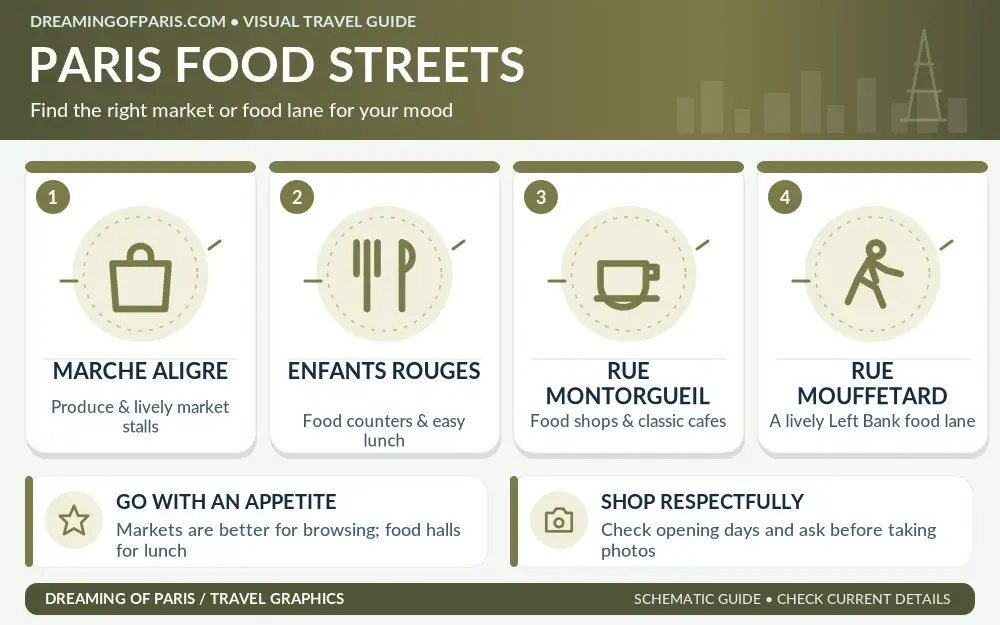
The key is to match the place to the experience you want. Marché d’Aligre is excellent for morning market energy. Marché des Enfants Rouges works well for prepared-food lunch. Rue Montorgueil is a central market street, not a traditional market hall. Rue Mouffetard changes from food-shopping street by day to restaurant and bar corridor later.
How Paris markets actually work
Paris has more than 80 food markets across the city, including outdoor and covered markets. Many outdoor markets operate only on specific mornings or afternoons. Covered markets may have longer hours, but individual vendors can still keep their own schedules.
The official Paris tourism market overview is a good starting point, while the City of Paris publishes exact schedules for municipal markets. Always check the market page for the day of week before traveling across town.
Marché d’Aligre: the best all-round morning market experience
Marché d’Aligre in the 12th arrondissement combines an outdoor market around rue and place d’Aligre with the covered Beauvau market. The neighborhood feels active rather than staged, and the mix of produce, food shops and surrounding cafés makes it worth visiting even if you are not shopping for a kitchen.
The City of Paris currently lists the outdoor market closed Monday, open Tuesday to Friday from 7:30 a.m. to 1:30 p.m., and Saturday/Sunday until 2:30 p.m. Arrive by 10 a.m. if you want the market in full swing without the final-hour rush.
What to do at Aligre if you cannot cook
Do not buy a basket of beautiful produce you will carry around all day. Look for fruit you can eat immediately, cheese in a practical quantity, bread, olives, charcuterie or prepared items. Then use a nearby square or park as a picnic stop where appropriate.
Also walk the surrounding permanent food shops. A market visit is better when it becomes a neighborhood walk rather than a 20-minute stall photograph.
Marché des Enfants Rouges: best for lunch, not solitude
Founded in 1615, Marché des Enfants Rouges is the oldest covered market still operating in Paris. Today it is famous for prepared food as much as traditional market shopping. Moroccan, Afro-Caribbean, Japanese and other cuisines sit alongside produce and food vendors, reflecting contemporary Paris rather than a frozen “old France” image.
The City of Paris listing shows the market closed Monday and open from 8:30 a.m. on other days, with later hours Thursday and a shorter Sunday. Specific stalls can differ. For lunch, arriving before noon is smarter than showing up at 1:15 p.m. expecting empty seating.
Enfants Rouges + Marais: the ideal combination
The market sits in the northern Marais, making it a natural lunch stop during our Le Marais walking route. This is much better than making a separate metro trip just to eat one viral sandwich.
If a famous stall has an enormous line, walk the market first and compare options. The market is small enough that you lose little by making a second choice.
Rue Montorgueil: a market street rather than a market
Rue Montorgueil and its surrounding streets form one of central Paris’s classic food-shopping areas. You will find bakeries, produce, fish, cheese, pastry shops, cafés and restaurants. Because the businesses are permanent, the street works later in the day than a morning-only outdoor market.
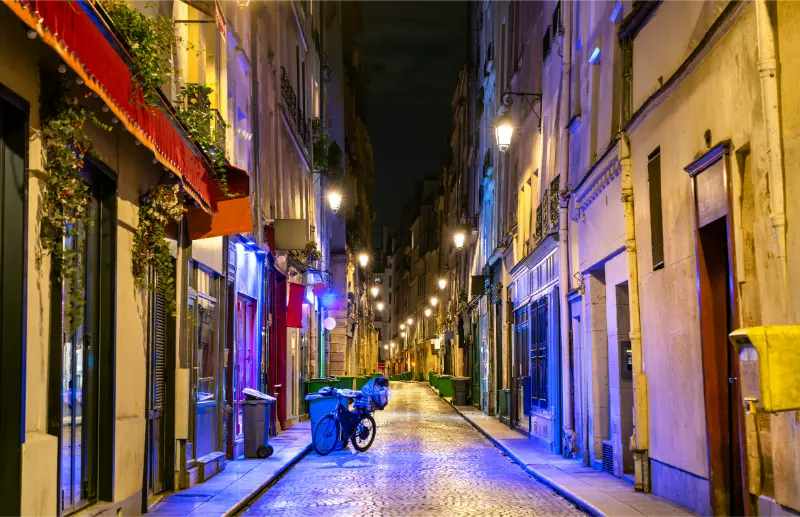
It is also convenient after the Louvre, Palais-Royal or covered passages. Pair it with our covered passages route for a central day with architecture and food rather than another major monument.
How to use rue Montorgueil well
Go with one or two goals: pastry and coffee, picnic ingredients, or lunch. Do not feel required to buy from every famous historic food address mentioned online. Current quality, opening hours and your own taste matter more than age alone.
Morning feels more like food shopping; evening shifts toward restaurants and bars. The street is popular with visitors, but it still serves residents too.
Rue Mouffetard: food street on a slope
Rue Mouffetard in the Latin Quarter is another street where the function changes by section and time. Lower sections around the market area emphasize food shops and produce; upper areas near Place de la Contrescarpe have stronger café and nightlife energy.
Walk it as part of our Latin Quarter route rather than treating it as an isolated destination. Morning is the best time if food culture is your priority.
Marché Bastille: scale and variety
The large market along boulevard Richard-Lenoir is a useful choice if you want a broad outdoor market with many stalls. Market days and hours should be checked on the City of Paris site because they differ from Aligre. Its size makes it visually impressive, but it can also be overwhelming.
Arrive with a short shopping list. Wandering without any goal often leads to buying food that does not fit the rest of your sightseeing day.
Marché Raspail: a different Left Bank option
Marché Raspail is well known, including for its organic market day. It can fit naturally with Saint-Germain, Luxembourg Garden or Montparnasse-area plans. Again, market identity changes by day, so verify which version you are visiting.
This is a good example of why “best market in Paris” is the wrong question. The best market is often the one operating near where you already are.
How to shop respectfully
Do not handle delicate produce without permission if the stallholder is selecting items for customers. Queue clearly, greet vendors and know roughly what quantity you want. Basic French—bonjour, s’il vous plaît, merci—goes a long way even if the rest of the transaction happens in English.
Ask before photographing a vendor at close range. A wide market scene is different from putting a camera in someone’s face while they work.
How much should you buy?
If you are staying in a hotel, buy like a traveler, not like a household. One small piece of cheese, two fruits and bread are useful. A kilo of tomatoes is not. If you have an apartment with a kitchen, markets become much more valuable because you can actually use seasonal produce.
Food safety and carrying purchases
Cheese, meat, seafood and prepared foods should not spend hours in a warm day bag. Plan the market near lunch or near your accommodation if buying perishable items. In summer, a small insulated bag is useful for apartment stays.
Markets with children
Markets can be excellent family stops because they are visual and interactive, but they are also crowded and full of fragile displays. Give children one small mission—choose fruit, pick a pastry, find three cheeses—rather than dragging them stall by stall. Prepared-food markets can solve the “everyone wants something different” lunch problem.
A food-focused day without turning it into a tasting marathon
Start at Aligre in the morning, then use the metro or walk toward the historic center. Have a simple market lunch rather than three pastry stops before noon. In the afternoon, explore a neighborhood such as the Marais. Finish with one deliberate dinner. Paris food is more enjoyable when you arrive hungry enough to taste it.
Common market mistakes
- Visiting on the wrong day or after the outdoor stalls have closed.
- Crossing Paris for one viral stall without a backup plan.
- Buying perishables before six hours of sightseeing.
- Confusing a market street with a scheduled outdoor market.
- Photographing vendors closely without asking.
- Trying to eat five “must-try” foods in one morning.
How to turn a market stop into a better meal
Buy components that complement one another rather than collecting random “famous” items. Bread, a small cheese, seasonal fruit and one prepared specialty create a coherent picnic. If you are eating immediately, ask vendors what is ready to enjoy now. If you are taking food back to an apartment, ask what will keep and how it should be stored.
A market is also a good place to notice seasonality. Strawberries, asparagus, tomatoes, mushrooms and stone fruit each have moments when they dominate displays. That is more useful than forcing the same food list in February and August.
FAQ
What is the best food market in Paris?
Aligre is one of the best all-round market experiences; Enfants Rouges is stronger for prepared-food lunch. The best choice depends on your day and neighborhood.
Are Paris markets open every day?
No. Many outdoor markets operate only on set days and hours. Covered markets may open more often but still have closures.
What time should I go?
Morning is best for traditional food-market atmosphere. For lunch-focused covered markets, arrive before the main midday rush.
Can I pay by card?
Many vendors accept cards, but not all situations are identical. Carry a small amount of cash as backup and check minimum card amounts where posted.
The smartest Paris food itinerary follows neighborhoods, not social-media rankings. Visit the market that fits your route, buy what you can actually eat and leave space for ordinary discoveries. A good market morning often teaches you more about Paris than a reservation at another “famous” address.
Shopping and budget cluster
Continue with our shopping in Paris guide for department stores, vintage and tax-free rules, or free Paris ideas for a lower-cost day.
Go deeper into Paris food and markets
Continue with our Rue des Martyrs food walk, Marché d’Aligre guide and Paris picnic guide.
Restaurant etiquette after the market
Before sitting down to eat, read our Paris restaurant etiquette guide covering service, tipping, tap water and reservations.
Food walks and guided tastings
Use our Paris food tours guide to decide when a guide adds value, or the boulangeries guide for a self-guided tasting strategy.
Montorgueil and Les Halles
For a permanent food-street experience rather than a conventional open-air market, use our Rue Montorgueil and Les Halles guide, including Saint-Eustache and the old market district.
Paris food cluster: go from markets to everyday eating
Use our practical guides to boulangeries and pâtisseries and Paris café culture for the everyday side of eating in the city. If you prefer a guided introduction, compare formats in our Paris food-tour guide.
Compare Paris market and food experiences
The live options below are useful if you want a guided visit, reserved experience or packaged activity for this specific part of the trip. Compare the exact inclusions, meeting point, language and cancellation terms before booking.
Continue exploring Paris food
For the wider culinary picture, continue with what to eat in Paris, then use the Paris cheese guide or vegetarian and vegan Paris guide to turn a market morning into a complete food plan.
Markets, food halls and quick meals
Use the markets in this guide together with our Paris food halls and covered markets guide and street food guide when you need a flexible lunch.