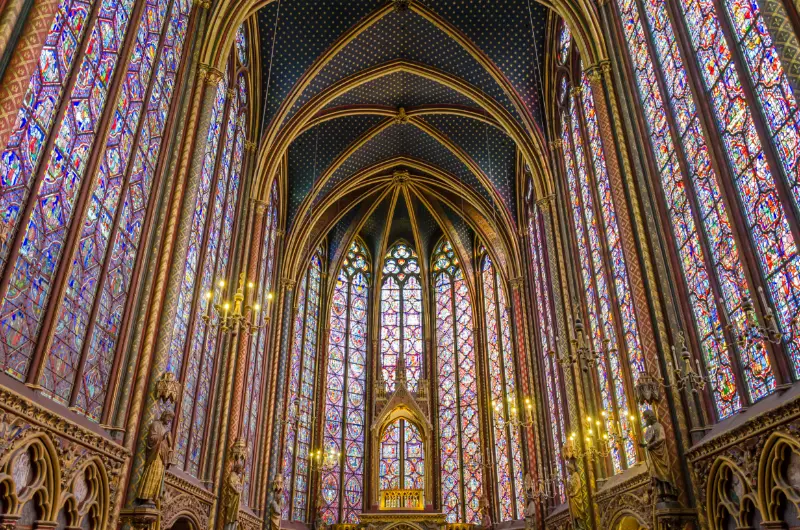
Sainte-Chapelle and the Conciergerie sit beside each other, but the visit can feel much longer than the map suggests if you ignore security and timed entry. They share the historic Palais de la Cité complex and are naturally paired, yet each has a different visual and historical role. Sainte-Chapelle is dominated by stained glass and vertical space; the Conciergerie explains the medieval palace and later prison history. Current 2026 official hours for Sainte-Chapelle are 9:00–19:00 from April through September and 9:00–17:00 from October through March, with last access 30 minutes before closing. A new 2026 pricing structure distinguishes some EEA residents/nationals from other visitors, so check the official ticket page for the category that applies to you.
Why the combination works
Sainte-Chapelle provides the emotional visual peak while the Conciergerie gives architectural and political context. Seeing both turns a beautiful chapel into part of a larger royal complex rather than an isolated stained-glass room.
Check tickets and Paris experiences
Compare current tours, timed-entry tickets and experiences before fixing your itinerary.
GetYourGuideTiqetsCivitatisViatorAffiliate links: we may earn a commission at no extra cost to you.
Security is part of the schedule
The monuments lie within a sensitive judicial area and screening can create delays. A timed ticket does not mean you should arrive at the exact minute. Build a buffer and avoid placing another immovable reservation immediately afterward.
Light matters, but there is no magic hour
Bright conditions can intensify the stained glass, yet the chapel remains powerful in varied weather. Chasing one perfect sun angle can create more stress than value. Choose a time that fits the island route and accept the atmosphere the day gives you.
How to sequence with Notre-Dame
Visit Notre-Dame separately enough that a queue at one site does not jeopardize the other. A practical day can place Sainte-Chapelle/Conciergerie as the timed anchor and Notre-Dame, exterior river walks and the island streets around it according to the cathedral’s current access conditions.
Understand the Conciergerie before focusing on Marie-Antoinette
The prison association is famous, but the site began as part of the medieval royal palace. Pay attention to the surviving Gothic spaces and institutional history first; the later Revolutionary layer then makes more sense.
Choose individual or combined tickets carefully
Official pricing changed in January 2026 and depends on visitor category. Combined admission can make sense if you definitely want both, but free-entry eligibility and concessions may alter the calculation. Verify current official conditions rather than using an old blog’s single price.
Useful connections on Dreaming of Paris
Start with our Notre-Dame and Île de la Cité guide. For a compact first-trip route, see 3 days in Paris.
What are Sainte-Chapelle’s current 2026 opening hours?
Official hours are 9:00–19:00 April–September and 9:00–17:00 October–March, with last access 30 minutes before closing, subject to exceptional closures.
Should I buy the combined Sainte-Chapelle and Conciergerie ticket?
It can be convenient if you want both, but check current 2026 eligibility and pricing because the official structure now varies by visitor category.
Can I visit Notre-Dame, Sainte-Chapelle and the Conciergerie in one half-day?
Yes for many visitors if timing aligns, but security and cathedral access can add uncertainty. Avoid stacking the schedule too tightly.
A final planning note
The smartest Île de la Cité visit has one timed anchor and enough slack for security. Let Sainte-Chapelle provide the visual high point, use the Conciergerie for context and treat Notre-Dame and the river as parts of the same historic landscape.
For Sainte-Chapelle and Conciergerie, one more practical point is worth keeping in mind. Timed entry solves only part of the crowd problem. Security, cloakroom restrictions, stairs and the natural bottlenecks around famous works still shape the experience. Arriving prepared for those small frictions is more useful than searching for a mythical completely empty hour. Use this as a decision rule rather than a rigid instruction: the best version of the day is the one that keeps the route coherent and leaves enough energy for the place itself.
For Sainte-Chapelle and Conciergerie, one more practical point is worth keeping in mind. Do not judge value only by visit duration. Some of Paris’s strongest cultural sites are compact. A focused ninety minutes with enough attention is often more rewarding than extending a visit simply because a ticket cost money. Use this as a decision rule rather than a rigid instruction: the best version of the day is the one that keeps the route coherent and leaves enough energy for the place itself.
For Sainte-Chapelle and Conciergerie, one more practical point is worth keeping in mind. A museum or monument is more memorable when it is connected to the streets around it. Before or after the visit, spend twenty minutes in the immediate neighborhood: the change in scale, materials and street pattern often explains more than another room of labels. Use this as a decision rule rather than a rigid instruction: the best version of the day is the one that keeps the route coherent and leaves enough energy for the place itself.
Grand Palais and Petit Palais nearby
If you are exploring the Champs-Élysées axis, add our Grand Palais 2026 guide and Petit Palais guide before deciding how much museum time to schedule.
Sequence the monuments around security, not distance
Sainte-Chapelle and the Conciergerie sit next to each other, but their visit does not behave like one continuous museum. Security, timed access and separate visitor flows can create pauses. If your Sainte-Chapelle ticket has a fixed slot, build the sequence around that time and use the Conciergerie more flexibly rather than assuming you can enter both whenever you arrive.
In 2026, Sainte-Chapelle publishes seasonal opening hours—9 a.m. to 7 p.m. from April through September and 9 a.m. to 5 p.m. from October through March, with last access before closing. The Conciergerie generally opens 9:30 a.m. to 6 p.m. The combined ticket can be good value for visitors who genuinely want both, but the official sites should be checked for current prices and exceptional closures.
What each monument adds
Sainte-Chapelle is about vertical space, stained glass and royal devotion. The Conciergerie is about the medieval palace complex and its later prison history. Entering the second only to see the Marie-Antoinette material reduces a much larger story. Spend time in the surviving medieval halls before moving to the Revolutionary period.
For Notre-Dame, avoid trying to squeeze the cathedral, towers, Sainte-Chapelle and Conciergerie into one two-hour block. Our Île de la Cité guide explains how to distribute the island, while the Notre-Dame Towers guide covers the separate timed climb.
Light inside Sainte-Chapelle is weather-dependent, but a cloudy day is not a failed visit. The glass can still be read clearly; what matters more is giving yourself enough time to let your eyes adjust. If the upper chapel is crowded, step aside from the entrance path before looking up or taking photographs so you are not blocking the circulation line.
A practical decision check for Sainte-Chapelle and Conciergerie
The Sainte-Chapelle/Conciergerie combination is best for visitors who want the medieval royal palace story plus Revolutionary history in one compact area. Before you give it a fixed slot, compare that reason with the strongest alternative already on your itinerary. If the alternative matters more, move this stop to an optional block instead of forcing both into the same half-day. That simple choice keeps the article useful for different travelers rather than implying that every reader needs the same Paris.

A realistic way to fit it into the day
Anchor the visit around the Sainte-Chapelle time slot, use the Conciergerie before or after depending on queue and opening, then move outside for Notre-Dame and the river. Keep the previous and following stops close enough that a delay of twenty or thirty minutes does not create a cascade of missed reservations. Paris days become much easier when the route can absorb a longer lunch, a queue or a weather change without requiring a taxi across the city.
The trade-off worth making explicit
The trade-off is security time versus geographic convenience. Three nearby monuments can still mean three separate entry processes, so proximity does not equal a fast itinerary. Making that trade-off deliberately is more useful than adding another item to a checklist. Ask what you would remove if this experience takes longer than expected; if the answer is “nothing,” the day is probably already too full.
Small details that prevent avoidable problems
Light changes the chapel atmosphere but cannot be scheduled perfectly. Give yourself enough time to sit and look rather than chasing a specific forecast hour. Save the exact address or entrance you intend to use, keep enough phone battery for the return route and recheck any time-sensitive information on the official site. These are small steps, but they protect the part of the experience that actually matters from being swallowed by logistics.
Where it belongs in the wider Paris cluster
Notre-Dame and Île Saint-Louis are the natural outdoor extensions. Notre-Dame Towers need their own timed planning and should not be assumed to fit automatically. Treat that pairing as a geographic or thematic cluster, not an obligation to complete everything. One strong connection is enough to make the day coherent; two or three distant add-ons usually reduce the value of the place you came to see.