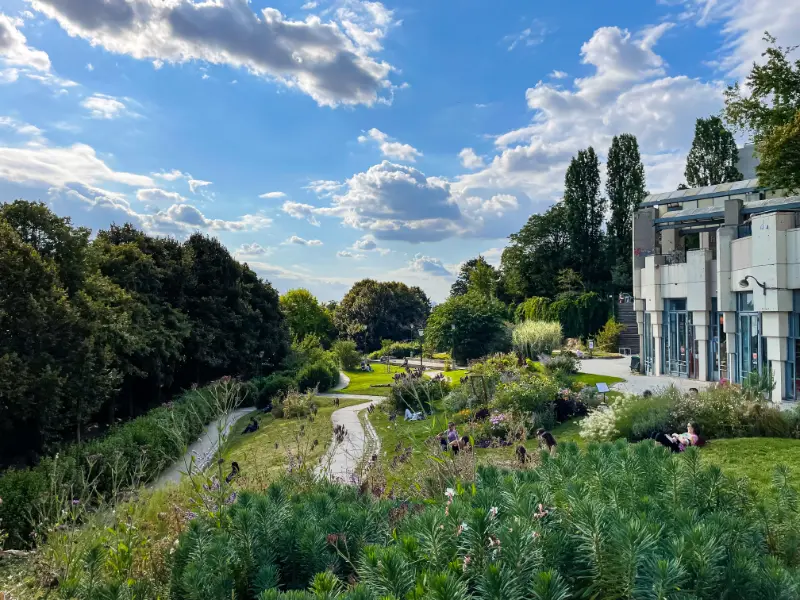
Paris changes character quickly once you move northeast from the monumental center. Along Canal Saint-Martin, the city becomes waterside and social; in Belleville, it becomes steep, multicultural and shaped by successive waves of immigration and artists; in Buttes-Chaumont, it suddenly opens into one of Paris’s most dramatic parks.
This route works best for travelers who have already seen the main monuments or who want to build local neighborhoods into a first trip. It is not “secret Paris”—locals use these places every day and visitors know them—but it feels fundamentally different from the Louvre–Tuileries–Champs-Élysées axis.
The route at a glance
| Stage | Approx. time | What you get |
|---|---|---|
| Canal Saint-Martin | 1.5–2 hours | Locks, footbridges, cafés, waterside walking |
| Belleville | 1.5–2 hours | Street life, food, art, steep viewpoints |
| Parc de Belleville | 30–45 min | Panoramic pause |
| Buttes-Chaumont | 1.5–2 hours | Slopes, lawns, lake and park landscape |
Do not treat the timing as a race. The appeal is stopping when the neighborhood gives you a reason.
Start near Jacques Bonsergent and walk toward the canal
Paris je t’aime’s official walking route begins near Jacques Bonsergent and follows rue de Lancry toward the canal. This is a useful starting point because you approach the water gradually rather than stepping out at the busiest waterfront section.
Once you reach Quai de Valmy, follow the canal north. The early nineteenth-century waterway is crossed by footbridges and punctuated by locks. If you are lucky enough to see a boat pass, stop and watch the lock mechanism. It explains the canal much better than a paragraph can.
Canal Saint-Martin: understand the water, not just the cafés
The canal is often presented as a lifestyle backdrop—wine, picnics and cafés—but it is working infrastructure. Locks regulate changes in water level, bridges open, and boats still move through. Parts of the canal continue underground toward the Seine, which is why the visible stretch feels like a linear urban room rather than a conventional river.
Swimming is not allowed in unauthorized parts of the canal. The City of Paris specifically warns about boat traffic, shallow water, lock suction and underwater hazards. Enjoy the edge, but do not treat it like an informal swimming basin.
Stop at Jardin Villemin if you need a reset
Jardin Villemin, close to the canal and Gare de l’Est, is a useful green pause. It is not a destination that most first-time visitors cross Paris to see, which is exactly why it works well on this route. Parks like this show how Parisians use smaller neighborhood green spaces between work, school and transport.
Continue north or cut east toward Belleville?
You have two good options. Continue along the canal toward Bassin de la Villette if waterside walking is your priority, then take transport back toward Belleville. Or cut east earlier and make Belleville the main middle section of the day. For a one-day route, I prefer the second option because it creates more contrast.
Paris je t’aime describes Belleville as cosmopolitan and shaped by multiple waves of immigration, with bars, artists’ studios and a hilltop park. That mixture is the point. Do not arrive expecting a single “Belleville style.” The neighborhood changes by street and time of day.
Belleville: walk uphill slowly
Belleville’s slope is part of its identity. Start around the lower metro area and work upward, exploring side streets rather than following only the main boulevard. You will encounter a mix of Asian restaurants, North African influences, newer cafés, social housing, older buildings and street art.
This is an area where rigid attraction lists are especially unhelpful. One mural may be painted over, a studio may close, and a food shop may change hands. Use the neighborhood as a place to observe contemporary Paris rather than a museum of “authenticity.”
Rue Dénoyez and street art: expect change
Belleville has long been associated with street art, but artworks are temporary by nature. If a guide promises that a specific mural will definitely be there, it may already be outdated. Look for current work and accept change as part of the medium. This is a better way to experience street art than hunting for one photographed wall from years ago.
Parc de Belleville: one of the city’s underused panoramas
Climb to Parc de Belleville for a broad view across Paris. The park itself includes slopes, terraces and greenery, and the elevated position makes it one of the best free viewpoints in eastern Paris. Paris je t’aime also notes a small vineyard in the area, a surprising echo of the agricultural landscapes that once existed on Paris’s outer hills.
This is a good lunch or snack stop if the weather cooperates. Unlike a formal monument viewpoint, you can sit without feeling pressure to move through a queue.
Walk or ride to Buttes-Chaumont
From Belleville, Buttes-Chaumont is close enough to connect by foot if you still have energy, though the terrain is hilly. Otherwise use a short metro or bus hop. The park opens early and is one of the largest green spaces in Paris.
Buttes-Chaumont was engineered on a dramatic former quarry landscape, which explains its steep slopes and theatrical scenery. The park feels very different from the formal geometry of the Tuileries or Luxembourg Gardens. Lawns rise and fall, paths curve, and the central lake creates a landscape that feels almost suburban despite being inside the city.
Important current access note for Buttes-Chaumont
The City of Paris has reported closures around the island, Temple de la Sybille and waterfall areas because of ground instability and rockfall risk. Some paths around the lake can also be closed. This is exactly why current official information matters more than an old walking map. You can still enjoy the park, but do not plan your whole visit around reaching one specific viewpoint that may be inaccessible.
Best way to finish the day
Stay in the northeast for dinner rather than going back to the tourist center. Belleville, the 10th and 11th arrondissements have extensive restaurant options. This turns the route into a complete neighborhood day and saves you another cross-city trip when you are already tired.
If you are considering staying in this part of Paris, see our accommodation neighborhood guide. Canal Saint-Martin can be an excellent base for repeat visitors, while the exact block around major stations matters more than the arrondissement label.
Photography without turning the neighborhood into scenery
Canal reflections, footbridges and Belleville street art are visually strong, but people live and work here. Because people live and work here, close-up portraits around markets, schools and residential entrances are better approached with permission. Street art is public-facing, while everyday private life is not necessarily part of the scene.
What to bring
- Comfortable shoes: Belleville and Buttes-Chaumont involve real slopes.
- Refillable water bottle: Paris has public drinking fountains, including Wallace fountains.
- Light layer: canal edges and parks can feel cooler in wind.
- Flexible map: park paths and construction closures can change your planned route.
- Time: this day is better with six relaxed hours than four rushed ones.
Can you do this route with children?
Yes, but shorten it. Canal locks are interesting to watch, parks provide space to run, and Buttes-Chaumont is a welcome break from museums. The slopes and walking distance can be tiring for small children. Consider doing only Canal Saint-Martin plus Buttes-Chaumont, using public transport between them. Our Paris with kids guide has more realistic family combinations.
Can you do it in bad weather?
Light rain can suit the canal, but strong rain reduces the value of Belleville viewpoints and the park. On a wet day, switch to the covered passages route or a museum. Save eastern Paris for a day when walking and sitting outdoors are pleasant.
How this route fits into a first Paris trip
Do the classic center first if it matters to you. Then give one day to a different urban texture. In our four-day first-time itinerary, this route is an optional “second Paris” afternoon after Montmartre. With five or six days, it deserves a full day.
Eastern Paris FAQ
Is Canal Saint-Martin worth visiting?
Yes if you enjoy neighborhood walks, water, cafés and observing city life. It is not a monumental attraction, so visitors expecting a single dramatic landmark may find it understated.
Is Belleville touristy?
It receives visitors but remains a lived-in, multicultural neighborhood. Its appeal is the mix of everyday life, food, street art and elevated views rather than conventional monuments.
Is Buttes-Chaumont free?
Yes, the municipal park is free to enter, subject to opening hours and temporary safety closures.
How much walking is involved?
A full route can easily exceed 8–10 km once side streets and park paths are included. Use a bus or metro hop if you want the atmosphere without the mileage.
This is the Paris I would recommend when someone says, “I have seen the monuments—what next?” The answer is not one hidden attraction. It is a day in neighborhoods where the city’s contemporary life becomes the main sight.
Food stops: use the neighborhood rather than a fixed hit list
This route crosses areas where restaurant turnover can be fast, so I would not build the day around a single supposedly “must-visit” café. Around the canal, look for a place that fits the time and weather; in Belleville, the range of Chinese, Vietnamese, North African, Middle Eastern and contemporary Parisian food reflects the neighborhood’s layered population. A better travel habit is to keep two or three streets in mind and choose what looks active when you arrive. That makes the advice more durable than chasing one social-media address that may be closed, full or completely changed by the time of your trip.
If you want a picnic, buy before entering the park and check current park rules. Remember that litter is especially visible around waterways and lawns: carry waste until you find the correct bin, and never leave glass or food packaging beside the canal.
Explore eastern Paris more deeply
If you enjoy Belleville, add our Paris street-art route for the 13th arrondissement, Belleville and Ménilmontant.
Continue along northeast Paris
Go farther with our La Villette and Canal de l’Ourcq guide or explore Ménilmontant and Belleville.
Continue into the 11th
If you like eastern Paris, continue from the canal toward Oberkampf and the 11th arrondissement for cafés, street art, restaurants and nightlife.
Build a deeper east and northeast Paris route
Continue with Parc des Buttes-Chaumont and the Bassin de la Villette/Canal de l’Ourcq. Farther south, the 11th and Oberkampf connect naturally with Atelier des Lumières and the Coulée Verte.
For a full green-space day, continue to Bois de Vincennes and the Château de Vincennes.