Disclosure: This article contains affiliate links or booking widgets. If you book through them, Dreaming of Paris may earn a commission at no extra cost to you. How our affiliate links work.
Two days in Paris is enough to have a memorable first trip, but not enough to “see Paris.” The difference matters. A good weekend plan does not squeeze ten monuments into twelve hours; it chooses a few high-value anchors, connects them with streets and neighborhoods that are interesting in their own right, and avoids wasting an hour crossing the city for one photo.
Book the practical parts of your Paris trip
Compare accommodation first, then check tickets and experiences for the fixed parts of your itinerary.
Check Paris hotelsGetYourGuideTiqetsCivitatisAffiliate links: we may earn a commission at no extra cost to you.
This itinerary assumes two full sightseeing days, a hotel in or reasonably close to central Paris, and a first visit. If you have only one usable day, use our one-day Paris itinerary. If you have three or more, the 3-day plan and 4-day plan are better because they let you slow down.
The booking order for a 2-day trip
With only two days, one badly placed timed ticket can damage half your itinerary. Reserve only the attractions that genuinely need a time slot, then keep the rest flexible. The priority order is usually Eiffel Tower if the summit matters to you, Louvre, Sainte-Chapelle or Notre-Dame Towers if they are must-sees, and a Seine cruise only if you want a fixed departure rather than choosing one on the day.
Our Paris attractions booking strategy explains the different release windows. Do not stack a 10:00 Louvre ticket, a 13:00 Eiffel Tower ticket and a 16:00 Montmartre tour. The map may make that look possible; security, queues, lunch and transport make it unpleasant.
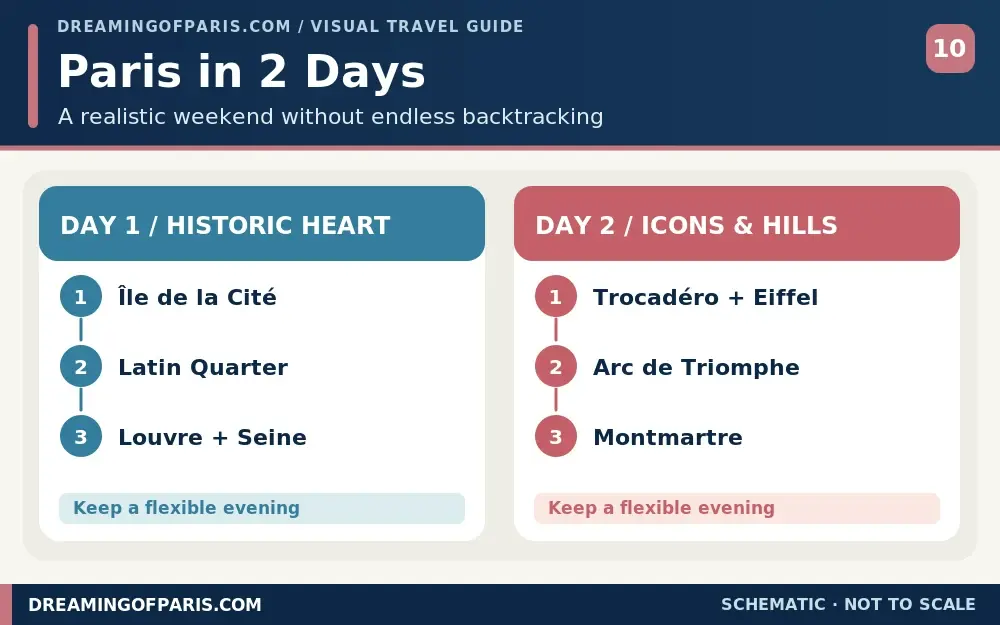
Day 1 morning: Île de la Cité before the city gets busy
Start around 8:15–8:30 on Île de la Cité. Walk the square in front of Notre-Dame, look at the cathedral exterior from both the parvis and the river side, then visit the interior when your timing allows. Entry to the cathedral itself is free; the towers are a separate visit with a reserved slot and a physically demanding stair route. Read our Notre-Dame and Île de la Cité guide and the dedicated Notre-Dame Towers guide before deciding whether the climb is worth one of your limited weekend slots.
If stained glass is a priority, reserve Sainte-Chapelle for roughly 9:30–10:00. The visit itself can be short, but security at the Palais de Justice can add friction. The strongest combination is Notre-Dame outside/interior, Sainte-Chapelle, then a short walk past the Conciergerie and along the Seine. Do not add every monument on the island just because they are close.
Late morning: cross into the Latin Quarter, but keep it selective
Cross to the Left Bank and give yourself about 75–90 minutes for the Latin Quarter. Walk past Shakespeare and Company without treating it as a mandatory shopping stop, continue through the older streets around Saint-Julien-le-Pauvre or Rue de la Huchette, then move south toward the Panthéon area if the atmosphere appeals to you. If you want a quieter route, our Latin Quarter walking guide has a more complete path.
For a two-day trip, the Panthéon interior is optional. If you visit it, cut something later rather than pretending the time does not count. A better short pause for many visitors is the Luxembourg Gardens: enter, walk the central basin and terraces, sit for fifteen minutes, then leave. Our Luxembourg Gardens guide explains which parts are worth your time.
Lunch: choose geography over “the best restaurant in Paris”
Your lunch should be near the route, not a famous place forty minutes away. In a two-day itinerary, a good neighborhood bistro, bakery lunch or market-area meal is more valuable than chasing a viral reservation across town. The practical rules in our Eating in Paris guide cover water, tipping, service and reservations.
Day 1 afternoon: Louvre, but with a limit
Book the Louvre for early afternoon, ideally around 13:30–14:30 depending on where you eat. Give it 2.5 to 3 hours, not the entire day. Pick one major painting cluster, one sculpture cluster and one section you personally care about. The goal is to leave while you still remember what you saw. Our 2–3 hour Louvre route is designed for exactly this.
When you exit, walk through the Tuileries instead of taking transport immediately. That transition from palace museum to formal garden is part of the experience and gives your brain a break from galleries. If energy remains, continue toward Place de la Concorde; if not, turn back toward Palais-Royal.
Day 1 evening: Palais-Royal, dinner, then the Seine
Palais-Royal works beautifully at the end of Louvre day because it adds architecture, gardens and arcades without another ticket. The Buren columns are only one element; the garden and historic galleries are the reason to stay. Our Palais-Royal guide gives a compact route.
After dinner, choose either a Seine cruise or a river walk. A cruise is especially efficient on a short trip because it lets you see bridges and monument facades while sitting down after a long walking day. Compare boarding points and boat styles in our Seine cruise guide. If you prefer walking, use the riverbanks between Pont Neuf and Pont Alexandre III.
Day 2 early morning: Trocadéro before the photo crowds
Start around 8:00–8:30 at Trocadéro for the classic Eiffel Tower perspective. This is one of the few “famous photo” stops that improves dramatically when done early. Walk down through the gardens and cross the Seine. If you only care about seeing the tower, stay at ground level and save two hours. If you want to go up, reserve a morning ticket and understand the difference between second-floor and summit access in our Eiffel Tower guide.

A summit visit can consume 2–3 hours once security, lifts and queues are included. That is not wrong, but it changes the rest of the day. If you climb the tower, do not also plan a long Invalides museum visit before lunch.
Late morning and lunch: choose one western-Paris add-on
You have three sensible options. Option A: walk toward Rue Cler for food and a neighborhood pause. Option B: visit Les Invalides if military history or Napoleon genuinely interests you. Option C: go straight to the Arc de Triomphe and keep the day more spacious. Our Invalides guide helps you decide whether it deserves the time.
Early afternoon: Arc de Triomphe and the Champs-Élysées, selectively
Take the metro to Charles de Gaulle–Étoile if your legs are tired. The Arc de Triomphe terrace gives one of the clearest views of Parisian urban geometry because the avenues radiate directly below you. If you climb, budget around an hour. If you do not, use the underpass to reach the monument safely, look at the Tomb of the Unknown Soldier, then leave.
Do not walk the full Champs-Élysées simply because it is famous. The most efficient first-time version is a short section around the Arc, then transport north toward Montmartre. If you want the historical route, use our Champs-Élysées walk.
Late afternoon: Montmartre after the day-trippers start thinning
Arrive in Montmartre around 16:00–17:00 rather than at midday. Use the metro to Abbesses or Lamarck-Caulaincourt depending on the route you want. Avoid treating Place du Tertre as the entire neighborhood. Walk the smaller streets, see the vineyards area if it fits your path, then approach Sacré-Cœur later.
Our Montmartre beyond Sacré-Cœur walk is designed to avoid the most repetitive tourist circuit. If you want the dome, check closing time before building your evening around it.
Day 2 evening: finish in one neighborhood, not three
Stay in Montmartre for dinner or descend toward South Pigalle and Rue des Martyrs. Do not go back across Paris for a restaurant reservation unless it is a major personal priority. If you still have energy, choose one final viewpoint or wine bar. The goal is to end the weekend with a place, not with another transport connection.
What this itinerary deliberately leaves out
Versailles, Disneyland Paris, Musée d’Orsay, Père-Lachaise, Canal Saint-Martin, Le Marais in depth and most small museums are excellent—but they compete directly with the core first-time experiences above. If one of them matters more to you than the Louvre or Eiffel Tower, swap it in. A personalized two-day trip is better than a canonical checklist.
Where to stay for only two days
For a short stay, transport convenience matters more than having the “prettiest” residential address. The 1st–6th arrondissements, western Marais, Opéra area and well-connected parts of the 9th can reduce friction. Montmartre is atmospheric but adds travel to some central sights. Our where to stay in Paris guide compares areas by trip style.
Compare hotels for your stay in Paris
Check current availability, location and prices before choosing the exact neighborhood.
Check Paris hotels on Booking.comAffiliate link: we may earn a commission at no extra cost to you.
Two practical rules that save a weekend
Rule one: never schedule two non-refundable timed attractions with a cross-city transfer and less than 90 minutes between them. Rule two: if weather is bad, move the flexible walk, not the hardest ticket. A weekend becomes far less stressful when you know which parts are fixed and which can move.
Frequently asked questions
Is two days enough for Paris?
Enough for a strong first impression, yes. Enough for the city, no. Focus on two geographic clusters per day and accept that major sights will remain for another trip.
Should I buy a Paris pass for two days?
Only if the included attractions match your actual plan. A 48-hour Museum Pass can work for an intensive museum itinerary, but this weekend plan mixes free neighborhoods, gardens and monuments. Use our city-pass comparison before buying.
How much walking is involved?
Expect a lot: often 18,000–25,000 steps on a sightseeing day if you follow the full route. Use the metro strategically between western Paris and Montmartre rather than proving a point by walking everything.